
Secure Outdoor Bounce Houses: 3 Critical Tactics

Secure outdoor bounce houses: 3 critical tactics
Master the art to secure outdoor bounce houses against high winds. Protect your rental inventory with our expert anchoring guide. Boost safety now!
The nightmare scenario
Picture the absolute worst thing that could happen to your rental business. It’s a sunny afternoon, everything seems fine, and then—boom.
A sudden gust hits. An improperly anchored inflatable lifts off the grass with kids still inside.
That isn't just a bad day; it’s a career-ending nightmare. In this industry, safety isn't some box you just tick off.
It is the backbone of your reputation and your revenue. If you can't guarantee a safe setup, frankly, you have no business operating.
I’ve spent over 17 years in the manufacturing trenches with CH Inflatable. I’ve watched this industry change, and I’ve seen the wreckage caused by cutting corners.
Knowing how to properly secure outdoor bounce houses is not a suggestion. It is the only thing standing between a successful party and a liability disaster.
This guide cuts through the fluff. We’re going deep into the hardware, the physics, and the operational standards you need to protect your assets.
We’ll look at how premium manufacturing—like our 0.55mm 1300D PVC and automotive-grade webbing—partners with your setup protocols to ensure total stability.
Understanding wind dynamics and load ratings
To beat the wind, you first have to respect it. Too many rookies in the rental game underestimate aerodynamic lift.
The science behind wind load ratings
When you inflate a 15x15 unit, you aren't just setting up a toy. You are essentially inflating a massive airplane wing.
As wind moves over the curved top of a bouncer, it creates low pressure. That generates lift.
This is why understanding wind load ratings is non-negotiable. A commercial unit is built to take specific pressures, but only if anchored right.
We talk about "The Uplift Factor" a lot. This is the vertical force trying to rip your stakes out of the earth.
Residential vs. commercial standards warning
There is massive confusion out there between "store-bought" units and real commercial inventory.
If you are running a legit rental business, you cannot rely on residential-grade stuff.
Sure, units found at Bounceland or Sam's Club might be fine for a private backyard playdate.
But for a paid public event? Forget it. Commercial businesses need significantly higher durability.
Commercial units, like the ones we build at CH Inflatable, use heavy materials. They resist wind better simply due to their weight and structural rigidity.
Using a residential unit for a gig is a recipe for disaster. The anchor points on those lightweight toys can't handle the torque needed to secure outdoor bounce houses effectively.
Tactic 1: The art of staking – heavy-duty implementation
When you are on grass or soil, stakes are your lifeline. But let's be real: not all stakes are created equal.
Choosing the right heavy-duty steel stakes
I still see operators showing up with those flimsy yellow plastic stakes or thin shepherd's hooks. That is pure negligence.
To truly secure outdoor bounce houses, you need to use heavy-duty steel stakes.
- Length: You need at least 18 inches (45cm).
- Diameter: Go for a minimum of 1 inch (2.5cm).
- Material: Hardened steel. Do not use rebar that bends when you look at it wrong.
Commercial inflatables generate thousands of pounds of lift force. A plastic stake will snap. A short stake will slide out like butter.
The 45-degree golden rule
Having the right hardware is only half the battle. You have to use it correctly.
The "Golden Rule" is the 45-degree angle. You must drive the stake into the ground at a 45-degree angle towards the inflatable.
Rookies drive them away from the unit. Don't do that. When you drive it away, the strap pulls the stake out along the path of least resistance.
When you angle it towards the unit, the stake has to plow through the solid earth to fail.
Expert take: If the ground is mushy—like after a storm—single staking won't cut it. Double-staking or cross-staking becomes mandatory.
To better understand the nuances of setup and see how experts secure outdoor bounce houses, this video tutorial is highly recommended:
https://www.youtube.com/watch?v=pj2W6Dz54Yo
Tactic 2: Rigging and strap systems (hardware focus)
Your stakes are solid, but what connects them to the bouncer? If your straps snap, the best stakes in the world won't save you.
Utilizing commercial tie-down strap systems
Cheap rope and bungee cords belong in the trash. You need robust tie-down strap systems.
Ratchets are superior to knots because they allow you to apply tension that creates a rigorous downward force.
The webbing strength matters, too. The tensile strength must exceed the lift capacity of the unit.
At CH Inflatable, we tackled this head-on. We upgraded our webbing material to match automotive safety belt levels.
This means even under sudden shock loads from wind gusts, the strap itself won't quit on you.
The critical role of D-Buckles
The weak link in many competitor units is the D-ring (or D-Buckle). Standard iron rings rust, weaken, and eventually tear loose.
We upgraded our process to use Stainless Steel D-buckles. They are waterproof, rustproof, and incredibly thick.
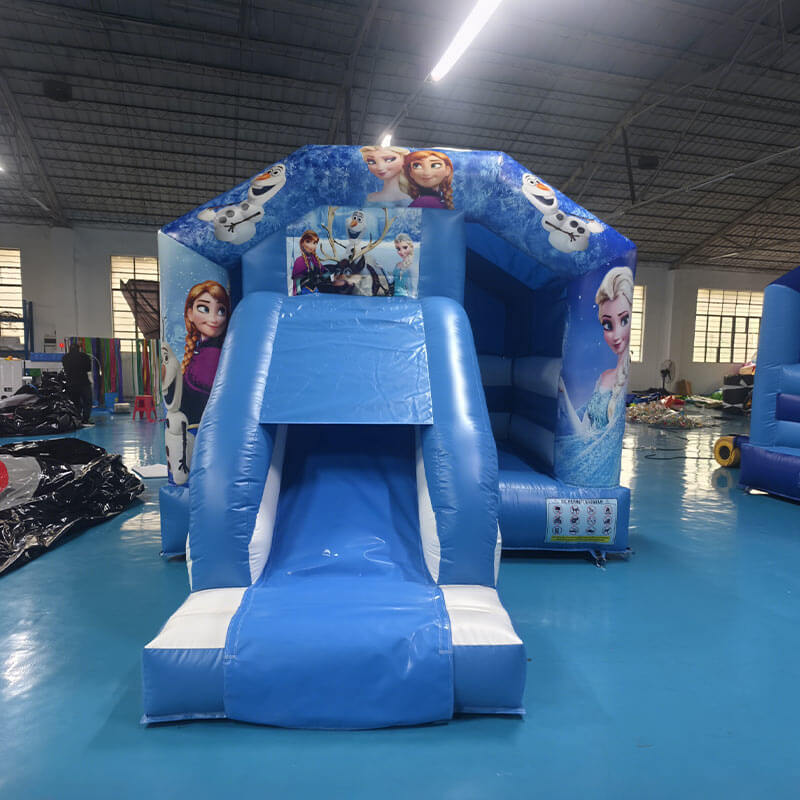
Check the base of our inventory. Look at the robust anchor layout on our Frozen princess bounce house and you'll see commercial-grade rigging points.
These anchors are positioned to distribute stress evenly. This prevents the vinyl from tearing even when you ratchet them down tight to secure outdoor bounce houses.
Tactic 3: Ballast management for hard surfaces
Rental operators know the pain. The client wants the setup in a parking lot, a gym, or a concrete driveway. You can't use stakes.
When stakes aren't an option
This is where ballast comes in. The debate between sandbags and water barrels is common, but physics doesn't change.
You need weight. A massive amount of it.
- Sandbags: These are preferred because they are dense and don't leak water all over the venue.
- Water Barrels: Effective, sure, but they are bulky to transport.
Pro Tip: Never guess the weight. Use a scale during your prep so you know exactly what your sandbags weigh.
Proper attachment of dead weight
In the industry, we often refer to heavy, immovable objects as a "Deadman Anchor."
A common mistake I see? Operators tying the strap to the handle of the sandbag or barrel. Under tension, that handle rips right off.
You must wrap your strap around the body of the weight.
This is crucial for larger units. Even massive structures like the Ocean Themed Inflatable Jumping Castle can be safely secured on asphalt using correct ballast calculations.
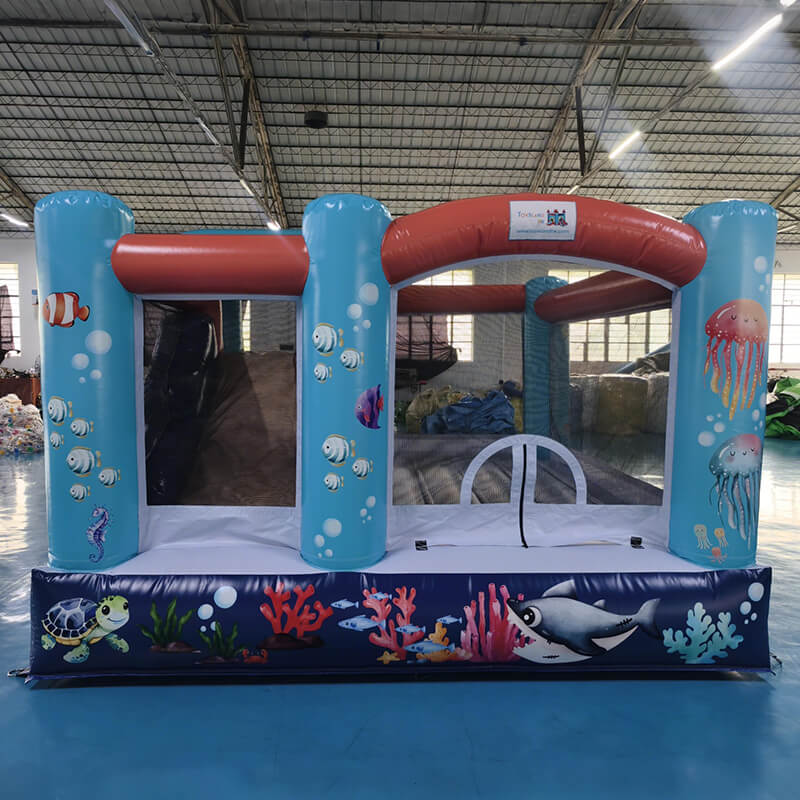
Figure 2: Secure Outdoor Bounce Houses - Featured Product Detail
For a unit of that size, you might need 400-500 lbs of weight on the windward side alone. You can't just drop a couple of bags and hope for the best.
Manufacturing integrity: The first line of defense
You can have the best anchors in the world. But if the attachment point rips off the bounce house? The unit is gone.
Reinforced D-rings and vinyl strength
This is where your supplier choice makes or breaks you. To properly secure outdoor bounce houses, the unit itself must be built like a tank.
We focus heavily on reinforced D-rings. At CH Inflatable, we use a "Triangle Reinforcement" technique at every single anchor point.
We sew a multi-layer heavy PVC patch onto the base. Then, we sew the D-ring webbing onto that patch. This distributes the force.
We use 0.55mm 1300D PVC material and advanced double stitching throughout the unit.
If you buy cheap units with single stitching? A 20mph gust won't pull the stake out—it will just rip the D-ring right off the vinyl.
Zipper and blower security
Safety also involves pressure management.
- YKK Zippers: We use genuine YKK. They don't jam, and they hold high pressure.
- HW CE Certified Blowers: Consistent pressure keeps the unit rigid. A floppy unit catches the wind like a sail.
- Deflation: In an emergency, reliable zippers let you drop the unit fast before it blows away.
Operational safety and ASTM standards
Hardware is useless without protocol. You must train your staff until they can do this in their sleep.
Adhering to ASTM operation standards
Adhering to **ASTM operation standards** is the hallmark of a professional B2B company.
Before a single child enters, a safety audit must be performed.
First, check that all anchors are tight. Second, ensure no straps are frayed. Finally, verify the blower is staked down (yes, the blower needs help too).
| Surface Type | Primary Method | Backup Method |
|---|---|---|
| Grass / Soil | Heavy-duty steel stakes (18"+) | Cross-staking (X-shape) |
| Concrete / Asphalt | Sandbags / Water Barrels | Deadman Anchors (Vehicles/Trees) |
| Indoor Gym | Sandbags | Floor Hooks (if available) |
The "stop play" threshold
I tell all my clients clearly: "Regardless of how well you anchor, operating in winds above 20-25 mph is negligence."
The best anchor is knowing when to deflate. We call this the "Wind Audit."
Every rental truck should have a handheld anemometer (wind speed gauge). If the wind gust readings spike, you stop operations immediately.
Knowing how to secure outdoor bounce houses includes knowing when not to use them.
Frequently asked questions (FAQ)
Here are the most common questions I hear from rental business owners across the USA and Europe.
What is the maximum wind speed for operating a bounce house safely?
Generally, you are looking at a threshold of 15-20 mph (approx 24-32 km/h). Always check your manual and local rules. If wind gusts exceed this, get the kids out and deflate. It is better to refund a client than to fight a lawsuit.
How many sandbags are required per anchor point on concrete?
It depends on the size. However, generally speaking, you need a minimum of 50-75 lbs (22-34kg) per anchor point. For a standard 15x15 bouncer, this often means 4 or more large sandbags per corner to truly secure outdoor bounce houses.
Can I use water drums instead of steel stakes?
Yes, but only if they provide holding power equal to stakes. Water drums must be tied down securely around the body, not the handle. Stakes are always preferred for soil because they use the earth's friction.
Bottom line
Securing your inventory isn't just about avoiding accidents. It's about building a reputation as detailed and reliable.
We’ve covered the big three: staking with proper angles, rigging with automotive-grade straps, and using calculated ballast for hard ground.
What's more, we’ve discussed why manufacturing quality—like reinforced D-rings and 0.55mm PVC—is your first line of defense.
If you want to secure outdoor bounce houses effectively, you need equipment that supports your safety goals.
Looking for customized inflatables built to withstand the elements? Contact CH Inflatable today to discuss our 0.55mm PVC heavy-duty inventory and wholesale pricing for your region.