
Master Inflatable Park Power Requirements: 5 Safe Hacks

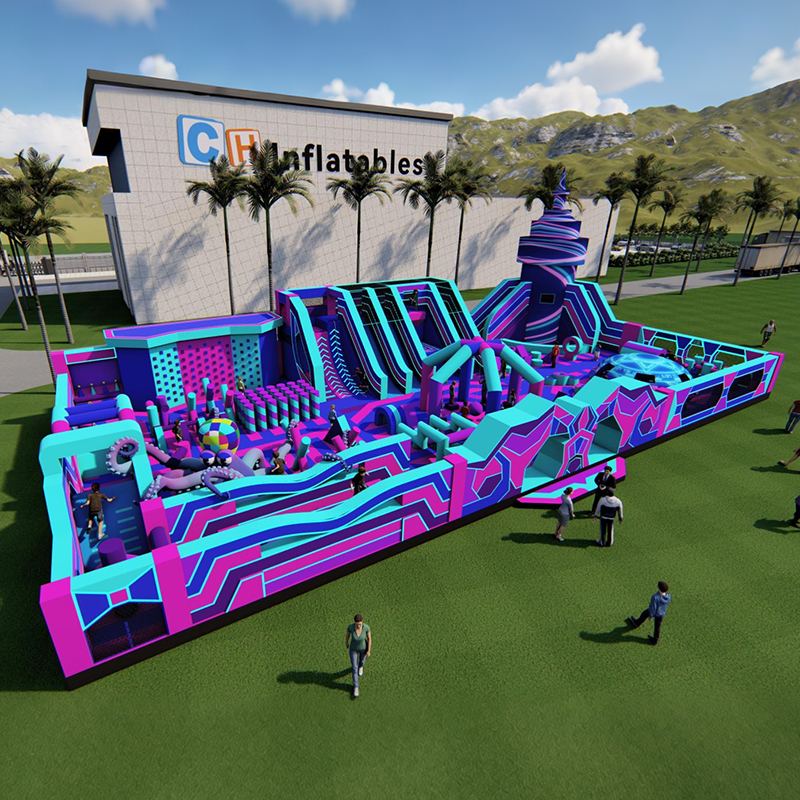
Master inflatable park power requirements: 5 safe hacks
Discover how to calculate Inflatable Park Power Requirements accurately. Secure your revenue with safe, efficient HW blower setups for B2B events. Read now!
Introduction
Picture this worst-case scenario.
It’s the peak of summer. You’ve just set up a massive commercial park for a huge corporate gig. The sun is beating down, kids are screaming with joy, and the client is happy.
Suddenly, silence falls.
The blowers cut out. Your massive investment begins to deflate right on top of the crowd. This isn't just a technical glitch; it’s a reputation killer.
In my 17 years in the deep end of the manufacturing and export industry, I’ve seen this happen way too often. The culprit? It’s rarely broken gear.
It is almost always a misunderstanding of Inflatable Park Power Requirements.
Power stability is your financial security. Many rental companies underestimate the specific electricity demands of large units.
This leads to tripped breakers, damaged equipment, and actual safety hazards. To run a mobile entertainment business that lasts, understanding Inflatable Park Power Requirements is the backbone of your operation.
At CH Inflatables, we commit to more than just selling you 0.55mm PVC units; we commit to your operational safety.
With our CE-certified HW blowers and industry expertise, I’m going to reveal the math, the gear, and the expert hacks to keep the fun running.
The math: watts, volts, and amps
Before we talk about generators, we function on the math. If you get the numbers wrong, your constant airflow blower specs won't matter.
They simply won't have the juice to run.
The critical math: calculating total amp draw
The question I get asked most by clients in the USA and Europe is simple: "How much power do I actually need?"
To determine your Inflatable Park Power Requirements, you need to understand the relationship between Watts, Volts, and Amps.
The formula is straightforward: Watts / Volts = Amps.
For example, if you are running a blower rated at 1100 Watts on a standard US 110V circuit, your draw is 10 Amps. But here is the kicker—don't just look at the sticker.
Expert Opinion: "Never rely solely on the sticker wattage. You must factor in a safety margin for startup spikes."
I always recommend an Amperage load calculation that adds 20% to your total expected draw. That buffer saves your bacon when things get hot.
Constant airflow vs. sealed units
Commercial inflatables, like our robust 0.55mm 1300D PVC bounce houses, function on a concept of "constant airflow."
Unlike a sealed pool toy, these units breathe.
We stitch CH Inflatables with precision double stitching. This allows a controlled amount of air to escape, keeping the unit bouncy rather than hard as a rock.
However, this means your blowers must run non-stop.
This continuous demand places a heavy load on your power source. Calculating your Inflatable Park Power Requirements isn't a one-time check; it is a continuous load management task.
If you are setting up a semi-permanent structure, the power dynamic changes slightly. For a deeper dive into static structures, check out What power does an inflatable building require?.
Choosing the juice: grid vs. generators
Once you know your math, you have to choose your source. Are you plugging into a building (Shore Power) or bringing your own power?
Tapping into the grid: evaluating circuit capacity
If you are at a venue, never assume the wall outlets are ready for your Inflatable Park Power Requirements.
In the USA, standard outlets are usually 15 or 20 Amps. In Europe, they are often 16 Amps at 220V.
If you plug two 1.5HP blowers into a single 15 Amp circuit, you will pop the breaker immediately. You have to find dedicated circuits.
This means finding outlets that don't share a fuse with the popcorn machine.
Generator sizing guide for efficiency
For most large mobile events, you cannot rely on the grid. You need a fast, reliable Generator sizing guide to ensure you aren't under-powered.
When sizing a generator for something massive, like a Big Inflatable Water Park, you need to calculate total wattage and multiply by 1.5.
A unit like our Big Inflatable Water Park uses thick 0.9mm PVC. It needs immense pressure to support slides and obstacles.
This setup might require multiple blowers running simultaneously.
If your total running watts are 6,000W, don't buy a 6,000W generator. You need at least 9,000W to handle the startup surge and keep the engine running cool.
Meeting Inflatable Park Power Requirements means having surplus power, not just "enough" power.
To better understand practical setup and Inflatable Park Power Requirements, this video tutorial is highly recommended:
https://www.youtube.com/watch?v=MII7heA0sTk
The gear: blowers and cords matters
Your generator creates the power, but your cords and blowers deliver it. This is where most efficiency is lost in the field.
Why HW blowers are the industry standard
We supply HW brand blowers with our inflatables for a reason. They are the gold standard for meeting strict Inflatable Park Power Requirements.
- CE Certified: They meet rigorous safety standards.
- Waterproof: High IP ratings prevent shorts in damp grass.
- Efficiency: They move more air with less amp draw than cheaper generic models.
When you buy a slide from CH Inflatables, getting a reliable HW blower is part of the package.
Avoiding the "voltage drop" trap
You can have a perfect generator and still fail if you use cheap cords. This introduces the concept of voltage drop.
If you run a 100-foot cord that is too thin, the electricity faces resistance.
By the time it reaches the blower, 110V might drop to 95V. This causes the motor to overheat and burn out fast.
You must use Heavy-duty extension cords. period.
Use 12-Gauge Cords for runs up to 50ft. Use 10-Gauge Cords for runs over 50ft.
Industry Slang: Avoid "Daisy-chaining." This is when you plug one cord into another to make it longer.
This is a fire hazard and a forbidden practice in professional Inflatable Park Power Requirements protocols.
For more details on keeping your setup lawful, look at Setup requirements for a safe and fun inflatable experience.
Compliance and safety standards (EN14960)
If you operate in the EU or reputable global markets, safety isn't just a suggestion; it is the law.
Navigating electrical safety standards EN14960
The Electrical safety standards EN14960 dictate how inflatable play equipment must be managed.
It covers everything from wind speed ratings to electrical safety.
Regarding Inflatable Park Power Requirements, the standard mandates a few key things. Blowers must be positioned at least 1.2 meters away from the open side.
Cords must be routed away from public pathways to prevent tripping. Cables should never be potential strangulation hazards.
Grounding and weather protection
Outdoor events are unpredictable. If you are running an inflatable water slide, water and electricity are a bad mix.
You must use GFI (Ground Fault Interrupter) or RCD adapters. These cut the power instantly if a leak is detected.
At CH Inflatables, we upgrade our units with stainless steel D-buckles to resist corrosion. But your power connection points must be kept dry.
Meeting Inflatable Park Power Requirements also means sealing those connections against the morning dew.
5 safe hacks to master inflatable power management
Here is the secret sauce. After helping clients in Germany, Poland, and the US for years, here is my cheat sheet.
| Power Factor | Standard Requirement | The "Pro" Hack Adjustment |
|---|---|---|
| Total Wattage | Specific Blower Rating | Sticker Rating + 20% buffer for surges |
| Cord Gauge | 14-Gauge (Standard) | 10-Gauge for anything over 50ft |
| Connection Type | Standard Plug | Twist-lock or "Clamshell" sealed box |
| Startup Method | All switches "ON" | Staggered Start (10s delay between units) |
Hack 1: map your circuits before setup
Don't guess. Buy a simple circuit tester. Plug it in and flip breakers until you know exactly which outlets are on separate circuits.
Mark them with tape. This ensures you never accidentally overload a breaker by plugging two high-draw blowers into the same loop.
Hack 2: the "staggered start" technique
This is crucial for generator health. When turning on your park, never hit the "On" switch for everything at once.
We call this "Inrush Current." Electric motors need 2-3 times their running watts just to start spinning.
If you start 5 blowers at once, the massive spike can stall your generator completely to meet Inflatable Park Power Requirements.
Turn on one blower, wait 10 seconds, then turn on the next.
Hack 3: secure connections with "webbing" grade thinking
We use car-seatbelt grade webbing to reinforce our inflatables. You should apply that same durability mindset to your cords.
Use locking connectors or "twist-lock" plugs if possible. If using standard plugs, use weather-safe plastic clamshell boxes.
Tape is not enough.
Hack 4: monitor amp draw in real-time
Don't just calculate it once. Buy a clamp meter. Throughout the event, clamp it around your power cords to see the actual amps flowing.
As blowers heat up, or if air pressure changes, the draw can fluctuate. Monitoring this ensures you are always meeting Inflatable Park Power Requirements safely.
Hack 5: optimize for large theme units
Massive units are beasts. Take a complex unit like our Space theme huge bouncy castle.
A unit like this, with its intricate shapes and large footprint, often requires multiple blowers. You cannot run this off a single standard outlet.
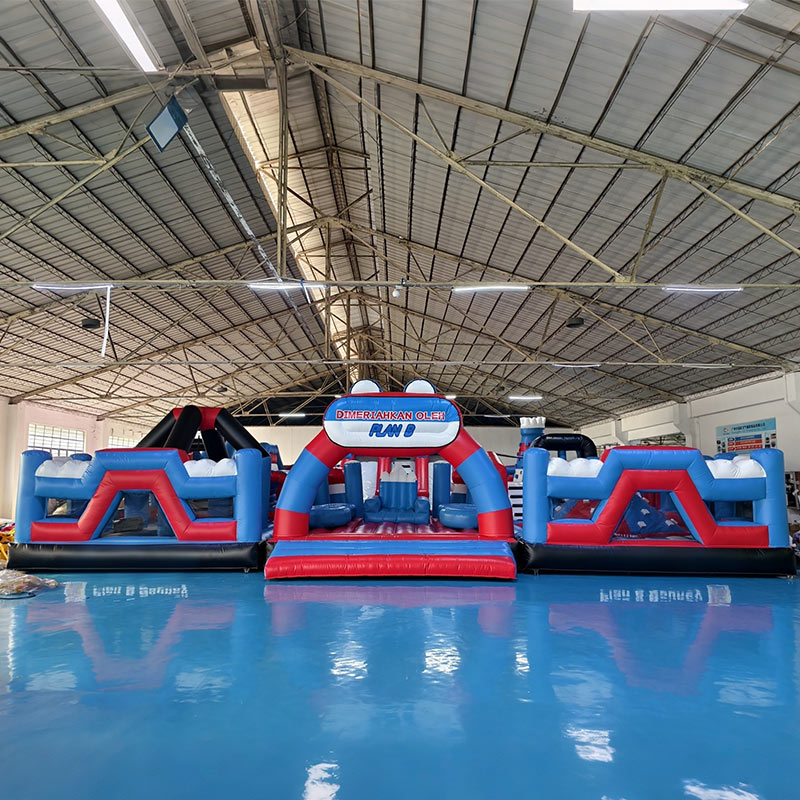
You need distinct power zones. For units exceeding 50 sq meters, always have a backup generator on standby.
Redundancy isn't an expense; it's insurance.
Frequently asked questions (FAQ)
How many amps does a 1.5HP commercial blower draw?
This is central to calculating Inflatable Park Power Requirements. Generally, a 1.5HP commercial HW blower has specific needs.
On 110V (USA), expect 7 to 12 Amps running, with a startup spike up to 20 Amps. On 220V (Europe), it's roughly 4 to 6 Amps running.
What size generator do I need for a large mobile inflatable park?
To determine the Inflatable Park Power Requirements for a whole park, do the math carefully.
Add up the wattage of every blower. Then add 20% for safety. Finally, add another 25% if you want the generator to run quietly at 75% load.
Long story short
Mastering Inflatable Park Power Requirements is about more than keeping the lights on. It is about protecting your inventory and your guests.
It involves precise math and using heavy-duty extension cords. It requires strict adherence to Electrical safety standards EN14960.
You simply cannot afford to guess when 1,000 lbs of plastic and excited children are involved.
At CH Inflatables, we back your rental business with superior engineering. From our tear-resistant 0.55mm PVC to the reinforced seams, we build for durability.
Ready to scale your inventory with safe, high-profit inflatables? Contact CH Inflatables today for a custom quote and let us help you build a reliable mobile park.