
The Ultimate B2B Guide to Sourcing the Best Inflatable Water Slide Inflatable for Maximum Rental Profits

```html
The Ultimate B2B Guide to Sourcing the Best Inflatable Water Slide Inflatable
Look, I'm going to be straight with you because you don't have time for fluff. In the hyper-competitive landscape of the US event rental industry, mediocrity is the fastest route to insolvency. Period. Rental operators are no longer just competing on price—they're competing on "Instagrammability," throughput capacity, and unyielding safety records that would make a NASA engineer nod in approval. Sourcing an inferior "inflatable water slide inflatable" from some non-certified factory isn't just a procurement error—it's a liability lawsuit waiting to happen and a brand reputation killer that can dismantle a decade of trust in a single afternoon.
I've seen too many operators make this mistake. They chase the lowest quote on Alibaba, get a unit that looks pretty in photos, and then spend the next three seasons patching blown seams while their competitors are out there printing money. Here's the deal: To secure maximum rental profits and long-term asset longevity, B2B buyers must pivot from consumer-grade thinking to industrial engineering standards. This definitive guide deconstructs the anatomy of a commercial-grade inflatable water slide, analyzing material tensile strengths, airflow dynamics, and compliance certifications like EN14960. We're going to reveal how to source units—such as the massive 62ft commercial giants—that guarantee high ROI, minimize maintenance downtime, and position your rental fleet as the undisputed market leader.
The difference between a $3,000 investment that pays for itself in five weekends versus a $800 paperweight that rots in your warehouse comes down to understanding the physics and materials science behind these structures. When you know what to look for—and more importantly, what to avoid—you stop being a customer and start becoming an informed procurement partner. That's where real margins live.
Table of Contents
- 👉 01. Market Dynamics: Why Size Matters in Rental Economics
- 👉 02. Engineering Standards: Material Science & Construction
- 👉 03. Safety Compliance: Navigating EN14960 & UL Certification
- 👉 04. Product Specifications: Industrial-Grade Catalog
- 👉 05. Operational Lifecycle: Maintenance & Throughput Management
- 👉 06. Customization & Branding for B2B Scalability
- 👉 07. Deep Dive: Technical FAQs for Procurement Managers
The Economics of Scale: Maximizing ROI with Large-Capacity Units
Throughput vs. Ticket Price Analysis
In the event rental business, time is literally money. Every minute your crew spends setting up or every minute a guest spends waiting in line is margin leaking out of your pocket. A standard backyard inflatable water slide, typically standing around 13 to 15 feet tall, might command a rental fee of $250 to $400 per day. While consistent, these margins are often eroded by delivery times, setup labor, and fuel costs. You're working harder for less return.
Conversely, sourcing an industrial behemoth—such as a 60ft+ commercial unit—allows operators to pivot into a completely different economic stratosphere. These units command premium rental fees ranging from $800 to over $1,500 per day. And here's why that's not just about sticker shock pricing:
Why the disparity? It comes down to Throughput Capacity. Let me break down the math for you:
- ⚙️ A small slide handles maybe 3-5 riders at a time. That means long lines, bored kids, and parents checking their watches wondering if they got their money's worth. Your labor efficiency tanks because one operator is managing a bottleneck.
- ⚙️ A giant Giant Inflatable Slide or complex water park system accommodates 25-35 concurrent users. This density reduces queue times dramatically. When guests aren't waiting in line, they're consuming concessions and generating positive social media buzz that brings in tomorrow's customers.
- ✅ Large-scale units act as "Destination Anchors." They are the reason people drive 45 minutes to a festival. By owning the centerpiece, you own the traffic, allowing you to upsell add-ons like obstacle courses or concession partnerships.
According to industry benchmarks aligned with ISO operational efficiency standards, increasing asset utilization density by 300% through larger capacity units can quadruple net profit margins per labor hour. That's not marketing speak—that's arithmetic that shows up in your P&L statement at the end of the season.
Target Demographics for Mega-Slides
If you're targeting suburban moms for toddler parties, size is irrelevant (and arguably a liability). You need a different inventory profile for that market. However, the true profit engine for a commercial inflatable water slide inflatable lies in the B2B sector. We're talking about clients who have real budgets and real insurance requirements:
- 🏢 Corporate Team Building events where Fortune 500 companies have budgets exceeding $5,000 for entertainment alone. They don't want cute—they want impressive.
- ⛪ Church Festivals and Municipal "National Night Out" events where city councils require vendors to carry specific liability limits—limits that consumer-grade equipment cannot meet.
- 🛍️ Shopping Malls seeking to revitalize foot traffic during off-seasons. A towering, brightly colored slide visible from the highway acts as a passive billboard, drawing families into the retail space.
These clients do not haggle over price. They demand safety documentation, visual impact, and reliability. By positioning your inventory as "Industrial Grade" rather than "Party Rental," you attract clients who view your service as a critical infrastructure component of their event, not just a novelty. That positioning shift alone can justify a 200% premium on your daily rate.
Material Science & Structural Integrity
Decoding PVC Tarpaulin Metrics (0.55mm vs. 0.9mm)
Not all vinyl is created equal. As someone who's been in the shop and seen what happens when specs get ignored, the most common misconception I encounter is the belief that "thicker is always better." This is dead wrong. Material selection must match the application geometry, or you end up with a structure that either tears under stress or fails from fatigue. Let me explain the two primary specifications you'll encounter:
0.55mm Plato PVC: This is the gold standard for high-complexity shapes and towers. Because it's lighter and more pliable, it allows for intricate digital printing and complex inflation geometries without stressing the seams. For a unit like our Campground Inflatable Water Slide, flexibility ensures that the structure can withstand variable wind loads without becoming a rigid sail. It offers optimal air-tightness and reduces the total weight of the unit, making it easier for a two-person crew to deploy without calling in extra hands.
0.9mm 1300D Reinforced PVC: This is tank armor. When we talk about the "D" (Denier) rating, we're referring to the linear mass density of the fibers. 1300D means the internal scrim fabric has extremely high tensile strength—we're talking serious resistance to tearing. This material is mandatory for high-friction zones—climbing lanes, impact landing pads, and base floors where thousands of shoes (or bare feet) will grind against the surface over a summer season. Using 0.9mm here prevents abrasion blowouts that would cripple a thinner unit. European engineering standards, such as those referenced by Rainbow Inflatables UK, emphasize matching material weight to stress load vectors, ensuring the substrate doesn't fatigue under cyclic loading.
The Critical Role of Stainless Steel Hardware
The #1 failure point for outdoor inflatables operating in wet environments is Rust. I cannot emphasize this enough. Most manufacturers cut costs by using iron or galvanized steel D-rings and buckles. Here's the problem with galvanization: it's just a zinc coating. Once that coating is scratched—which happens instantly when metal clips clank together during setup—the underlying iron oxidizes. In a wet environment (like a water slide), this oxidation accelerates rapidly.
A rusty D-ring is a ticking time bomb. Under wind load, an inflatable acts like a parachute. The tension forces on the anchor points are immense—I've calculated loads exceeding 500lbs per anchor point on large units in moderate wind. If a ring snaps due to rust-fatigue, the entire structure becomes unstable, posing a severe risk of overturning. This is why industrial specifications mandate SUS304 or SUS316 Stainless Steel hardware. Our engineering protocol upgrades every anchoring point and D-buckle to marine-grade stainless steel. These components are impervious to chlorine, saltwater (coastal rentals), and constant moisture. They ensure that the connection between your ground stakes and the inflatable remains at 100% tensile strength for the lifespan of the product.
Seaming Technology: Heat Welding vs. Stitching
How the pieces are joined determines the durability profile of the entire unit. There are two primary methods, and each has its place depending on the structural demands:
- Heat Welding: Melting PVC together creates a chemically seamless bond. It's 100% airtight and very smooth. However, if the weld cools improperly, it can become brittle over time, especially under UV exposure. It's excellent for water pools and air-tight sealed units where seam visibility matters.
- Industrial Stitching: For structural columns that move and flex constantly, multi-needle stitching is superior because thread has "give"—it can absorb dynamic loads without fracturing. We utilize double-stitching everywhere, and quadruple-stitching at high-stress joints where forces concentrate. Crucially, every stitch line is covered with a bonded reinforcement strip (tape). This prevents water ingress into the needle holes and distributes tension loads across a wider surface area. This hybrid approach ensures the inflatable water slide inflatable can breathe slightly under stress without seam failure.
Navigating Global Safety Standards (EN14960)
Understanding CE-EN14960 Certification
Compliance isn't optional—it's the barrier to entry for professional markets. The CE-EN14960 standard is the European norm for inflatable play equipment, but it's been adopted globally as the benchmark for safety due to its rigor. Adhering to ISO-aligned manufacturing processes ensures consistency, but EN14960 specifically dictates the physical safety parameters that keep people alive when things go sideways. Here's what you need to verify:
- 🔥 Fire Retardancy: The material must be self-extinguishing. If a spark lands on the slide—from a grill nearby or a careless cigarette—the material should char rather than melt and drip flaming plastic onto riders. We utilize ROHS-compliant, lead-free PVC that meets BS7837 standards. No exceptions.
- 🧱 Fall Containment (Sleeve Heights): The standard calculates the mathematical probability of a rider being ejected from the slide path based on speed, angle, and rider mass. Side walls must be a minimum percentage of the platform height to prevent fall injuries. If those walls look short, they probably are—and that's a lawsuit waiting to happen.
- ⚓ Anchor Load Distribution: EN14960 calculates the uplift force of wind speed (usually up to 38km/h or higher depending on class). The number of anchor points must mathematically counteract this lift force. Fewer anchors = cheaper manufacturing = higher risk. Always ask for the anchor point calculation sheet.
Understanding Inflatable Slide Wind Ratings is vital for operators who want to sleep at night. A certified unit provides the data needed to make the "Go / No-Go" call when weather turns sour. Without that certification data, you're guessing—and guessing gets people hurt.
Blower Compatibility & Electrical Safety (UL/CE)
The blower is the respiratory system of the unit. A common error I see is pairing a high-volume, low-pressure residential fan with a commercial structure. Commercial slides require specific static pressure (measured in Pascals or inches of water column) to remain rigid under dynamic loads (jumping/sliding users). If the pressure drops, the walls get soft, and that's when accidents happen.
Furthermore, electrical safety is paramount. In the US market, blowers must carry UL (Underwriters Laboratories) certification. This ensures that the motor windings and capacitors can handle continuous duty cycles (running 8-12 hours straight in July heat) without overheating or short-circuiting near wet environments. Using non-UL blowers is a primary cause of electrical fires and voids most commercial liability insurance policies. Check the label—if it doesn't have that UL mark, don't put it on your rig.
Top-Tier Industrial Inventory Selection
Below we analyze our flagship units engineered specifically for high-throughput rental businesses. These models represent the intersection of visual marketing appeal and ruggedized construction, designed to dominate the competitive landscape for the inflatable water slide inflatable keyword segment. We've built these units to handle abuse that would destroy consumer-grade equipment in a weekend.
Product A: The "Crowd Magnet" – Largest Inflatable Water Slide
Best For: Shopping Mall promotions, Park activities, High-visibility branding events, and medium-to-large community gatherings requiring high visibility.
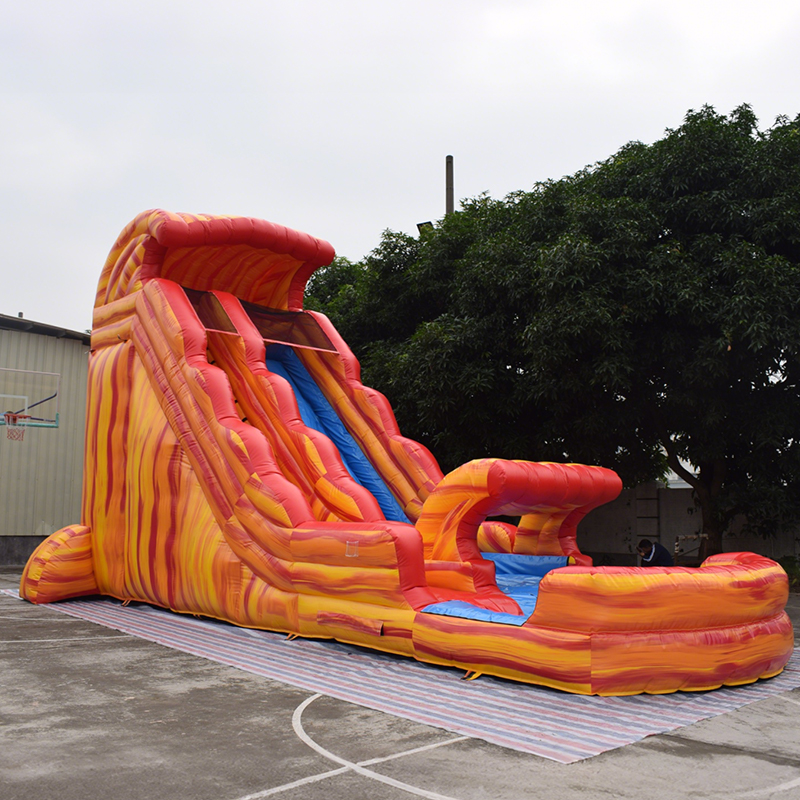
| Specification Parameter | Industrial Data |
|---|---|
| Model ID | CH-WS081 |
| Dimensions (L x W x H) | 10m x 3.3m x 6.5m (32.8ft x 10.82ft x 21.32ft) |
| User Throughput Capacity | 10-15 Users Concurrent |
| Material Composition | 0.55mm Lead-Free Plato PVC Tarpaulin |
| Safety Hardware | Stainless Steel D-Buckles (Rust/Waterproof) |
| Certifications | CE-EN14960, ROHS, UL |
| Standard Accessories | Repair Kits, Blower |
Architect's Note: The CH-WS081 utilizes a towering 21ft height (6.5m) to maximize visibility from distance, acting as a passive billboard for your brand. The choice of 0.55mm Plato PVC here is strategic; it ensures easier setup and teardown for mobile rental operators who may need to move the unit daily. Despite the lighter gauge material, the stainless steel D-buckles ensure that the anchor points never compromise on safety, even after hundreds of wet cycles. This unit strikes the perfect balance between "Massive Visual Impact" and "Operational Mobility"—exactly what you need if you're running multiple events per weekend across a wide service area.
View Product Details & Pricing: Largest Inflatable Water Slide ➔
Product B: The "Profit Engine" – Easy-Setup 62ft Commercial Inflatable Water Slides
Best For: Summer Festivals, Carnivals, Large Corporate Picnics, High-volume throughput events requiring maximum capacity.
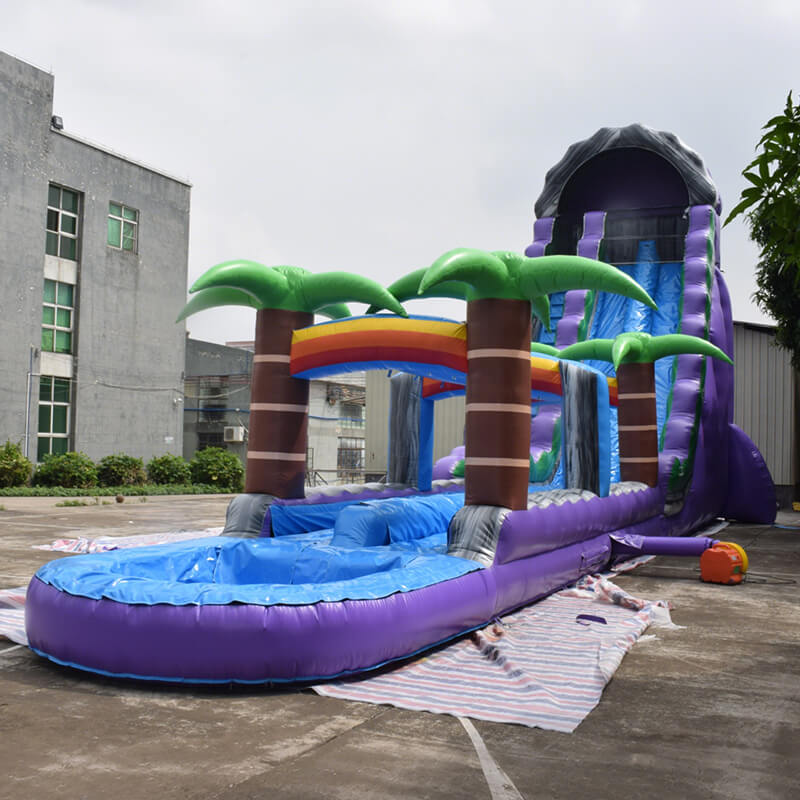
| Specification Parameter | Industrial Data |
|---|---|
| Model ID | CH-WS093 |
| Dimensions (L x W x H) | 19m x 4.8m x 8m (62.33ft x 15.74ft x 26.24ft) |
| User Throughput Capacity | 25-35 Users Concurrent |
| Material Composition | 0.55mm PVC tarpaulin / Upgraded Options Available |
| Certifications | CE-EN14960, ROHS, UL |
| Standard Accessories | Repair Kits, Blower |
Architect's Note: The CH-WS093 is a beast of burden designed to handle the rigors of the busiest rental calendars. With a staggering length exceeding 62 feet and a height of over 26 feet, this unit dominates the skyline—you can see it from three blocks away, which means your potential customers can too. The engineering focus for this model was Throughput Maximization. By accommodating 25-35 peoples simultaneously, it eliminates bottlenecks that plague smaller units. While the standard spec utilizes robust 0.55mm PVC suitable for the main body, we highly recommend the upgraded heavy-duty 0.9mm 1300D PVC for the climbing lanes and impact zones to extend the service life beyond 5+ years. This unit is built for operators who want to own their local market, not just participate in it.
View Product Details & Pricing: 62ft Commercial Slide ➔
Durability, Drainage, and Long-Term Asset Management
Solving the "Swamp Water" Problem
One of the biggest operational headaches for rental fleets—and one that doesn't get talked about enough—is mold and odor caused by trapped water inside the air columns. This phenomenon, often called "water logging," occurs when water splashes into the air intakes or condenses inside the tubes during operation. I've opened units that smelled like a swamp after sitting in storage for two weeks. That's not just gross—that's a health hazard and a reputation killer.
When water remains inside a deflated tube, two things happen that will cost you money:
- Biological Growth: Black mold thrives in warm, dark, damp vinyl tubes. Once it takes hold, it creates a foul smell that leads to negative client reviews and potential health code violations. Good luck getting referrals when parents are complaining about the smell.
- Weight Degradation: Water is heavy—about 8.34 pounds per gallon. If you roll up a 62ft slide with 50lbs of trapped water inside, you're putting immense strain on the internal seams during transport. That added weight causes friction points that accelerate wear.
To mitigate this, proper Inflatable Water Slide Storage procedures must be followed religiously. Our designs incorporate baffled tubes that encourage gravity-fed drainage. However, operator discipline is key. Units must be inflated fully (without water) in a dry staging area before final packing to allow evaporation, or tilted aggressively to drain lower chambers via the air intake valves. Train your crews on this—it takes an extra 20 minutes at teardown but adds months to your equipment lifespan.
Repair Protocols for Commercial Use
Even with the best materials, accidents happen. Vandalism, sharp objects in pockets, or dog claws can puncture PVC. A professional repair kit is essential, and your crew needs to know how to use it. For minor pinholes on 0.55mm material, a simple heat patch works fine. For tears on 0.9mm reinforced material, a two-part process is required: a chemical bond (glue) followed by a mechanical stitch (if near a seam). All our commercial packages include color-matched repair kits and spare vinyl material, ensuring your crew can execute field repairs in under 15 minutes, keeping the revenue stream active rather than sending the unit to the shop for a week.
Customization & Branding for B2B Scalability
In the modern rental market, generic colored castles are losing ground to branded experiences. Customers today expect customization, and businesses that deliver it command higher prices. CH Inflatables offers comprehensive B2B customization solutions. Whether you want to integrate your company logo into the art file of a Kuromi Theme Castle or develop a proprietary color scheme for your fleet, our engineering team manages the process from vector design to print execution.
We use digital printing technology that bonds the ink into the PVC coating, preventing peeling or fading even under harsh UV exposure. This allows rental companies to effectively turn their inventory into mobile billboards, advertising their brand at every event they service. Customization also extends to functional modifications—adding specific branding banners to the entry archway or adjusting colors to match a corporate client's identity for exclusive long-term contracts. Think of it this way: every hour your unit is set up at an event, it should be working double duty—as both a revenue generator AND a marketing tool.
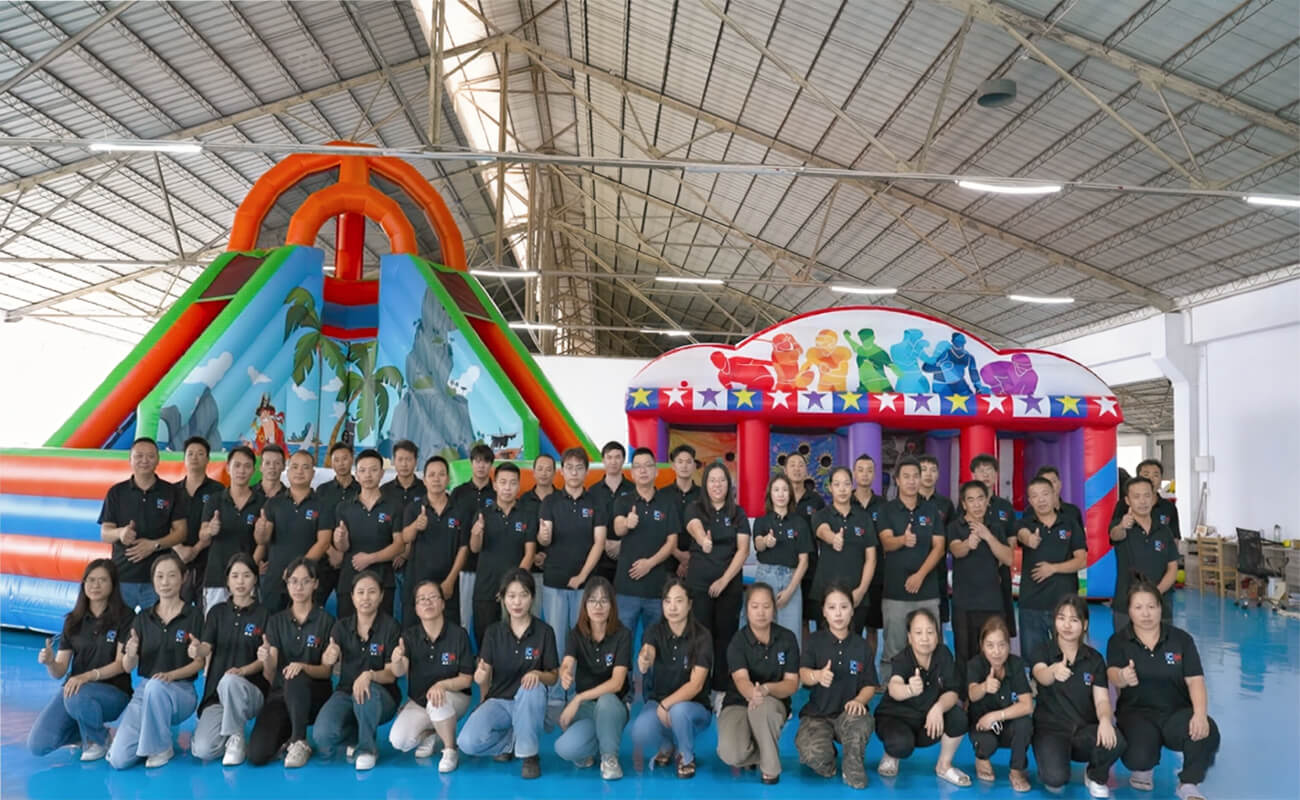
Expert Technical FAQ for Procurement Officers
Q1: How do I prevent water from getting trapped inside the air chambers of my commercial inflatable water slide?
This is arguably the most critical maintenance issue facing rental companies today, and it's one that separates professional operations from amateurs. Trapped water inside air columns adds dead weight—which can exceed the blower's lifting capacity, causing the structure to sag—and inevitably leads to mold and rot, emitting a foul odor that results in negative client reviews. To prevent this, you cannot rely solely on the blower's air push. You must source slides that utilize internal baffling with drainage apertures.
Our commercial units (like the CH-WS093) are engineered with a "breathing" tube design where the bottom of the main support columns utilizes gravity-fed exit points. Furthermore, the use of 0.55mm/0.9mm Plato PVC is vital here because cheaper vinyls are porous; they absorb water molecules into the polymer matrix, whereas premium PVC is hydrophobic, forcing water to bead up and roll out during deflation. Always ensure your setup crew tilts the unit slightly during breakdown to allow physics to drain the lower chambers before rolling. It sounds simple, but this one habit change can add years to your equipment's usable life.
Q2: Is investing in a professional-grade inflatable water slide better than buying cheaper retail versions for my rental fleet?
From a purely financial standpoint, buying retail grade is a capital destruction strategy. I've run the numbers dozens of times, and the math never lies. While a retail unit may cost $500-$800, it will likely survive fewer than 10 rental cycles. Here's the engineering reality: Retail units rely on simple cold-air welding which cracks under UV exposure. Professional B2B units, such as those detailed above, utilize double-to-quadruple electronic stitching. Every seam is reinforced with a bonded strip of PVC, effectively turning the entire surface into one continuous tension member.
Let's look at the ROI calculation because this is where smart operators separate themselves. A commercial slide costing $3,000 renting for $600/day pays for itself in 5 events. After that, it's pure profit minus maintenance. A retail slide renting for $100/day takes 5-8 events just to break even, but will likely need replacement by event #10 due to blown seams or zipper failures. So you're spending the same amount—or more—on replacements while dealing with downtime and unhappy customers. Commercial units also carry Liability Insurance compatibility; most insurers will void your policy if they find non-EN14960 equipment on site, leaving you exposed to million-dollar lawsuits. Is saving $2,000 upfront worth that risk?
Q3: What specific safety features should I verify before purchasing an inflatable water slide for the US market?
Safety verification must go beyond a simple "safe" claim from a salesperson. You need documented proof of three distinct pillars, and you need to actually read the certificates—not just accept that they exist:
- Structural Integrity (CE-EN14960): Verify the anchor point count. For a 62ft slide (CH-WS093), you require significant anchorage density. If a manufacturer reduces D-rings to save cost, the unit becomes a sail in high winds. Ensure every major stress point has a stainless steel D-ring (not iron). Ask for photos of the actual hardware, not stock photos.
- Flammability (ROHS/Fire Retardant): In the US, fire marshals are strict, and they will shut you down at a moment's notice. The material must self-extinguish within seconds of the flame source being removed. Ask for the Fire Retardant Certificate specific to the batch of PVC used. Generic certificates won't cut it if there's ever an incident investigation.
- Electrical Safety (UL): The blower is often overlooked, and that's dangerous. An incorrectly rated blower can overheat after 4 hours of continuous operation at a festival. Ensure the blower carries a UL (Underwriters Laboratories) rating matching US voltage (110V) and amperage standards to prevent thermal events. Without these three documents, you're not buying a product; you're buying a liability that could bankrupt your business.
Q4: How does the 0.55mm PVC compare to 0.9mm PVC in terms of longevity for a water slide?
This is a question of application suitability rather than absolute quality. Think of it like tires on a vehicle: you don't use racing slicks (specialized) for off-roading (heavy duty), even though both are "high quality" products. Each has a specific job. 0.55mm PVC is lighter and more flexible. It's ideal for the towering vertical sections of a slide where the primary force is upward lift and air pressure retention. It resists "creeping" (stretching out of shape) better than heavier materials in vertical columns because there's less internal stress on the polymer chains.
0.9mm 1300D PVC, however, contains a much denser woven internal scrim (the fabric mesh sandwiched between the vinyl layers). This makes it resistant to abrasion and tearing. On a water slide, the bottom sliding lane and the climbing steps take tremendous physical abuse from friction—thousands of slides worth of skin contact, swimwear, and debris. If you use 0.55mm on a high-traffic step, it will wear thin within 2 seasons, guaranteed. Therefore, premium manufacturers often use Hybrid Construction: 0.55mm for the tower/body to keep weight down and setup manageable, and 0.9mm reinforced patches for the floor, steps, and splash zone. When sourcing, ask if the vendor uses hybrid layering to get the best of both worlds. If they look confused by the question, that's a red flag.
Q5: What is the typical lead time and logistics process for importing commercial inflatables?
For custom or stock commercial units, the manufacturing lifecycle generally takes 15-25 working days depending on the complexity of the order and the factory's current queue. Since these are B2B assets, they're shipped via Sea Freight (FOB or CIF terms) to reduce costs, as Air Freight on volumetric (but light) inflatables is economically unviable—you'd pay more for shipping than the product itself.
Plan for roughly 30-40 days of ocean transit time to US ports (Los Angeles, Long Beach, Savannah, New York), plus customs clearance which can add another week depending on port congestion. Here's my advice from years of doing this: to avoid gaps in your rental season, procurement managers should place orders for the upcoming summer season no later than January or February. Waiting until April means you're scrambling in June when everyone else is ordering, and lead times balloon. Reputable suppliers provide a production schedule update with photos at the welding/stitching stage and before packing, allowing you to verify quality remotely before the container is sealed. Ensure your supplier packs units in heavy-duty pallet bags (PP Woven Bags) to prevent forklift damage or water intrusion during maritime transit. Saltwater damage during shipping is a real thing, and proper packaging prevents it.
📚 References & Further Reading
- Global Quality Standards: International Organization for Standardization (ISO) - Guidelines for quality management in manufacturing.
- European Safety Benchmarks: Rainbow Inflatables UK - Reference for EN14960 compliance and safety engineering norms.
- Operational Guides: Understanding Inflatable Slide Wind Ratings & Best Practices for Water Slide Storage.
- Related Products: Giant Inflatable Slide Models | Campground Solutions | Themed Castles
```