5 Proven Mastery Hacks: Inflatable Park Wind Safety

5 proven mastery hacks: Inflatable park wind safety
Running a commercial rental business is high-stakes. The weather is your ultimate wildcard. Look, understanding Inflatable Park Wind Safety isn’t just about following some boring manual; it’s the thin line between a killer profitable weekend and a legal nightmare you can't wake up from.
After 17 years in the trenches at CH Inflatable, I’ve seen it all. I’ve watched sudden gusts try to turn massive setups into kites. Most clients ask me how to shield their investment when the sky turns gray in an instant. Here is the straight talk on how we engineer for survival.
In this B2B guide, I’m pulling back the curtain on our engineering secrets. We’re talking material resilience and the real physics of anchoring. Bottom line: these methods keep your rental ROI locked down and your guests safe when the wind starts acting up.
The foundation of stability: 1300D PVC resilience
When we talk about Inflatable Park Wind Safety, your fabric choice is everything. It dictates how the structure fights environmental stress. That’s exactly why 1300D PVC resilience is the gold standard for any serious commercial park operation.
For your standard dry bounce houses, we use premium 0.55mm 1300D PVC. But if you’re moving into water slides or full-scale water parks, we kick it up to 0.9mm 1300D PVC. It’s not just about being waterproof; it’s about massive weight tolerance.
To be honest, thickness alone won't save you. It’s the tensile strength of that internal 1300D polyester scrim. That’s what actually stops the fabric from ripping apart when the wind starts making the unit oscillate. Cheap stuff just can't handle the tension.
In open fields, big inflatables act like giant parachutes. Wind hits those broad sides and wants to lift the whole thing. Low-grade 800D or 1000D materials lack the "memory" to snap back, leading to micro-tears and total failure during high-pressure fatigue.
Our reinforced 1300D PVC spreads those wind loads across a much larger surface area. If you're a wholesaler or a rental pro, investing in real commercial-grade material is the only way to sleep at night when a squall hits.
| Material Grade | Tensile Strength | Best Use Case | Wind Performance |
|---|---|---|---|
| 1300D PVC (0.9mm) | Ultra High | Giant Water Parks | Maximum stability |
| 1300D PVC (0.55mm) | High | Commercial Bounce Houses | Standard Ops |
| 1000D PVC | Medium | Residential/Light Use | Risk of micro-tears |
Engineering anchor points for heavy loads
Anchoring is arguably the most vital physical part of Inflatable Park Wind Safety. To make sure these points don't fail, we’ve ditched standard iron for stainless D-buckle longevity. Rust is a silent killer that eats your safety budget from the inside out.
If you're operating on the beaches of Spain or the humid Florida coast, rust will wreck standard buckles in months. For our UAE and Middle East clients, this corrosion resistance is a non-negotiable part of the build. We don't cut corners here.
We often talk about "tie-down clusters." This is a strategic grouping of anchor points designed to fight off-shore winds. We don't just guess where they go; we customize the count and position based on exactly how you plan to operate.
But here’s the kicker: an anchor is only as good as the webbing. At CH Inflatable, we use car-belt grade webbing. This is the same stuff used in automotive safety because it flexes without snapping. It absorbs the wind’s kinetic energy instead of breaking.
We don’t just slap the webbing on the surface. We bury it deep into the structural seams with a multi-layered double-stitching technique. This gives you absolute reliability when the weather takes a turn for the worse.
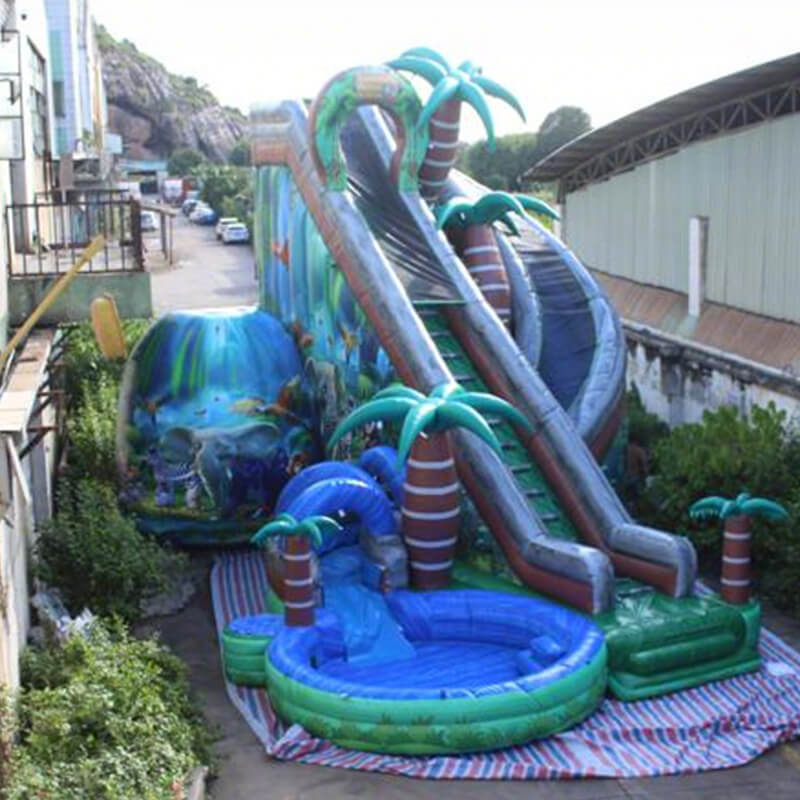
If you want to see this level of hardware in action, take a look at our Giant Coconut Tree Inflatable Water Slide which features reinforced tie-downs at every critical stress point.
Rigorous compliance: EU TEST EN14960 standards
If you want real peace of mind with Inflatable Park Wind Safety, you need to live by the rules. The EU TEST EN14960 standard is your best friend. It sets the hard limit: you evacuate and deflate once wind speeds hit 38km/h. No exceptions.
Beyond Europe, having UL and SGS material certificates is basically a ticket to getting Tier-1 insurance in the USA and Canada. As a B2B wholesaler, I make sure every roll of material passes these tests before we even turn on the sewing machines.
Let's be real: a safety certificate isn't just paper. It’s your legal shield. If a site inspector shows up or—heaven forbid—an accident happens, those documents prove you did your homework and used compliant gear.
Safety protocols have to change depending on where you are. A park in the Saudi heat needs different pressure management than a unit facing the Baltic winds in Latvia. We help our clients from Poland to Colombia adapt to their local "Site-Specific" audits.
Our dual-line sewing and corner reinforcement ensure that no matter what your local inspector throws at you, CH Inflatable gear passes. We build for global markets because wind doesn't care which country you're in.
Critical hardware: HW blower certifications and flow
Keeping the air pressure steady is massive for Inflatable Park Wind Safety. If the pressure drops, the structure buckles, and the wind takes control. That’s why we only trust HW blower certifications. They are the workhorses of the industry.
Every blower we ship is a genuine HW brand with full CE certification. They provide the consistent CFM (Cubic Feet per Minute) needed to keep walls firm. If the blower can't fight "Static Pressure Drop," the wind will literally push the air back inside.
What's more, you have to think about power failure. If the lights go out, you need time to get everyone out safely. That’s why we exclusively use YKK zippers for all our deflation ports. They are the best in the world for a reason.
These zippers don't warp under tension. Plus, we use back-flow baffle systems. When the power cuts, an internal flap seals the port, so the air bleeds out slowly instead of just collapsing like a pancake. This is what separates pros from amateurs.
To better understand Inflatable Park Wind Safety, this video tutorial is highly recommended:
https://www.youtube.com/shorts/xvdZWzhRyYM
Maintenance hacks for long-term ROI
Winning in the rental game is about keeping your gear in the field, not in the repair shop. Because we use genuine YKK zippers, our units don't suffer from the teeth bending or fabric catching that kills cheap alternatives when the wind shifts the PVC.
At CH Inflatable, every single corner is double-stitched. We use "V-Stitch stress-plates" at every major junction. These reinforced patches soak up the friction from the wind so your seams don't have to. It turns a 2-season asset into a 5-season moneymaker.
When you look at our wet/dry solutions, the engineering really shines. We balance guest fun with pure structural physics. We want your customers to have a blast, but we want your investment to stay firmly on the ground.
Mastering Inflatable Park Wind Safety is a mix of the right materials (1300D PVC), the best hardware (YKK Zippers, HW Blowers), and smart rigging. Don't settle for "good enough" when the wind starts blowing.
Frequently asked questions (FAQ)
What wind speed is safe for commercial inflatables?
According to the EU TEST EN14960, you must stop operation at 38km/h (24mph). Always keep a handheld anemometer in your pocket. Don't guess—measure the wind to keep your Inflatable Park Wind Safety protocols tight.
How does 1300D PVC improve wind resistance?
It's all about the internal polyester weave. Higher denier means the material doesn't stretch or warp as easily. When the wind hits a huge surface area, 1300D PVC stays stable while thinner fabrics might tear or lose shape.
Can I customize anchor points for my location?
Totally. Since we are a B2B manufacturer, we can add extra D-rings or longer webbing if you're anchoring in high-wind zones or on concrete. Customization is the key to local Inflatable Park Wind Safety.
Conclusion
Long story short, mastering Inflatable Park Wind Safety isn't rocket science, but it does require professional-grade gear. Using 1300D PVC resilience, HW blower certifications, and stainless D-buckle longevity is how you stay in business for the long haul.
When you buy equipment that blows past the EU TEST EN14960 standards, you aren't just buying a toy. You're buying insurance for your reputation. Don't let a sudden gust of wind blow away your hard-earned profits.
Ready to level up your fleet with gear that's actually built for the real world? We've got 17 years of experience ready to back you up. Let's make your next event the safest one yet.
Check out our full range and secure your next big winner here: Shop the Giant Coconut Tree Inflatable Water Slide & Enquire Now.
For more pro tips, check out these industry standards: Inflatable Safety Rules: Keep Your Kids Safe at Bounce House and the official guidelines at Inflatable Devices - EHS | The University of Alabama.
Image by: Amar Preciado
https://www.pexels.com/@amar