
Prevent Tears: 5 Commercial Inflatable Slide Netting Tips

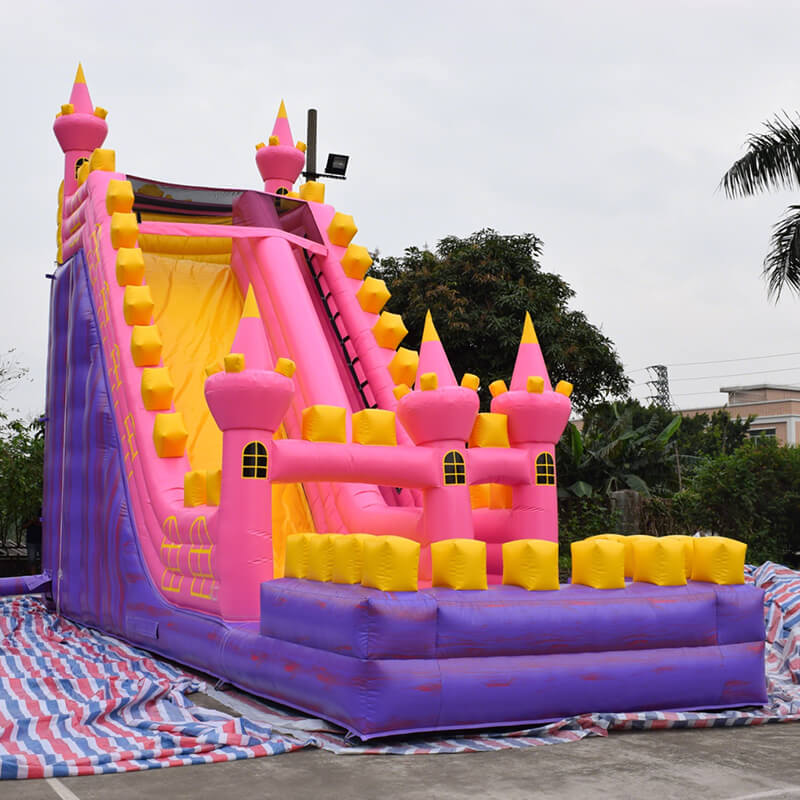
Prevent tears: 5 commercial inflatable slide netting tips
Maximize safety with top-tier Commercial Inflatable Slide Netting. Discover 5 vital tips to prevent injuries and extend equipment life. Upgrade now!
Let’s be real about safety
We’ve all had that nightmare. It is the peak of the summer season, your calendar is slam-packed, and suddenly, your biggest money-maker is out of commission.
Why? Maybe a kid’s finger got snagged in cheap mesh, or a barrier wall blew out during a rowdy graduation party. Downtime costs you rent money, sure. But liability? That kills businesses.
In this high-stakes game, Commercial Inflatable Slide Netting isn't just an accessory. It is your first line of defense. It prevents falls, keeps riders contained, and keeps you compliant with safety standards like EN14960 and ASTM.
I’ve been in this industry for 17 years. I’ve seen too many operators ignore their netting until a lawsuit gets filed. They worry about the digital print but forget the mesh.
Here is the hard truth: If the netting fails, the slide shuts down. Period.
You need to focus on material quality and specs to stop "Blowouts"—those sudden failures that ruin your reputation. Let's talk about how to get the right Commercial Inflatable Slide Netting for your fleet.
Understanding netting anatomy: why mesh matters
Not all nets are the same. When you are sourcing from China, knowing the granular details of Commercial Inflatable Slide Netting can save you thousands in repairs.
The science behind finger-safe safety mesh
Safety regs in the USA (ASTM) and Europe (EN14960) act as the law of the land. To run a legit operation, your units must use Finger-safe safety mesh.
So, what does that actually mean?
It’s all about the aperture size—the holes in the grid. On top-tier commercial units, this grid has to be tight enough that a child’s finger physically cannot pass through it.
If that hole is too big, a kid sliding down will instinctively grab the net. That leads to broken fingers. Cheap units use loose "fishing net" weaves. Avoid those like the plague.
Finger-safe safety mesh is tightly woven. It allows you to see through it to monitor the riders, but it stays a solid wall against small hands.
Material composition: polyester vs. nylon
There is a massive shift happening right now with materials.
Back in the day, nylon was the go-to. But nylon drinks water like a sponge and falls apart under the sun. That doesn't work for outdoor rentals.
In my 17 years dealing with Commercial Inflatable Slide Netting, high-gauge PVC-coated polyester is the clear winner. It’s stronger and holds its shape.
| Feature | Old School Nylon Mesh | Commercial Polyester Mesh |
|---|---|---|
| UV Resistance | Low (Fades/Cracks quickly) | High (Reflects UV rays) |
| Water Absorption | High (Gets heavy/rots) | Hydrophobic (Sheds water) |
| Tensile Strength | Moderate | Heavy-Duty |
| Likely Lifespan | 1-2 Seasons | 5+ Years |
We use this reinforced material because it doesn't just need to stop a child. It has to handle the constant bouncing of the structure without snapping.
To better understand the craftsmanship behind Commercial Inflatable Slide Netting, this video tutorial is highly recommended:
Tip 1: Prioritize anti-climb netting walls at the top deck
The scariest spot on any unit is the top platform. Excitement is high, and common sense gets left at the bottom of the ladder.
Creating an effective visual and physical barrier
You have to ensure your units feature robust Anti-climb netting walls. Standard stuff allows kids to hook their toes in and climb over the sidewalls.
Anti-climb netting walls utilize a weave pattern that provides zero grip. It feels smooth but acts as a wall.
This forces riders to sit down and slide the right way, rather than goofing off 20 feet in the air. It’s a passive safety feature that actively drops your accident rate.
Integration with slide structure
The netting can't just be stitched to the surface. It needs to be anchored deep into the slide's bones.
At CH Inflatable, we bond our Commercial Inflatable Slide Netting directly to the 0.55mm 1300D PVC chassis. We use reinforced strips right where the net meets the vinyl.
A perfect example of this engineering is our forest-themed designs. These units need high tops for the "wow" factor, which makes the netting placement absolutely critical.
See how the Forest inflatable slide for sale utilizes integrated anti-climb walls for maximum safety.
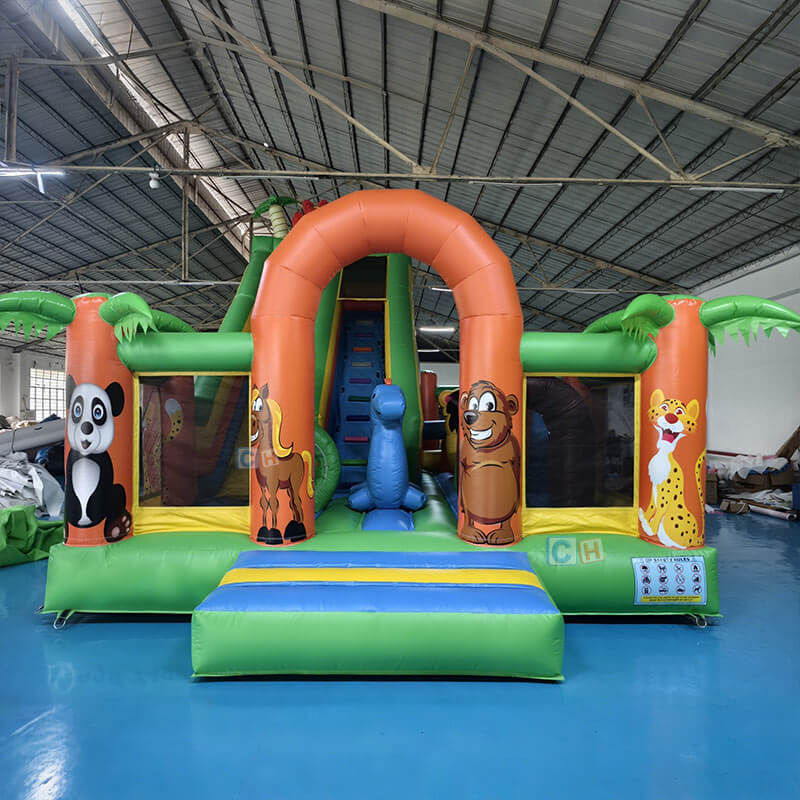
If that netting were to pop loose when a rider leans on it, the results would be catastrophic. Proper integration stops that from happening.
Tip 2: Invest in heavy-duty barrier nets for stress zones
The top deck isn't the only danger zone. The bottom of the slide, specifically the "run-out" and lane dividers, takes a total beating.
Reinforcing high-traffic areas
When a kid hits the bottom, they have serious momentum. They crash right into the end barriers.
These areas require Heavy-duty barrier nets. Standard mesh here? It will look like shredded cheese after three months of heavy rotation.
We say double-stitch or quadruple-stitch these zones. The net needs to act like a catcher's mitt—absorbing energy without failing.
The CH Inflatable manufacturing standard
When you are checking out Commercial Inflatable Slide Netting, look at the anchor points.
We upgrade our webbing to automotive safety belt standards. Plus, we use stainless steel D-buckles to lock these heavy nets down.
Why stainless? Rust acts like a knife on fabric. Our buckles are rust-proof, keeping the net secure even when wet.
When evaluating inventory, ensure the barriers meets industry standards found in guides like Your Guide To Acquiring Top-Quality Commercial Inflatable Water Slides For Sale.
If the hardware is junk, the strongest net in the world won't help you. It will just rip the anchor right off the inflatable.
Tip 3: Combatting degradation with UV protective mesh layers
For my guys in Texas, Spain, or the Middle East, the sun is your enemy.
The invisible enemy: sun damage
UV rays burn plastic and polyester slowly. Over time, they destroy the molecular bonds in your Commercial Inflatable Slide Netting.
This leads to what we call "Crispy Net."
You’ve probably seen it. The net looks okay, but you touch it, and it turns to dust. That is a liability nightmare waiting to happen.
To stop this, you must demand UV protective mesh layers. This is a special coating put on the thread before weaving.
Extending product lifespan in hot climates
Generic netting might last a season in Arizona. Commercial Inflatable Slide Netting with UV treatment can last five.
It reflects the rays instead of soaking them up.
If you are buying outdoor units, asking about the UV rating is just as vital as asking about the blower.
Don't accept generic stuff for outdoors. "Crispy Net" will force you to retire a money-making unit way too early.
Tip 4: Recognizing when to buy replacement slide netting
Even the best gear dies eventually. Safety is knowing when to quit trying to patch it.
The 3-strike inspection rule
I teach the "3-Strike Rule." If you see any of these, order Replacement slide netting immediately:
- Fraying Edges: If the border meeting the vinyl is fraying, the strength is gone.
- Big Holes: If the mesh has holes bigger than a pencil eraser (5mm+), it’s not finger-safe anymore.
- Detached Anchors: If D-rings or velcro are pulling away from the net itself.
You need to source your Replacement slide netting before the season starts. Shipping takes time, and you don't want a unit sitting dead in July.
Modular vs. fixed netting
This is why smart design matters.
Some factories sew the net into the structure. To fix it, you have to ship a 500lb unit to a repair shop. That's a hassle.
We prefer modular systems. Heavy-duty velcro or lacing lets you swap a damaged panel right on the grass.
See examples of high-traffic commercial units that require robust maintenance plans, such as the 20 Fire Curve Inflatable Dual Slide.
Keeping spare Replacement slide netting on the shelf is what separates the pros from the amateurs.
Tip 5: Proper anchoring and tension management
You got the right net. Now, how is it installed?
Avoiding over-tensioning
A classic DIY mistake I see is over-tightening the net.
Here is the kicker: Nets usually fail because they were installed too tight, not because they were weak. There was no room for the bounce.
Inflatables move. They breathe. If your Commercial Inflatable Slide Netting is cranked tight like a guitar string, the bouncing will snap it.
There has to be a specific amount of slack—"tolerance precision"—to let the unit flex without ripping the mesh.
Hardware reliability
The system relies on the synergy between the mesh, the zipper access, and the anchors.
We use YKK zippers. They are the gold standard because they don't burst under pressure.
When you secure a net on a massive unit, like a water park obstacle, tension is everything.
Large scale units like the Commercial Mobile Water Theme Park utilize advanced tension management to keep netting secure without tearing.
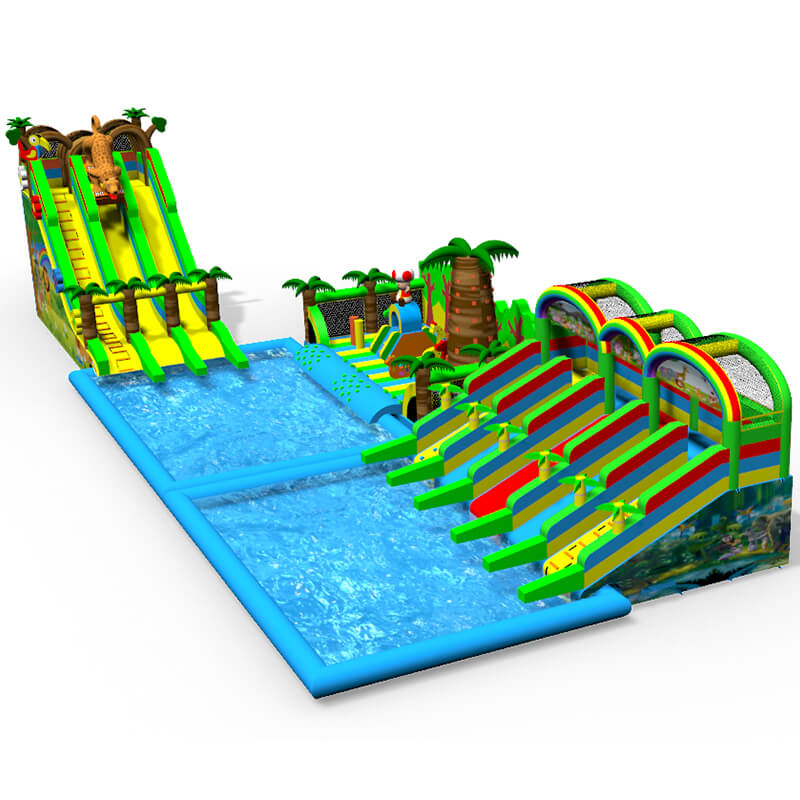
This ensures that even when fifty people are climbing over the park, the barrier nets remain secure but flexible.
Why CH Inflatable is your trusted heavy-duty partner
You aren't just buying plastic; you are investing in your reputation.
17 years of B2B safety innovation
At CH Inflatable, we’ve spent 17 years refining this craft. We know the difference between a backyard "toy" and a commercial asset.
Our materials carry UL and SGS certifications. Our designs hit CE EN14960 standards. We get what clients in the USA, Germany, and France actually need.
Superior components for global rental business
We offer the Total Safety Package. This includes top-tier Commercial Inflatable Slide Netting, genuine HW Blowers (CE certified), and double-stitching everywhere.
We use 0.55mm 1300D PVC for dry slides and thicker 0.9mm 1300D PVC for water parks.
We don't just sell inflatables. We provide "Turnkey Rental Horses."
These are reliable units that go out every weekend, earn you cash, and come back ready for more. No breakdowns, and no "Crispy Net" after one summer.
Frequently asked questions (FAQ)
Here are the questions I hear most often from rental owners about their netting.
Why is small-hole netting crucial for commercial inflatable slide safety?
Small-hole netting, or Finger-safe safety mesh, is non-negotiable for three reasons. First, it stops finger entrapment, meeting ANSI/ASTM rules. Second, the tight weave is hard to climb, making it a great Anti-climb netting wall. Third, despite the tight weave, you can still see through it to spot trouble inside the slide.
How often should I inspect my inflatable slide netting for UV degradation?
It depends on where you live. For normal climates, check monthly. But if you are in a high-UV zone like Texas or Dubai, check your UV protective mesh layers every two weeks. Look for fading or brittleness. If the net feels crunchy, it’s toast. Order Replacement slide netting immediately.
Wrapping it up
Effective Commercial Inflatable Slide Netting isn't an afterthought. It is a critical component that defines how long your fleet lasts and how safe you are from liability.
From ensuring you have Finger-safe safety mesh to verifying those UV protective mesh layers, the quality of your netting hits your ROI directly. Don't let a cheap blowout ruin your season.
Don't compromise on safety. Whether you need a custom design or wholesale stock for the rush, contact CH Inflatable today for slides built to last 17+ years.
Image by: king Ho
https://www.pexels.com/@king