Stop Sun Damage: 3 UV Resistant Inflatable Vinyl Secrets

Stop sun damage: 3 UV resistant inflatable vinyl secrets
Short Description: Protect rental assets with 0.55mm UV resistant inflatable vinyl. Learn how high-grade PVC prevents sun damage. Request a free quote today!
Introduction
Picture this scenario. It’s the start of the busy summer season. You pull your most popular bounce house out of storage, expecting it to be ready for a rental in Dubai, Texas, or maybe a coastal town in Spain.
Instead, you find a rental business owner’s worst nightmare.
The surface feels sticky. The vibrant colors have turned into a washout. Worst of all, the material feels brittle, like a cracker ready to snap.
This isn't just normal wear and tear. This is the direct result of using inferior materials in harsh environments.
Look, in my 17 years in the inflatable manufacturing industry, I’ve seen thousands of dollars of equipment scrapped prematurely. Why? Because it couldn't handle UV radiation.
The solution to stopping this financial bleed is simpler than you think. You have to choose the correct UV Resistant Inflatable Vinyl.
If you run a B2B rental business, your inventory is your livelihood. You can't afford to replace units every season.
I’m going to share 3 industry secrets regarding material grades, advanced coatings, and heat-resistant construction. These are the factors that separate a 1-year disposable product from a 5-year profit generator.
The science of sun damage (why inflatables fail)
To make smart purchasing decisions, you need to understand what is happening at a molecular level when your equipment sits in the sun.
Understanding PVC photodegradation
A lot of rental owners ask me why their units get "sticky" before they actually crack. The answer is pure chemistry.
Standard vinyl is made of PVC (Polyvinyl Chloride) and liquid plasticizers. These plasticizers are what make the material flexible.
When exposed to intense sunlight, a nasty process called PVC photodegradation kicks in.
UV radiation carries enough energy to break the chemical bonds within the polymer chains.
As these bonds break, the plasticizers—which are supposed to stay embedded—start migrating to the surface. That creates the dreaded sticky residue.
Once the plasticizers are gone, the remaining vinyl becomes rigid. Without high-quality UV Resistant Inflatable Vinyl, this process accelerates rapidly.
I’ve seen standard nylon units lose their structural integrity in less than six months of exposure in high-index UV zones like the Middle East.
Polymer breakdown prevention strategies
There is a massive difference between a product labeled "sun-resistant" and one that has undergone true polymer breakdown prevention treatment.
"Sun-resistant" often just means the color won't fade for a few weeks. True prevention involves adding UV stabilizers like HALS (Hindered Amine Light Stabilizers).
We add this during the raw material mixing stage, not just partially spraying it on top later.
Industry Slang: "Chalking"
Rub your hand across an old slide. Does it come away with a white, powdery residue? That is called "chalking."
Chalking is physical evidence that the polymer matrix is disintegrating. If your current inventory is chalking, it’s honestly already too late.
Investing in UV Resistant Inflatable Vinyl from the manufacturing stage is the only way to stop chalking before it even starts.
Secret 1: Material density and thickness (0.55mm vs 0.9mm)
Not all vinyl is created equal. The first secret to longevity is the density of the base mesh inside the PVC.
The role of 1300D in outdoor material longevity
You’ll often see competitors boasting about "1000D" vinyl. While 1000D (Denier) is the industry standard for general use, we realized it just doesn't cut it for extreme conditions.
At CH Inflatable, we found it insufficient for extreme outdoor material longevity.
That is why we utilize 1300D PVC.
So, what does this mean for your bottom line? The higher Denier count means the internal mesh fabric is woven 30% tighter with thicker threads.
Expert Opinion:
"While many competitors use 1000D, we find that 1300D offers the necessary tensile strength to resist the heat-cycle expansion and contraction. When the air inside expands in the heat, 1300D holds the shape without stretching out and sagging."
This extra density provides a robust skeleton for the PVC coating. It ensures that our UV Resistant Inflatable Vinyl remains taut and bouncy year after year.
Choosing the right thickness for the job
Thickness determines abrasion resistance and air retention. For standard bounce houses, 0.55mm is the gold standard.
It is heavy enough to last but light enough to transport. However, some units require more grit.
For sealed air units or water parks that sit in the water—amplifying UV rays through reflection—we upgrade to 0.9mm.
For example, when constructing a Mobile Water Theme Park for Children, using 0.9mm material is essential.
Water parks face a double threat: direct sun from above and reflected sun from the water below. Standard vinyl would delaminate quickly here.
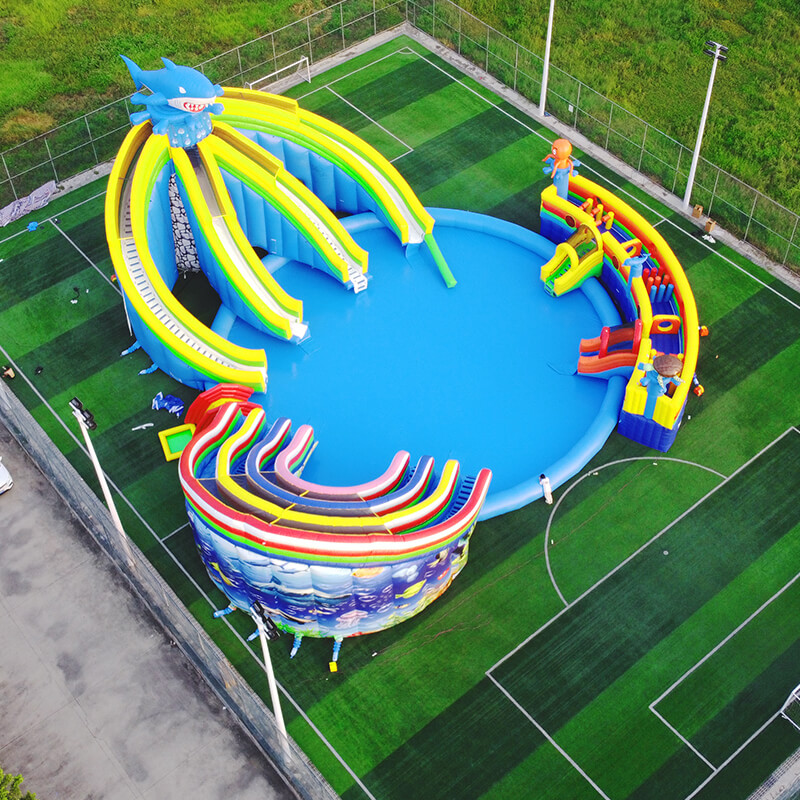
By using 0.9mm UV Resistant Inflatable Vinyl, we ensure that these massive investments maintain their air pressure. They keep their structural rigidity even after weeks of floating on a lake.
Material Comparison Table
To give you a clearer picture, here is how our specific vinyl stacks up against common market alternatives.
| Material Type | UV Resistance Level | Expected Lifespan (High UV Zone) | Main Application |
|---|---|---|---|
| Standard Nylon | Low (None) | 3-6 Months | Home use / Toys |
| Standard 1000D PVC | Moderate | 1-2 Years | General Rental (Low Sun) |
| UV Resistant Inflatable Vinyl (1300D) | High (HALS Treated) | 5+ Years | Commercial Rental / Water Parks |
Secret 2: Advanced coatings and visual appeal
The second secret lies in the invisible shield we apply to the vinyl.
The importance of anti-UV coating
At CH Inflatable, every yard of our widely utilized UV Resistant Inflatable Vinyl is treated with a specialized anti-UV coating.
Think of this coating as SPF 100 sunblock that never washes off. It is designed to reflect a significant portion of the UV radiation rather than absorbing it.
Absorbed radiation becomes heat, and heat kills PVC. By reflecting the rays, the surface temperature of the inflatable helps stays down.
Lower surface temperatures mean less plasticizer migration. It also means less risk of burns for the kiddos playing on the unit.
For more technical data on fabric standards, check out The Ultimate for Inflatable Bounce House Material & Slides.
Professional manufacturers know that this coating is the first line of defense in maintaining the asset's value.
Decoding the colorfastness level
Ever notice how red and blue colors tend to turn pink and grey? This is a failure of the colorfastness level.
In the B2B rental market, visual appeal is everything. No parent wants to rent a faded, tired-looking castle.
Our UV Resistant Inflatable Vinyl achieves a high grade on the Blue Wool Scale (the industry measure for colorfastness).
Industry Slang: "Crazing"
When cheap vinyl dries out, you might see a fine web of tiny cracks on the surface. We call this "Crazing."
Crazing is the precursor to tearing. It happens when the surface coating loses its elasticity.
By maintaining a high colorfastness level and proper moisture content in the vinyl, we prevent crazing. This ensures your units look brand new even after two or three seasons of heavy outdoor use.
Secret 3: Heat-resistant construction techniques
The best UV Resistant Inflatable Vinyl in the world is useless if the glue melts or the threads rot. Secret #3 is about how we put the unit together.
Reinforcement beyond the fabric
Sun damage isn't just limited to the fabric. UV rays attack glue and thread with equal aggression.
At CH Inflatable, we employ double stitching throughout the entire unit. We also use four-fold stitching at bottom stress points.
But we go further. We use customized Stainless Steel D-buckles.
Why stainless steel? Standard iron rings rust when exposed to humidity. Furthermore, black iron rings get incredibly hot in the sun, melting the vinyl strap holding them.
Stainless steel remains cooler and is impervious to rust.
We also use YKK Zippers. Cheap zippers warp in the heat, making deflation impossible. YKK zippers are heat-stabilized and refuse to deform.
Automotive-grade webbing and safety
The webbing (those black reinforcement straps) is often the weak link. Standard polypropylene webbing becomes brittle in the sun.
We have upgraded our manufacturing process. We now use webbing that meets automotive seatbelt standards.
This is particularly critical for massive structures. Take, for instance, the largest inflatable water slide we manufacture.
A structure of this magnitude generates immense stress on its anchor points. If the sun weakens the webbing, a sudden gust of wind could cause a failure.
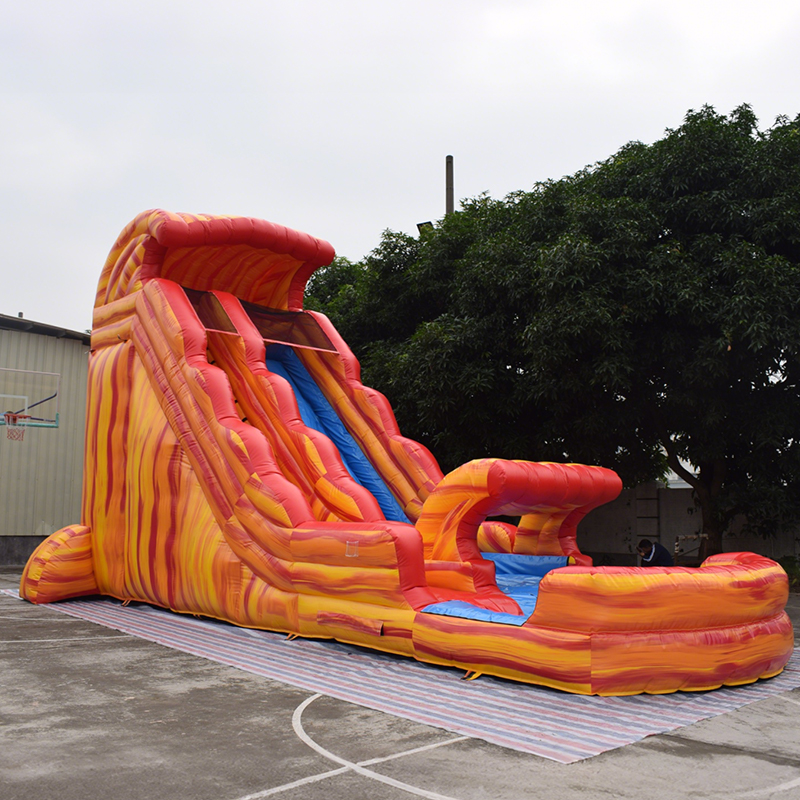
By combining seatbelt-grade webbing with UV Resistant Inflatable Vinyl, we provide the highest safety margins in the industry.
Maintenance and repair for sun-exposed gear
Even with the best UV Resistant Inflatable Vinyl, maintenance is key to hitting that 5-year profit mark.
How to patch UV-compromised vinyl
If you spot minor damage, you need to act fast. Sun-damaged vinyl tears more easily than fresh vinyl.
When sourcing repair materials, ensure you are buying commercial-grade specs.
You can see examples of raw material standards here: Inflatable Raft Tube Boat Material - 32 oz Vinyl - Tear and Puncture Resistant – MyTarp.com.
Pro Tip: Always clean the area with MEK (Methyl Ethyl Ketone) before applying glue. UV exposure creates a layer of oxidation that prevents glue from bonding.
Visual guide to PVC repair
Industry Slang: "Skinning"
If a slide lane is badly sun-damaged (chalky and rough) but the structure underneath is fine, we perform "Skinning."
This involves gluing a fresh layer of UV Resistant Inflatable Vinyl over the entire sliding surface.
To better understand how to handle PVC repairs on widely exposed surfaces, this video tutorial is highly recommended:
https://www.youtube.com/watch?v=v6YmWa7ScOc
Frequently Asked Questions (FAQ)
Does direct sunlight weaken commercial inflatable PVC?
Yes, absolutely. Direct sunlight introduces UV radiation which attacks the polymer chains in the plastic.
However, CH Inflatable's UV Resistant Inflatable Vinyl is engineered with added stabilizers (HALS).
These stabilizers absorb or reflect the harmful energy. It significantly slows down the degradation compared to standard nylon or untreated PVC.
What is the lifespan of UV-treated vinyl in hot climates?
This depends heavily on the quality of the vinyl. Standard vinyl in intense heat zones like Dubai or Arizona might only last 1-2 years before becoming brittle.
In contrast, our high-grade 0.55mm 1300D PVC, when treated as UV Resistant Inflatable Vinyl, can last 5+ years with proper care.
How does 1300D PVC compare to standard nylon for sun resistance?
Expert Opinion: "Nylon is essentially disposable in high-UV environments. It dries out, fades, and tears within months. 1300D PVC is an investment asset."
The molecular density of PVC prevents the 'drying out' effect seen in nylon. Nylon fibers degrade and snap under UV exposure.
The PVC coating protects the internal mesh of our UV Resistant Inflatable Vinyl in a way nylon just can't match.
Conclusion
The difference between a rental business that struggles with repairs and one that scales profitably often comes down to one thing: material choice.
Long story short, we have covered the three secrets to stopping sun damage:
- Material Grade: Using 1300D and 0.55mm/0.9mm density.
- Coatings: Applying advanced anti-UV coating and ensuring high colorfastness.
- Construction: Using heat-resistant YKK zippers, stainless steel hardware, and automotive webbing.
Don't let your profits fade with the sun. Your inventory is your biggest asset—protect it with UV Resistant Inflatable Vinyl.
At CH Inflatable, we have spent 17 years perfecting these formulas. We meet CE EN14960 and EU testing standards.
Ready to upgrade your fleet?
Contact CH Inflatable today for a free quote on custom, UV-resistant designs that are built to last.