
Mobile Inflatable Park Setup: 5 Steps to Zero Errors

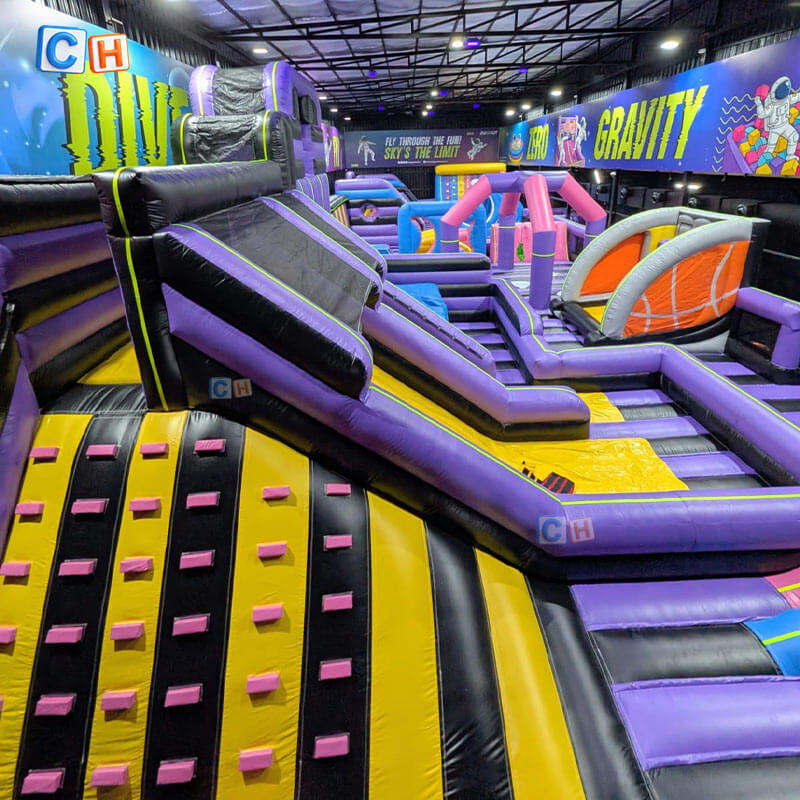
Mobile inflatable park setup: 5 steps to zero errors
Boost efficiency for your rental business. Master Mobile Inflatable Park Setup with expert tips on layout and power. Scale your profits today!
Let's be real for a second. In the rental business, time equates to cash flow, and safety? That is absolutely non-negotiable. I’ve seen seasoned pros sweat bullets when a massive event timeline gets tight.
When the crew is struggling with a complex layout, the stakes are incredibly high. Inefficient processes don't just frustrate your team; they lead to serious safety hazards.
We are talking about delayed opening times and skyrocketing labor costs here. If you aren't optimizing your workflow, you are basically leaving money on the table. At CH Inflatable, we have spent over 17 years manufacturing high-end commercial units using 0.55mm 1300D PVC.
We know that the difference between a profitable weekend and a nightmare scenario often comes down to procedure. That is why mastering a professional Mobile Inflatable Park Setup is the key to scaling a rental company.
You want to move from a side hustle to a regional powerhouse? Follow my comprehensive guide below. We cover everything from power management to the final "shoe test" for zero errors on site.
Step 1: Pre-arrival planning and rental logistics optimization
The perfect Mobile Inflatable Park Setup actually begins long before your truck leaves the warehouse. I always tell my B2B clients a simple truth.
If you are solving problems at the event site, you have already failed the preparation phase. You need to handle the headache before you hit the road.
Analyzing the terrain and access
You must apply strict Rental Logistics Optimization to ensure your delivery vehicles can actually access the deployment zone. I recall one client in Germany who booked a massive park but dropped the ball on the site check.
They forgot their site had a 2-meter arched gate. The result? They spent 4 hours hand-carting 300kg units. Don't be that guy.
Always verify the following before loading the truck:
- Gate Widths: Ensure pallet jacks and dollies fit.
- Overhead Obstructions: Check for low-hanging trees or power lines that conflict with tall slides.
- Turning Radius: Can your trailer navigate the site entrance?
Site surface evaluation
Not all ground is created equal. You need to distinguish clearly between grass, concrete, and indoor surfaces, as this dictates your anchoring hardware.
Expert Opinion: "Never trust a client's estimation of 'flat ground.' Always demand photos or perform a site visit for large parks to prevent uneven inflation stresses."
A slight slope might look fine to a layperson. But for a Mobile Inflatable Park Setup, it can cause water slides to lean dangerously or dry obstacles to twist.
Step 2: Strategic event site layout and unfolding
Once you are on-site, the clock starts ticking. This is where your blueprint comes to life. Strategic positioning is essential for massive units like obstacle courses and fun cities.
Mastering the event site layout
Utilizing Event Site Layout best practices is about more than just aesthetics; it is about safety and crowd control. You must ensure traffic flow is intuitive.
Emergency exits must remain unobstructed at all times. For residential units, the layout is simple, often just a single backyard unit. You can see a basic residential example here: Inflatable Water Park with Slide and Bounce House – SunnyAndFun.
However, for a commercial Mobile Inflatable Park Setup, you are dealing with a complex ecosystem of connected units. This requires far more rigorous planning.
Key layout considerations include:
- Entrance/Exit Separation: Keep queues away from exit zones to prevent collisions.
- Blower Positioning: Keep blowers away from foot traffic to avoid tripping hazards.
- Sun Orientation: Position metal slides away from direct afternoon sun to prevent burns.
Handling heavy units
Unrolling 0.55mm 1300D PVC units requires technique to minimize dragging protection. Dragging a 300kg unit across asphalt is the fastest way to ruin the bottom tarp.
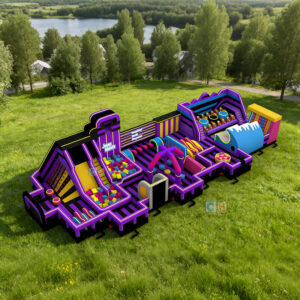
For complex layouts, like our Construction team inflatable fun city, the orientation is critical. You must identify the air intake tubes before you unroll.
If you unroll it backward, you lose 20 minutes flipping it over. When executing a Mobile Inflatable Park Setup, always align the unit so the intakes face your power source effectively.
Step 3: Inflation and high-output blower management
This is the phase where the park comes alive, but it is also where electrical issues usually strike. Ensuring consistent pressure without tripping breakers is an art form.
Calculated airflow and power
High-Output Blower Management is crucial here. You must match the right HW Brand (CE Certified) blower to the specific air intake tube.
Not all blowers are the same 1.5HP or 2HP generic boxes. A proper Mobile Inflatable Park Setup relies on matching push to resistance.
Industry Slang: Avoid "Daisy-chaining." This is when rookie crews plug too many blowers into a single extension cord sequence. This causes significant voltage drops.
This can burn out your blower motors or cause the inflatable to be soft. Follow these rules:
- Always use dedicated circuits for heavy loads.
- Use thick gauge extension cords to prevent power loss over distance.
- Secure connections to prevent accidental unplugging during operation.
The inflation sequence
For a multi-part Mobile Inflatable Park Setup, do not inflate everything at once. Use a step-by-step visual method to avoid structural twisting.
To better understand the practical mechanics of Mobile Inflatable Park Setup and blower handling, this video tutorial is highly recommended:
https://www.youtube.com/watch?v=JH8Ba_KrVAU
Watch how the crew manages the airflow to ensure the structure rises evenly. Doing this wrong puts immense stress on the seams.
Step 4: Security protocols and ground anchoring
Safety comes first. Meeting international standards like EN14960 is what separates professional rental companies from liability lawsuits.
Ground anchoring protocols
Implementing strict Ground Anchoring Protocols is non-negotiable. At CH Inflatable, we have upgraded to stainless steel D-buckles that are waterproof and rust-proof.
Industry Slang: "Ballasting." This is the term used when using water weights or sandbags on hard surfaces where staking isn't possible.
| Surface Type | Protocol Requirement | Commercial Standard (EN14960) |
|---|---|---|
| Grass / Soil | Steel Stakes (Pegs) | Min 380mm length, driven at 45° angle. |
| Concrete / Hard | Sandbags / Ballast | ~163kg per anchor point (wind dependent). |
| Indoor | Sandbags | Prevents shifting during heavy usage. |
EN14960 compliance checks and material strength
Performing EN14960 Compliance Checks regarding wind speed ratings and anchor angles is vital. You cannot treat a massive commercial slide like a backyard toy.
Residential units often have lighter anchoring needs. For a comparison of a lighter-duty residential setup, look at this: Inflatable Water Park with Slide and Water Gun – SunnyAndFun.
In contrast, a commercial Mobile Inflatable Park Setup demands much higher tensile strength. We highlight the importance of webbing quality.
We use automotive-grade webbing—the same material used in seatbelts—to prevent anchor failure during high gusts.
Step 5: Final inspection and "zero error" verification
The park is up, the staked are driven, and the blowers are humming. But you are not done. Quality Control is the final barrier before customers enter.
The tactile walkthrough
Why is a visual check not enough? Because air is invisible. You need to physically test the bounce integrity.
Expert Opinion: "The 'Shoe-Test' is vital. I walk onto the inflatable bed myself. If my heel touches the ground through the mattress while walking, the air pressure is too low."
This involves immediate High-Output Blower Management adjustment or leakage repair. Never skip this step.
Checking obstacles and zippers
You must verify that all YKK zippers are fully sealed under the velcro flaps. If a zipper is open, you lose pressure rapidly when kids start jumping.
Take a unit like our complex 29ft Jungle inflatable obstacle course. You have internal pop-ups, slide covers, and tunnel connections.
You must crawl through the entire course to ensure no internal baffles are twisted and all safety netting is secure. A flawless Mobile Inflatable Park Setup is verified by touch, not just by eye.
Bonus: Efficient tear down and maintenance
Your asset's longevity depends on how you treat it when the party is over. Protecting the asset for the next rental is where your profit margin is protected.
Quick deflation techniques
- Turn off blowers in a sequence, not all at once, to control the collapse.
- Open all zipper vents immediately to allow rapid air escape.
- Walk the air out towards the ports (without shoes!).
Folding for transport
Industry Slang: "The Taco Fold." This is crucial for maintaining a compact Mobile Inflatable Park Setup configuration. You fold the sides to the middle before rolling.
This technique is vital for preventing water retention in slides. If you roll it up with water inside, you will have a moldy unit next week.
Frequently asked questions (FAQ)
How much space is typically needed for a complete mobile inflatable park?
Calculating the footprint requires the dimensions of the unit plus a mandatory safety perimeter. For a standard Mobile Inflatable Park Setup, you generally need a clearance of at least 1.5 to 2 meters on all sides.
This aligns with Event Site Layout safety standards. We need to ensure no one hits a fence or wall if they fall off an entry step.
What are the electrical power requirements for a multi-unit inflatable setup?
This depends heavily on your High-Output Blower Management. Typically, a commercial blower requires 1.5HP to 2HP. On a standard 110V or 220V circuit, you can usually only run 1 to 2 blowers maximum.
If you trip a breaker, the park goes down. For a large park with 10 blowers, you will likely need a commercial generator or a power distribution box (spider box).
How many crew members are required for safe inflation and deflation?
The crew size depends on the weight of the PVC.
- Standard Bounce House: 1-2 people.
- Large Obstacle Course: 3-4 people.
- Massive Mobile Inflatable Park Setup: 4-6 strong crew members.
You need enough hands to guide the unit during unrolling to prevent dragging. It also takes muscle to manage the heavy "Taco Fold" during pack-up.
Wrapping things up
To recap, achieving a "Zero Error" deployment involves five critical phases. Planning your logistics and terrain analysis is step one. Next, focus on layout for strategic positioning and safe traffic flow.
Smart power management and blower selection handle the inflation. Strict adherence to safety protocols secures the anchoring. Finally, inspection via the physical shoe-test and zipper checks seals the deal.
Mastering your Mobile Inflatable Park Setup processes will reduce stress. It lowers labor costs and keeps your clients safe.
At CH Inflatable, our commitment to quality—using double stitching, reinforced corners, and automotive-grade webbing—makes the setup process easier. The equipment is built to last.
Our units, fully compliant with EN14960 standards, are designed to help you scale your business without the headache of equipment failure.
If you are ready to upgrade your fleet with reliable, custom-designed parks, browse our catalog today. See the difference commercial-grade manufacturing makes.
Image by: Andrey Matveev
https://www.pexels.com/@zeleboba