
5 Best Floating Water Park Layouts for Massive ROI

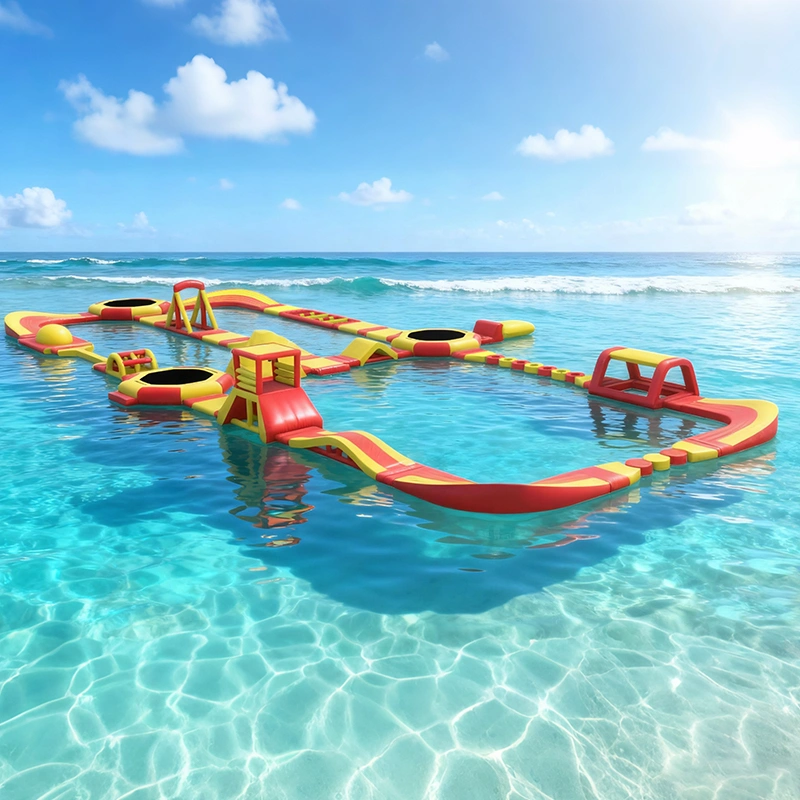
5 best floating water park layouts for massive ROI
Optimize capacity using smart Floating Water Park Layouts. Durable 0.9mm PVC designs for profitable lake businesses. Boost your rental revenue now!
Introduction
Let’s be real for a second. In the commercial water sports game, profitability isn’t about owning the flashiest gear on the market. It is fundamentally about flow efficiency.
I’ve seen way too many lake resorts drop a fortune on expensive equipment, only to arrange it like a chaotic puzzle. The result? Bottlenecks, annoyed guests, and ticket sales that tank.
If you are running a rental business in competitive spots like Florida, Spain, or the GCC, your layout is your logistics. There is no way around it.
Strategic Floating Water Park Layouts are the backbone of any successful commercial lake attraction. They dictate exactly how many heads you can get in the water per hour without compromising strict safety measures.
A bad design creates "dead zones" where guests basically never go, flushing your investment down the drain. On the flip side, a smart configuration keeps everyone moving.
At CH Inflatable, we’ve spent 17 years manufacturing and exporting to the US and Europe. We know exactly where durability meets design. We don’t just sell inflatables; we help you squeeze every dollar out of your park.
Here are the top 5 layouts designed for maximum guest throughput, CE EN14960 safety compliance, and operational durability.
The science of lake resort attraction planning
Understanding water depth and perimeter safety
Before we dive into shapes, we need to talk about lake resort attraction planning. Trust me, effective Floating Water Park Layouts have to adapt to your specific depth charts.
You can't just drop a high-tower diving obstacle in shallow waters unless you want a lawsuit. Safety zoning is critical. You have to segregate high-adrenaline zones from beginner areas.
- Shallow Zone (1.2m - 1.5m): Stick to simple balance beams and small slides here.
- Deep Zone (2.0m+): This is for climbing icebergs, high jumps, and giant slides.
- Perimeter: Always establish a safe buffer zone from the shore and boat traffic.
Throughput vs. dwell time
In this B2B industry, we talk a lot about "Throughput" (passengers per hour) versus "Dwell Time" (how long a guest gets stuck on one element).
If a guest spends ten minutes struggling on one ladder, they block the flow for everyone else. Your layout needs to balance active moving zones (slides, runways) with resting zones.
To better visualize how crowd flow impacts revenue in Floating Water Park Layouts, check out this simulation insights video:
1. The "circuit" layout: continuous flow for high traffic
Why the loop design wins for ROI
The "Circuit" is arguably the gold standard for high-volume commercial operations. It features a circular or oval track design where obstacles are connected in a loop.
This design kills bottlenecks because traffic moves in one continuous direction. Guests enter, traverse the course, and loop around again.
It stops those annoying "two-way traffic" jams you see on linear tracks. Effective commercial water obstacle configuration relies on placing obstacles sequentially—slide, then climb, then jump—to keep bodies moving.
Ideal for open water & busy weekends
This layout is a beast for rental businesses in tourist hotspots that get slammed with attendance surges. I’ve seen this work wonders in high-traffic beach resorts in France.
From my experience, a closed-loop circuit increases ticket sales by roughly 20%. Why? Because guests don't get stuck waiting in line for a single feature.
2. & 3. The "runway" and "hub-and-spoke" designs
The runway (linear) layout
The Runway layout looks exactly like it sounds—a long, straight line of obstacles. Think of it as an aquatic drag strip.
It’s the standard for time-trial obstacle course races. However, creating effective Floating Water Park Layouts means knowing your limits. If a slow participant blocks the path here, nobody moves.
The hub-and-spoke layout (central hub)
The Hub-and-Spoke design features a massive central feature—like a giant trampoline or mountain—with slides radiating outward like a wheel.
Lifeguards love this one. From the central high point, they can monitor multiple "spokes" at once, cutting down blind spots significantly.
If you are aiming for high capacity, you can use this layout to highlight the massive scale of the 150 persons inflatable floating water park. The central hub acts as a gathering point, while the spokes disperse the crowd into different activity zones.
4. The "modular grid": flexibility for business growth
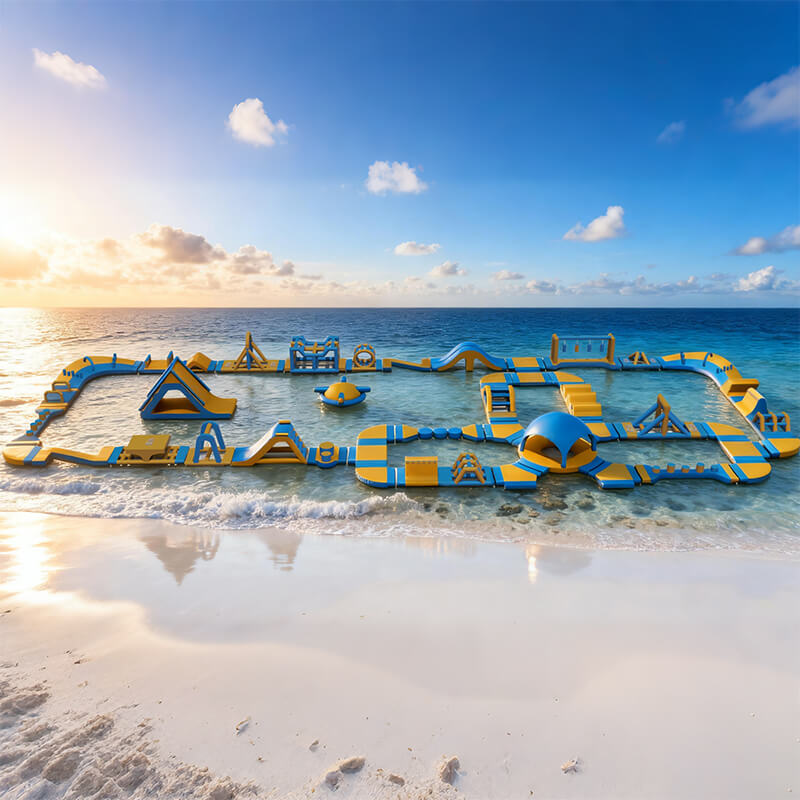
Scaling up with modular aqua park design
One question I get constantly from startups is, "Can I start small?" The answer is a massive yes, thanks to modular aqua park design.
We call this "Plug-and-Play." You don't need to buy a massive park on day one. You can buy standard elements—straight runways, corner turns—and connect them to create a grid.
This allows you to test the market with a smaller investment and expand your **Floating Water Park Layouts** year after year using your profits.
For visual inspiration on how diverse these grids can be, you can look at various examples here: Water Park Layout on Pinterest
Adapting to seasonal demands
The grid offers incredible operational flexibility. When the low season hits, disconnect a few sections to shrink the perimeter and save on guarding costs.
5. The "mega-complex" layout: the ultimate destination
Combining elements for maximum capacity
For the ultimate destination resort, we combine the Runway, Circuit, and Hub layouts into one giant "Mega-Complex." This is for operators targeting 100+ guests simultaneously.
Successful guest capacity management at this scale requires strict separation. You must have a designated "Kid Zone" separate from the "Adult X-Treme Zone."
This prevents larger adults from strictly colliding with children, which is a primary safety concern in mixed-use Floating Water Park Layouts.
A Mega-Complex isn't just big; it's tall. It incorporates high-ticket features like Giant Inflatable Slides and The Blob that act as billboards for your resort.
Technical specs: why material determines layout longevity
0.9mm 1300D PVC vs. the competition
Look, you can have the best Floating Water Park Layouts in the world, but if the material fails, your business sinks.
At CH Inflatable, we use strictly 0.9mm 1300D PVC. Many competitors try to cut costs by using 0.55mm PVC (meant for land bouncers) on water products. Here is the difference:
| Feature | Budget PVC (0.55mm) | CH Commercial PVC (0.9mm) |
|---|---|---|
| Application | Dry Land Bouncers | Open Water Parks |
| UV Resistance | Low (Fades quickly) | High (Treated coatings) |
| Air Tightness | Leaks over 24 hrs | Holds pressure for weeks |
| Lifespan | 1 - 2 Seasons | 5+ Years Commercial Use |
Anchoring details
A layout is only as good as its anchors. We use strategic "Anchor Mapping" to hold the shape against wind and waves.
We use marine-grade stainless steel D-rings. If your layout relies on cheap iron anchors, they will rust within a month. Your park will literally drift away.
For more community discussions on how park owners optimize their setups, check out this thread: r/waterparksimulator on Reddit
Frequently asked questions (FAQ)
How does the layout affect the safety of a floating water park?
Your choice of Floating Water Park Layouts is the main factor in safety management. A well-planned layout ensures proper spacing between obstacles to prevent collisions.
Plus, it allows for clear lines of sight. A circular or grid layout improves visibility for lifeguards, reducing blind spots. All our designs support compliance with EN14960 standards.
Can I expand my floating water park layout seasonally?
Absolutely. This is the beauty of modular aqua park design. All CH Inflatable products feature a universal connection system.
You can buy new sections—like extra slides or runways—and connect them to your existing park. It keeps your attraction fresh every season without buying a whole new system.
Wrapping it up
Choosing the right configuration from these 5 Floating Water Park Layouts—Circuit, Runway, Hub-and-Spoke, Modular Grid, or Mega-Complex—will directly influence your ticket sales.
Don't let a chaotic setup drain your profits. Operational success requires durable equipment that withstands the elements.
At CH Inflatable, we prioritize your long-term ROI. We utilize premium 0.9mm 1300D PVC and reinforced welding to ensure your investment lasts.
Ready to start? For smaller startups or those with budget constraints, you can begin with a base model like the Inflatable Floating Water Park and eventually expand it into a complex by adding more modules next season.
Contact CH Inflatable today for a free consultation and get a quote for durable, commercial-grade equipment.