
5 Vital Steps for Inflatable Aqua Park Anchoring

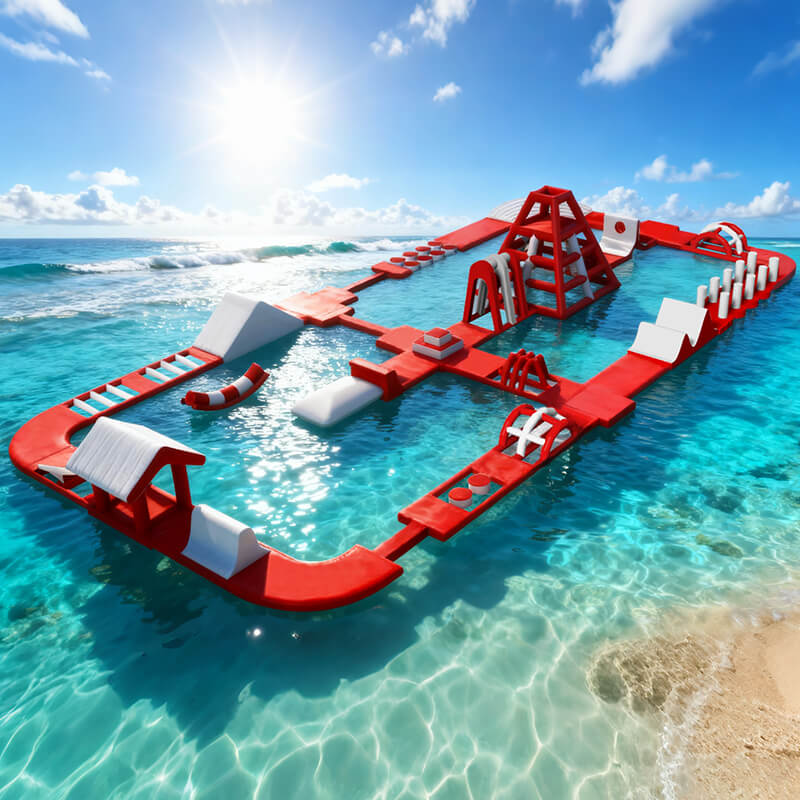
5 Vital Steps for Inflatable Aqua Park Anchoring
Secure your investment with expert Inflatable Aqua Park Anchoring. We use 0.9mm PVC and stainless steel D-buckles for ultimate stability. Boost safety now.
Introduction
Picture this scenario. You’ve dumped thousands of dollars into a massive floating playground. It is the peak of summer, and your park is packed with happy customers.
Suddenly, a gust of wind picks up. Your entire structure begins to drift, snapping lines and colliding with a nearby pier. That is the nightmare every rental business owner fears.
The difference between a profitable season and a liability disaster often comes down to one thing: Inflatable Aqua Park Anchoring. Stability is the backbone of safety in this industry.
At CH Inflatable, we have spent over 17 years manufacturing commercial-grade water parks. We have seen firsthand that even the highest quality inflatables can fail if the anchoring system is flawed.
Proper anchoring is not just a suggestion; it represents a hard requirement to comply with strict CE EN14960 standards.
Whether you are operating in the calm waters of a German quarry or the coastal tides of Spain, this guide is for you. We’ll cover everything from wind load calculation to selecting the right hardware.
Step 1: Environmental assessment and load calculation
Before you even drop a weight into the water, you need to understand the forces at play. I cannot stress this enough: guessing is not an option when dealing with Inflatable Aqua Park Anchoring.
Analyzing wind and water conditions
Your local geography dictates your stability requirements. The first thing we look at is the wind exposure.
Operators must perform a precise wind load calculation. This involves calculating the total drag force based on the height and surface area of the inflatables.
A tall slide acts like a sail. The higher it is, the more force it transfers to the anchor lines.
- Wind Speed: What are the maximum gust speeds in your area?
- Currents: Is the water stagnant (like a lake) or moving (like a river)?
- Fetch: In the biz, we talk about "Fetch." This is the distance wind travels over open water before hitting your park.
A long fetch allows wind to generate larger, more destructive waves. Even a moderate breeze over a long fetch can create wave energy that snaps inferior ropes.
Understanding seabed composition
Once we know what's happening above the water, we look below. Your seabed fixing methods must match the ground composition.
To give you a clearer picture, here is a breakdown of common seabed types and the anchoring strategy required:
| Seabed Type | Best Anchor Method | Why? |
|---|---|---|
| Sandy Bottoms | Helical Screws or buried Deadweights | Sand shifts easily; burying provides necessary friction. |
| Mud / Silt | Manta Ray Anchors | Deep penetration is easy, creating a suction effect for holding power. |
| Rocky Bottoms | Gravity Anchors (Concrete) | Penetration is impossible. You need pure mass to hold the line. |
For a broader perspective on how different locations handle these systems, you can review general Inflatable Aqua Park Systems for Waterfronts. However, remember that your specific site needs a custom verified plan.
Step 2: Selecting the correct anchor weights
A common mistake I see among new rental entrepreneurs is underestimating weight. A 50lb dumbbell isn't going to hold a 3-ton water park. Effective Inflatable Aqua Park Anchoring relies on mass and friction.
Concrete block anchors (deadweights)
For 90% of our clients, underwater concrete ballasts are the gold standard. Concrete is reliable, cheap, and acts as a "deadweight."
Unlike localized anchors that rely on gripping the soil, concrete relies on pure mass.
- The Safety Factor: We recommend a minimum safety factor of 2:1.
- The Math: If your wind load calculation suggests you need 500kg of holding power, drop 1000kg of concrete.
It is always better to over-anchor than under-anchor. I have never heard a client complain that their park was "too stable."
Helical screws and manta ray anchors
Sometimes, concrete isn't feasible. Regulations might block it, or logistics might get in the way.
In these cases, we look at alternative marine grade mooring systems.
- Helical Screws: Great for sandy or clay bottoms. They screw into the seabed.
- Manta Ray Anchors: These toggle open under the seabed, creating a lock.
Just keep in mind these usually require professional divers. Concrete blocks can often just be dropped from a barge.
Step 3: Hardware and connection lines quality
You can have a 2-ton anchor, but if the connection line snaps, your park is gone. This is where Inflatable Aqua Park Anchoring becomes a science of materials.
The importance of shock absorption
Never use a static rope directly from the anchor to the inflatable. The ocean moves. The park moves.
If the line is rigid, that energy has to go somewhere. Usually, it rips the D-ring right off your expensive inflatable.
This is why bungee cord tensioning is vital. We insert a heavy-duty bungee section into the anchor line favoring elasticity. This absorbs the shock of waves.
Why material quality matters (CH Inflatable USP)
At CH Inflatable, we don't cut corners. While many competitors use 0.55mm PVC (standard for dry bounce houses), we use 0.9mm 1300D PVC for all our water park items.
Why? Because water environments are harsh. Furthermore, rusty metal is a safety hazard.
We have upgraded all our anchor points to Stainless Steel D-buckles. These are rust-proof and corrosion-resistant. This is non-negotiable for long-term Inflatable Aqua Park Anchoring.
If you are looking for equipment that utilizes these high-spec materials, check out our Inflatable Obstacle Course for Pool. It features the same robust anchoring points we use on massive open-water parks.
Looking at the specs, you'll see why thicker PVC matters for longevity.
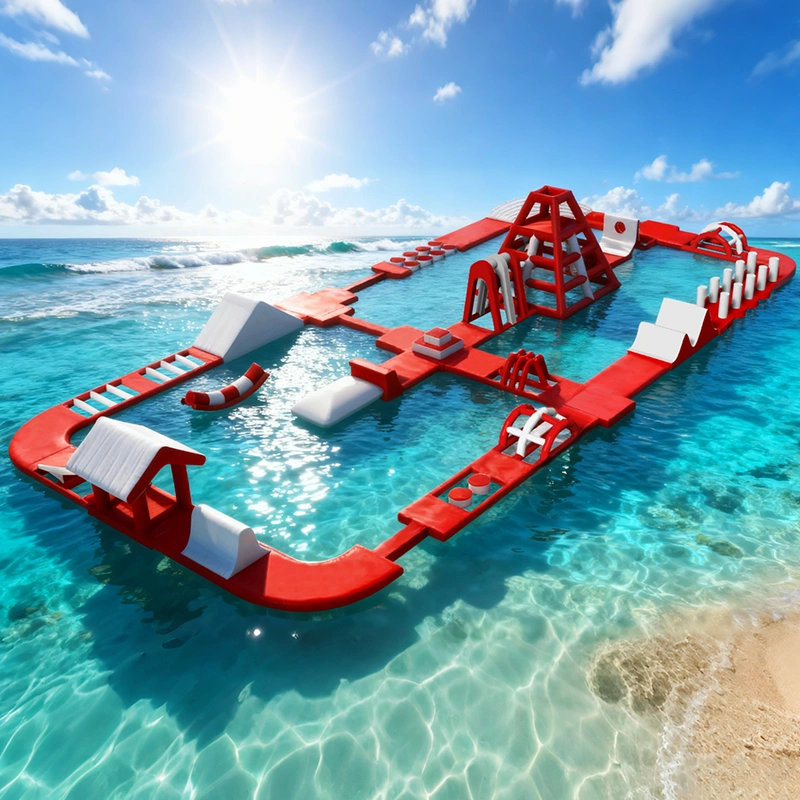
Step 4: Deployment and triangulation logic
Dropping an anchor straight down is a rookie mistake. Professional installation requires geometry.
The 45-degree rule and scope
To maximize holding power, we follow the "Scope Ratio." Ideally, the line should pull at a 45-degree angle or less relative to the seabed.
If you anchor vertically (90 degrees), you are pulling the anchor straight up off the bottom. By angling the line, you dig the anchor deeper.
Creating a stable floating grid
For large commercial parks, we don't just anchor each piece individually. We triangulate.
We connect multiple modules to ensure the whole park moves as one cohesive unit. This distribution of force means that if one anchor point is stressed, the others help support the load.
In my experience, never anchor directly vertically unless the water is extremely shallow. It creates excessive uplift force on the D-rings.
You can see examples of complex park layouts at America's Largest Inflatable Water Park, Wisconsin Dells. Notice how the massive structures require precise positioning to maintain their shape.
Step 5: Inspection, maintenance, and safety standards
Inflatable Aqua Park Anchoring is not a "set it and forget it" task. It requires eyes on the prize, constantly.
Routine checks for commercial operators
We advise our rental business clients in the USA and Europe to perform daily startup checks.
Your Daily Checklist:
- Webbing Wear: Check for fraying. CH Inflatable uses automotive seatbelt-grade webbing.
- Corrosion: Inspect D-buckles. Even stainless steel should be cleaned of organic buildup.
- Drift: Has the park moved overnight? If so, an anchor is dragging.
Adapting to water level fluctuations
If you operate in a tidal zone or a reservoir, your Inflatable Aqua Park Anchoring system must be adjustable.
As the water level rises, your anchor lines become tighter, potentially pulling the inflatable under. As water drops, lines become slack.
For versatile setups that handle these changes well, consider the engineering behind our Mobile Water Theme Park for Children, designed for rapid deployment and adjustment.
To better understand the scale and stability required for Inflatable Aqua Park Anchoring, this video tutorial is highly recommended:
https://www.youtube.com/watch?v=7dFgMdTPgno
Frequently Asked Questions (FAQ)
How much weight is required per anchor point for stability?
This depends entirely on your wind load calculation. Generally speaking, for commercial parks, we recommend between 300kg to 1000kg per major anchor point.
Corner pieces and tall slides require the heaviest weights (often 1000kg+). Smaller runways might only need 300-500kg. Always call an engineer before deciding.
What is the minimum water depth for safe anchoring?
Safety clearance is priority number one. For high slides or jumping towers, you typically need a minimum depth of 2.5 meters (approx 8 feet).
However, regarding Inflatable Aqua Park Anchoring, deeper water actually helps. It allows for a better scope ratio and more effective bungee cord tensioning.
Can I use sandbags for open water park fixing?
Short answer? No.
Sandbags are what we call "Temporary Ballast" for pool parties. They are totally insufficient for open water. They lack the density.
Sandbags shift, tear, and lose weight. For a commercial setup, you must use underwater concrete ballasts or professional marine grade mooring systems. Don't gamble with your insurance.
Conclusion
Securing your water park isn't just about keeping it in one place. It is about protecting your business reputation and the lives of your customers.
Long story short, successful Inflatable Aqua Park Anchoring requires assessing your seabed and using heavy underwater concrete ballasts.
You need to invest in quality hardware like our stainless steel D-buckles and use bungee cord tensioning. Finally, keep checking that webbing.
Don't let poor anchoring turn your investment into a liability nightmare.
Ready to build a safe and profitable water park? Contact CH Inflatable today for a custom quote on CE-certified water parks equipped with the industry's strongest anchoring systems. We support customization for rental businesses worldwide!
Image by: Kindel Media
https://www.pexels.com/@kindelmedia