Master Inflatable Obstacle Course Operations: 5 Hacks

Master Inflatable Obstacle Course Operations: 5 Hacks
Running a successful rental business is about much more than just buying inventory and hoping the phone rings. It implies mastering the complex logistics of deployment, safety, and flow.
Whether you are managing a high-stakes corporate team-building day in Germany or a massive community festival in the USA, Inflatable Obstacle Course Operations can be the bottleneck. It either breaks your profitability or becomes the engine that drives it.
In my 17 years in the industry, I have seen too many rental companies fail. Not because they lacked good gear, but because they lacked a plan. In this guide, we dive deep into the specific operational hacks that streamline your workflow.
We are specifically focusing on high-traffic event management. From understanding the critical nuances of EN14960 Safety Standard compliance to leveraging specific manufacturing advantages, we will show you how to win. Using materials like our 0.55mm 1300D PVC turns daily operations into your sharpest competitive edge.
The foundation: prioritizing safety standards and certifications
Safety isn't just a legal requirement you check off a list. It is the currency of trust that your business trades in every single weekend.
If you want to master Inflatable Obstacle Course Operations, you must start with the hardware's compliance. There is no way around it.
Navigating the EN14960 Safety Standard
For our clients in Europe and global markets, adherence to the EN14960 Safety Standard is non-negotiable. This standard dictates strict rules. It covers everything from the number of anchor points to the flammability of the materials.
When you purchase from CH Inflatable, you align your operations with safety completely. Our units come with CE and UL/SGS material certifications. This ensures that when a safety inspector shows up at your event, you pass without hassle.
In the industry, we often talk about "Tagging out." This is when an inspector shuts down a unit immediately because it lacks a visible PIPA tag or CE mark.
To avoid this operational nightmare:
- Ensure every unit has a dedicated logbook on site.
- Verify the flame retardant properties of your PVC personally.
- Check that your manufacturer provides the correct wind rating documentation.
Why material specification matters for operations
Operational efficiency drops to zero when repairs are needed on-site. Nothing kills the vibe of an event faster than a seam bursting mid-day. It’s a disaster.
We explore why using 0.55mm 1300D PVC (and 0.9mm for water units) reduces downtime significantly. Cheap units use lower denier fabrics. These delaminate after just a few seasons of folding and unfolding.
CH Inflatable feature highlights:
- Double Stitching: We use twin needles for all structural seams.
- Reinforced Corners: Quadruple stitching at high-stress points.
- Material Science: Our PVC is strictly resistant to tearing and fading.
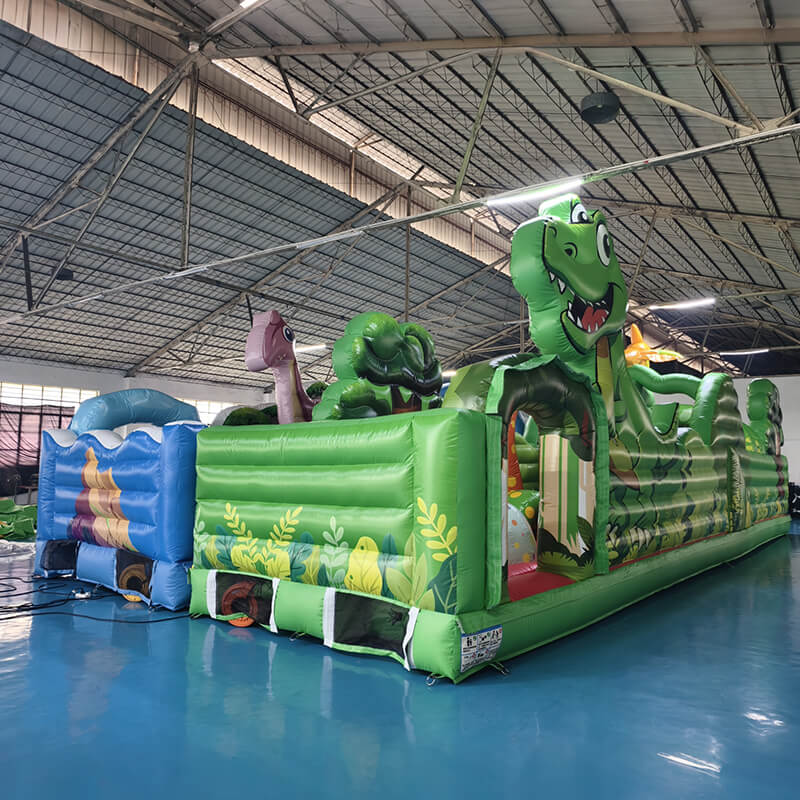
If you are running complex units, material quality is paramount. For example, check out our Forest Dinosaur Themed Inflatable Obstacle Castle. This unit involves complex shapes and high-stress climbing areas that require the highest material standards to maintain operational uptime.
Having a unit like this as the centerpiece of your event attracts huge crowds, but it demands robust construction to handle the constant friction and weight loads.
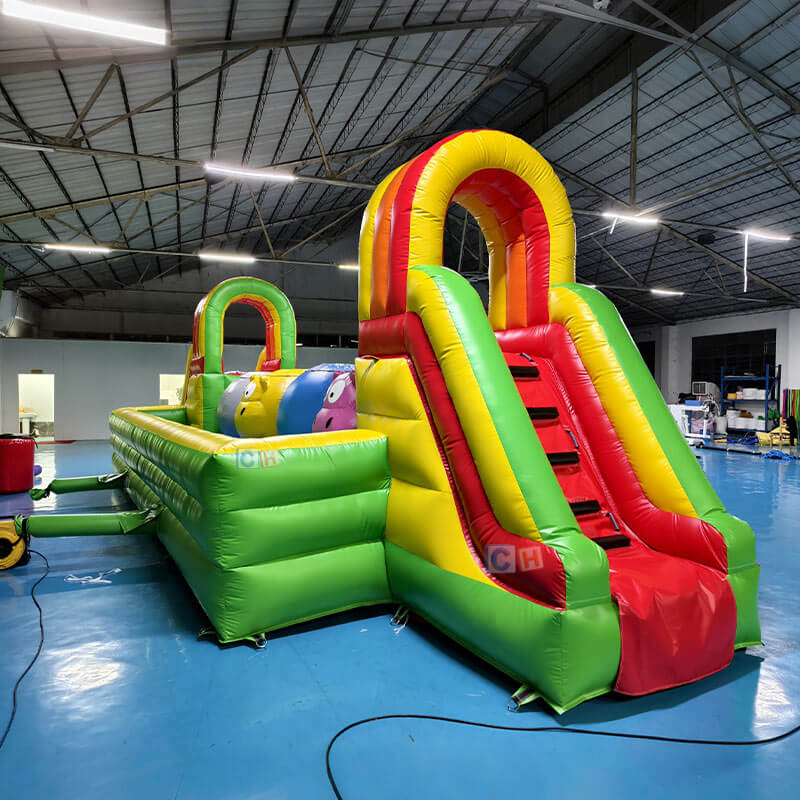
Hack 1: optimizing throughput capacity planning
One of the biggest profitability killers in the rental game is a slow-moving line. Throughput capacity planning is the art of moving participants through safely.
It’s about getting as many people through the course in the shortest amount of time without compromising safety.
Designing layouts for continuous flow
When purchasing, you need to think about flow. Single-lane obstacle courses are cheaper upfront. However, they cut your throughput in half.
Operational comparison:
- Single Lane: 60-100 participants per hour.
- Dual Lane: 200-300 participants per hour (induces racing, which speeds people up).
For large festivals, you must choose multi-element designs that prevent bottlenecks. To see how different configurations affect footprint, look at standards like those at Inflatable Obstacle Courses - USA made Commercial Inflatables - eInflatables. Understanding these layouts helps you plan your site map effectively.
Identifying and eliminating choke points
You need to analyze your Inflatable Obstacle Course Operations to spot where kids or adults get stuck.
Common Choke Points:
- The Squeeze: Tight tunnels often scare younger children.
- The Apex: The top of the slide is where hesitation happens.
I often tell clients: "Throughput is currency. If your line stops for 5 minutes every hour, you lose 8% of your daily revenue potential."
The Hack: Place your most energetic staff member at the top of the climb (the apex). Their job is to encourage participants to slide down immediately, keeping the flow moving.
Hack 2: extending lifespan with reinforcement webbing technology
Durability directly impacts your operational bottom line. If you have to replace a unit every two years, your ROI is destroyed. Investing in the right manufacturing details saves you money.
The science of reinforcement webbing technology
At CH Inflatable, we do not cut corners. We utilize **Reinforcement webbing technology** that is comparable to automotive seat belts.
We sew this webbing over the seams at the base of obstacles and along the slide covers. This strengthens the stress points significantly.
When 200 kids jump on a bouncer in an hour, that webbing absorbs the kinetic energy. Without it, that energy would simply rip the PVC apart.
| Feature | Standard / Budget Operator | Pro Operation (CH Inflatable) |
|---|---|---|
| Stitching | Single stitch, exposed seams | Double/Quadruple stitch + Webbing |
| Deflation | Slow, standard zipper | YKK Zippers + Rapid open vents |
| Anchoring | Rusted iron D-rings | Stainless Steel D-Buckles |
| Safety Standard | Often non-compliant | EN14960 Safety Standard Certified |
Hardware that handles the stress
It is the small details that cause operational headaches. Have you ever had a zipper break during pack-up? It is a nightmare scenario.
CH Inflatable Hardware Upgrades:
- Stainless Steel D-Buckles: We upgraded to stainless steel. It is waterproof, rustproof, and prevents the corrosion that weakens anchor points over time.
- YKK Zippers: We only use YKK. They are high-strength and resist deformation under pressure.
To better understand the mechanics and excitement behind Inflatable Obstacle Course Operations, and to see how quality materials perform in action, check out this reel:
https://www.instagram.com/reel/DS0ptx8kjkl/
Hack 3: mastering anchor point verification and set-up
The setup phase dictates the safety of the entire event. Improper anchoring is the leading cause of inflatable accidents globally. Mastering Inflatable Obstacle Course Operations means mastering the stake.
Protocols for anchor point verification
You must have a strict checklist for Anchor point verification before inflation begins. Don't skip this step.
The Setup Protocol:
- Angle Matters: Stakes should be driven in at a 45-degree angle away from the unit.
- Indoor Operations: Use sandbags or water barrels. Ensure the weight matches the wind load calculation (usually 163kg per anchor point minimum for outdoors).
- The Tug Test: A supervisor must physically check every D-ring connection before the blower is turned on.
Efficient blower management
Using the right blower prevents "soft" units. A soft obstacle course is dangerous because ankles get twisted in the slack material.
Feature Highlight:
CH Inflatable provides HW Blowers. These are CE Certified and energy-efficient. They are paired specifically to the cubic volume of your unit to ensure firm pressure.
For a look at a unit that requires precise air pressure management, consider our standard Commercial bounce house obstacle course. Proper blower setup on these units is critical to maintaining the structural integrity of the walls during use.
Hack 4: staffing strategies for high-traffic event management
An obstacle course without proper supervision is a liability waiting to happen. Efficient staffing ensures smooth Inflatable Obstacle Course Operations.
Calculating staff-to-participant ratios
How many operators do you really need? It depends on the design, but don't understaff.
The "Carny Count" (Staff Positioning):
- Entrance (The Gatekeeper): Controls the pulse. Checks for sharp objects, glasses, and shoes.
- The Transition (The Spotter): Located at the most difficult obstacle. Helps participants up and over.
- The Exit (The Clearer): Ensures participants leave the landing zone immediately to prevent collisions.
For high-traffic event management, you need a minimum of 1:10 ratio for active participants. However, staff position is more important than raw numbers.
Training staff on emergency deflation
Standard Operating Procedures (SOPs) for rapid deflation are vital.
The Scenario: High winds hit suddenly.
The Action:
- Evacuate: Blow the whistle. Clear the unit.
- Cut Power: Turn off blowers.
- Open Vents: Unzip the YKK deflation zippers immediately.
- Secure: Ensure the unit collapses inward, away from the crowd.
Hack 5: commercial considerations and market positioning
To run a successful operation, you must understand the market landscape. You need to know wholesale pricing dynamics. You are not just an operator; you are a business owner.
Sourcing for ROI
Understanding the balance between cost and quality is tricky. You want affordable gear, but "cheap" gear breaks.
When researching market rates, you can see wholesale pricing structures at sites like Inflatable Obstacle Courses For Sale | See Wholesale Pricing. Use this to compare against factory-direct custom options. You will often find that purchasing direct from manufacturers like CH Inflatable offers better margins.
Customization as an operational asset
One major operational hack is fit. Many venues (like school gyms) have height restrictions.
CH Inflatable Customization:
We allow rental owners to build courses that fit specific venue sizes. If you know all the local gyms have a 15ft ceiling, ordering a 14ft unit is smart.
It makes you the only provider who can service those winter events. In my experience, don't just buy off the shelf. Customizing your unit's dimensions to fit standard school gymnasiums can double your winter booking rate.
This is how you use Inflatable Obstacle Course Operations strategy to boost sales.
Frequently asked questions (FAQ)
How do I manage crowds on a large obstacle course?
Crowd control is part of high-traffic event management. Utilize fencing to create snake queues (like at an airport) leading to the entrance. Implement a "pulsed" entry system. Send pairs of racers every 30 seconds rather than a continuous stream. This keeps a safe distance between jumpers inside the unit.
What are the best staffing ratios for commercial inflatable courses?
The general rule is 1 trained operator per unit. However, for large Inflatable Obstacle Course Operations, aim for a minimum of two. Have one operator at the entrance and one at the exit to ensure the landing zone is clear. For units with high slides (over 15ft), a third spotter at the top is recommended.
Can obstacle courses be operated safely in windy conditions?
No. Strictly adhere to EN14960 Safety Standard limits. The maximum wind speed is usually 24 mph (38 km/h). Always use a handheld anemometer on-site. If the wind gusts exceed this, you must deflate immediately. Do not rely on weather apps; local conditions vary.
Wrapping it up
Mastering Inflatable Obstacle Course Operations requires a blend of rigor and smarts. You need safety protocols, smart throughput capacity planning, and high-quality gear.
By leveraging Reinforcement webbing technology and adhering to strict Anchor point verification checklists, you ensure success. Your events become safe and profitable.
It is about being proactive rather than reactive. CH Inflatable brings 17 years of manufacturing expertise to your business. We offer 0.55mm PVC durability, CE-certified HW blowers, and custom designs.
Ready to upgrade your inventory with high-efficiency, durable obstacle courses? Contact CH Inflatable today for a custom quote and elevate your event operations.
Image by: Михаил Крамор
https://www.pexels.com/@vantik93