Master Commercial Obstacle Course Durability: 3 Rules

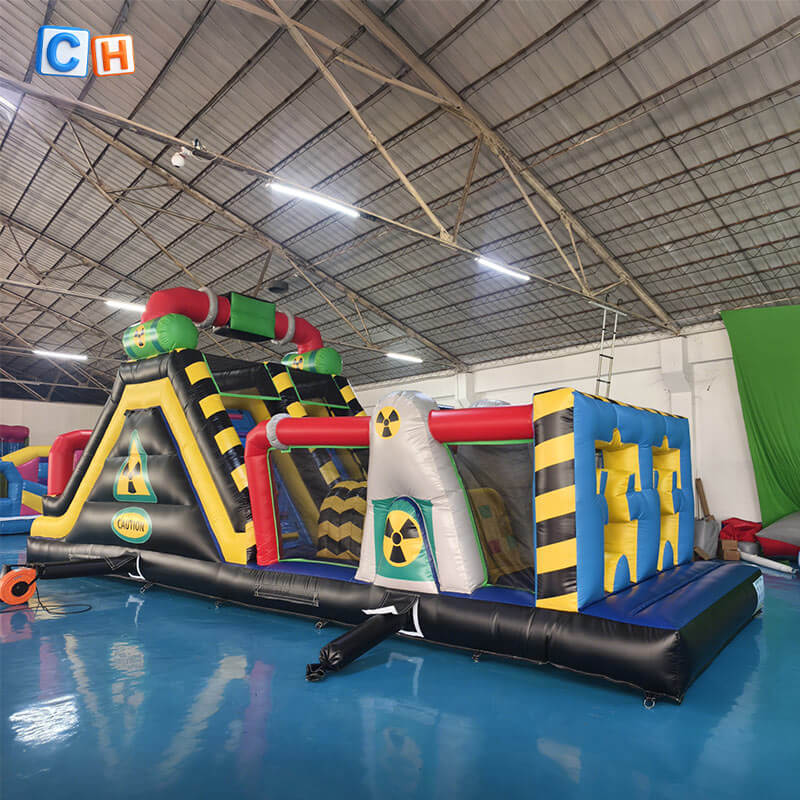
Master commercial obstacle course durability: 3 rules to profit
Picture this scenario. It’s the peak of July, hotter than asphalt at noon. You have a corporate gig booked with 500 attendees relying on your entertainment.
Suddenly, midway through the event, your main attraction—a massive obstacle course—suffers a catastrophic seam blowout. The structure collapses. Safety is compromised.
Worst of all? Your reputation takes a nosedive right along with the vinyl. This is the rental business owner’s absolute nightmare.
In the high-stakes world of event planning, equipment failure isn't just a hassle; it is a direct hit to your bank account. I have seen too many rental companies try to save cash upfront on cheaper units.
They usually end up spending double on repairs and losing repeat clients. To secure a long-term ROI, you must prioritize Commercial Obstacle Course Durability above everything else.
It is the single most important metric for profitability. At CH Inflatable, we have spent 17 years refining heavy-duty manufacturing. From the USA to Europe, our clients know durability isn't an accident—it’s engineered.
Here involves the "3 Golden Rules" of durability: Material Science, Precision Engineering, and the Hardware Ecosystem. Mastering Commercial Obstacle Course Durability is how you turn a one-time rental into a decade of profit.
Rule 1: Material science – why 1300D PVC tarpaulin is non-negotiable
The foundation of any inflatable is the fabric itself. If the base material cannot withstand the friction of thousands of children (and adults) climbing, sliding, and bouncing, the stitching method frankly doesn't matter.
In my experience, the biggest mistake new rental owners make is confusing "consumer-grade" vinyl with "commercial-grade" tarpaulin.
The myth of standard vinyl vs. 1300D PVC
Look, not all vinyl is created equal. Standard nylon or lightweight vinyl found in big-box stores is designed for occasional backyard use.
It lacks the tensile strength required for true Commercial Obstacle Course Durability. At CH Inflatable, we strictly use 1300D PVC tarpaulin.
- Thickness Matters: For land-based obstacle courses, we utilize a 0.55mm thickness. This beats the perfect balance between weight (for transport) and tear resistance.
- Water Park Specs: If you are looking at a water park or slip and slide, we upgrade the material to 0.9mm 1300D PVC to handle the extra weight of water.
- Safety Standards: Our materials meet rigorous UL and CE/EN14960 standards for fire retardancy.
When you invest in heavy-duty renting gear, you are paying for the internal mesh scrim of the PVC. The "1300D" refers to the density of the internal weave.
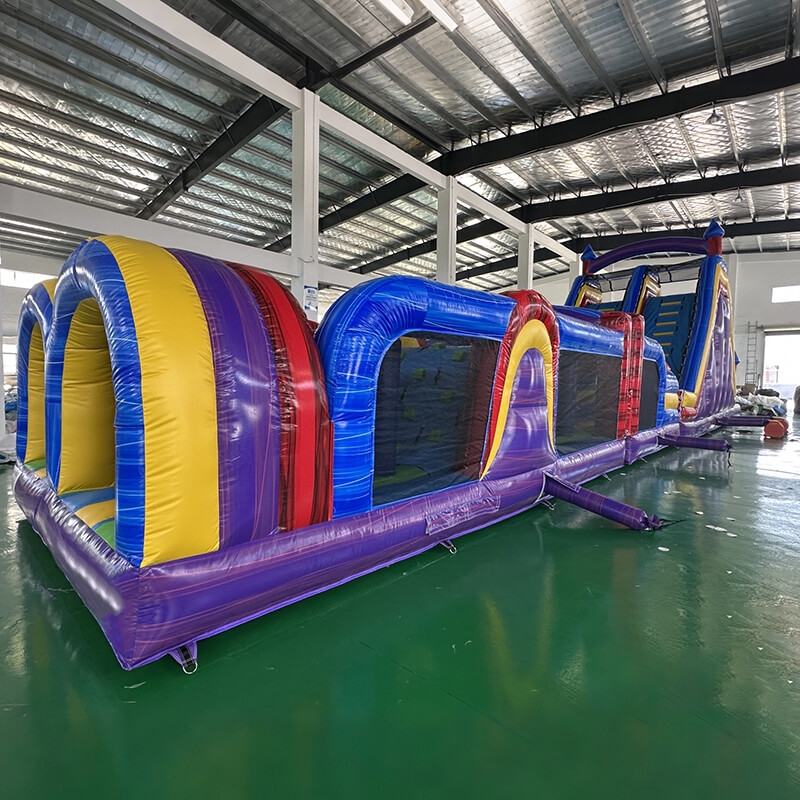
This is what prevents a small puncture from becoming a massive tear. You can see this material quality in action on our massive units, like the Giant 68ft commercial inflatable obstacle course.
Weather resistance and UV protection
Rental equipment lives outside. It battles the scorching sun in Spain, the rain in London, and the humidity in Florida. Commercial Obstacle Course Durability depends heavily on how the material reacts to UV radiation.
Cheap vinyl becomes brittle and cracks after one season of sun exposure. Our 1300D PVC features a specialized UV-resistant coating. This prevents the "chalking" effect where color fades and fabric weakens.
As our Production Manager often says, "The sun is the enemy of profit. Our UV coating buys you three extra years of rental life."
Rule 2: Precision engineering & reinforced vinyl stitching
You have the best material. Now, how do you put it together? This brings us to engineering.
Achieving superior Commercial Obstacle Course Durability requires combatting "Seam Fatigue." This acts as the silent killer of inflatables.
It occurs when air pressure expands the needle holes over time, causing the unit to become soft and bouncy performance to tank.
Double vs. quadruple stitching techniques
At CH Inflatable, we don't just sew; we engineer structure.
- Double Stitching: We use double stitching everywhere on the unit. This is the industry standard for non-stress areas.
- Quadruple Stitching: This is where we differ from the budget manufacturers. We apply quadruple stitching at the bottom stress points.
By using reinforced vinyl stitching, we ensure that the air pressure remains consistent. If an inflatable loses pressure too fast, the blowers work harder, and the fun stops.
Preventing blowouts with high-traffic seam sealing
Where do kids bounce the most? The center of the mattress and the entry/exit ramps. These are "High-Traffic Zones."
To maximize Commercial Obstacle Course Durability, we use high-traffic seam sealing techniques.
We add an extra layer of PVC strip at the joint where the mattress meets the wall. This takes the tension off the threads and places it on the strip.
Every corner is a potential weak point. We reinforce these internally and externally. I have seen competitors' units split right at the floor seam because they didn't smooth out the stress distribution.
For a broader look at market options, you can compare different structural approaches. Sites like Happy Jump showcase various obstacle course designs to benchmark structural standards.
Rule 3: The hardware ecosystem – zippers, anchors, and blowers
Durability isn't just about big fabric panels. Often, it is the small hardware components that cause the biggest headaches.
A rusted D-ring or a broken zipper can render a $3,000 unit useless quicker than a hole in the floor.
Stress point D-rings and anchoring safety
Safety is paramount. The only thing keeping your inflatable on the ground during a gust of wind is the anchoring system.
We have upgraded our anchoring hardware to ensure maximum Commercial Obstacle Course Durability.
- Stainless Steel D-Buckles: Unlike standard galvanized steel that rusts after a few rainy events, our stainless steel D-buckles are rust-proof.
- Automotive Grade Webbing: The strap that holds the D-ring is the same material used in car seatbelts.
Stress point D-rings are properly triangulated to distribute the load. This ensures they don't rip out of the vinyl during high winds.
The importance of YKK zippers and CE blowers
Air management is the heart of the inflatable. We use genuine YKK zippers for all deflation flaps. They are high-strength and resist deformation.
Cheap zippers jam or break, making it impossible to pack the unit away efficiently. We also bundle our units with HW brand blowers.
You can see how hardware influences design variety. For example, check out the specs on other platforms like XJUMP alongside our own to understand quality variances.
ROI analysis: investing in heavy-duty renting gear
Let’s talk numbers. Why should you pay for Commercial Obstacle Course Durability features? It comes down to ROI (Return on Investment).
Here is a quick breakdown of why going cheap is expensive:
| Feature | Generic Unit (Budget) | CH Inflatable (Commercial) |
|---|---|---|
| Material | Standard Vinyl (Low Denier) | 1300D PVC Tarpaulin |
| Lifespan | 2 Seasons | 5-8 Seasons |
| Stitching | Single/Double | Reinforced Vinyl Stitching (Quad) |
| Maintenance Cost | High (Frequent Patching) | Low (Rare Repairs) |
| Estimated Profit | $6,000 Lifetime | $18,000+ Lifetime |
Investing in heavy-duty renting gear like 1300D PVC units lowers your "Total Cost of Ownership." You aren't just buying a product; you are securing an income stream.
Versatility in rental inventory
When you have equipment that you trust, you can rent it out for more intense events. Think teenage parties, corporate team building, and festivals.
Durable gear allows you to command higher ticket prices. You can also expand your offerings. For instance, you can diversify your inventory with durable add-ons like the Inflatable cartoon dry slide.
Maintenance and care for long-term durability
Even the strongest Commercial Obstacle Course Durability features need help from you, the operator. To get 8+ years out of your unit, follow these rules.
First, never roll up a wet inflatable. Mold rots the threads faster than anything else. Second, clean softly using non-corrosive cleaners.
Third, always use a ground sheet to protect the bottom vinyl from rocks and abrasion.
DIY vs. commercial standards
There is a massive difference between backyard DIY projects and commercial setups. While DIY can be fun, it is not a business model.
Frequently Asked Questions (FAQ)
How long do commercial obstacle courses survive in high-traffic events?
With a high-quality build focused on Commercial Obstacle Course Durability, specifically using 1300D PVC like CH Inflatable units, you can expect a lifespan of 5 to 8 years. This significantly outperforms standard vinyl units, which often fail after 2 to 3 years of heavy use.
Why is 1300D PVC better than standard vinyl for rentals?
1300D PVC tarpaulin is superior because of its internal mesh density. It offers higher tensile strength (tear resistance) and better adhesion for coatings. It complies with strict safety codes (EN14960) and resists UV degradation much better than standard consumer vinyl.
What maintenance extends the life of inflatable courses?
To maximize Commercial Obstacle Course Durability, ensure the unit is bone dry before rolling it to prevent mildew (which eats stitching). Extensive use of ground sheets protects the base. Additionally, regularly inspect stress point D-rings and reinforced seams for any early signs of wear.
Wrapping up
Mastering the rental business requires mastering your equipment. By adhering to the 3 Rules of Commercial Obstacle Course Durability—Superior 1300D Material, Reinforced Stitching Engineering, and Premium Hardware—you safeguard your investment.
Don't let a blown seam ruin your reputation. Choose gear that works as hard as you do.
Ready to upgrade your rental fleet with gear that lasts?
At CH Inflatable, we combine 17 years of manufacturing expertise with top-tier materials like YKK zippers and stainless steel anchors. Contact us today for a quote on our custom obstacle courses and slides. We ship globally to the USA, Europe, and beyond.
Image by: Tima Miroshnichenko
https://www.pexels.com/@tima-miroshnichenko