
Premium Commercial Inflatable Obstacle Course for Rental Profits & Adult Events

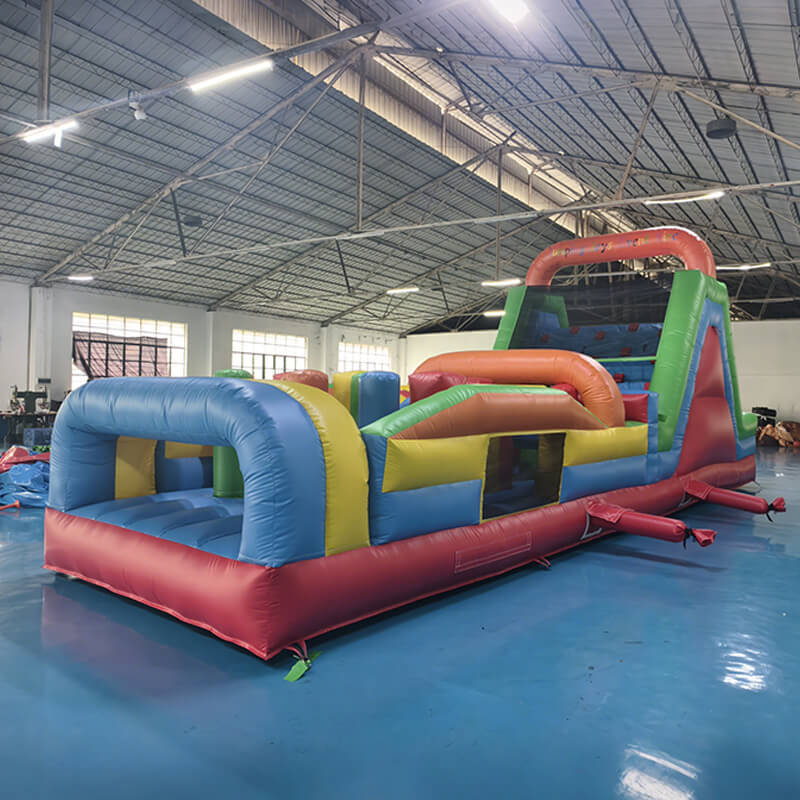
Industrial SEO Guide Blueprint: Premium Commercial Inflatable Obstacle Course for Rental Profits & Adult Events
1. Hook & Dual-TOC Plan
In the highly competitive B2B event rental market, maximizing ROI means investing in attractions that offer high player throughput, universal demographic appeal, and unyielding structural durability. The commercial inflatable obstacle course has rapidly evolved from a niche carnival attraction into a cornerstone asset for rental companies, corporate team-building events, and adult sporting festivals. Unlike standard bounce houses, these multi-lane, high-velocity structures are engineered to handle heavy foot traffic, aggressive adult play, and diverse environmental conditions, translating directly into higher booking rates and repeat clientele.
This comprehensive industrial guide is architecturally designed to provide rental operators, event planners, and FEC (Family Entertainment Center) managers with a deep-dive analysis into the engineering, material science, and operational profitability of commercial-grade inflatables. Here's the deal: from understanding the tensile strength of 0.55mm Plato PVC tarpaulin to calculating the revenue-per-square-foot of multi-challenge courses, this blueprint equips you with the technical knowledge required to scale your rental fleet and dominate your local market. Explore our flagship models below to see how strategic design directly impacts your bottom line.
Table of Contents
The Evolution of the Commercial Inflatable Obstacle Course
The landscape of temporary entertainment structures has undergone a massive transformation over the past three decades. What began as a simple, sealed vinyl structure for children's backyard entertainment has now morphed into a highly sophisticated, continuously inflated architectural ecosystem designed for extreme physical exertion and industrial-level wear. In the shop, we see this evolution firsthand. Understanding this progression is critical for B2B operators who need to assess structural capabilities and market demands accurately.
From Residential to Commercial-Grade
The fundamental difference between a residential bounce house and a commercial inflatable obstacle course lies in the engineering tolerances and material specifications. Early residential models relied on lightweight nylon or thin Oxford cloth, which lacked the tensile strength required for continuous, high-impact use. These materials were prone to rapid delamination and tearing when subjected to the shear forces generated by multiple moving bodies. Look, you can't put adults on that kind of fabric and expect it to last the weekend.
As demand grew for more durable carnival and festival attractions, manufacturers transitioned to heavy-duty PVC tarpaulin. This shift allowed for the creation of massive, multi-segmented structures held aloft by continuous positive pressure generated by high-CFM blowers. The modern commercial inflatable obstacle course is no longer just a bouncing platform; it is a complex pneumatic structure featuring steep climbing gradients, constrained crawl tunnels, and high-velocity descent slides. For a comprehensive historical overview of how these pneumatic structures developed, you can refer to this resource on Wikipedia.
The Rise of Adult Corporate Events
A major catalyst for the rapid advancement in inflatable engineering was the sudden influx of the adult demographic into the market. Event planners began shifting away from passive entertainment, seeking active, competitive experiences for corporate team-building exercises and adult sporting festivals, often drawing inspiration from endurance events like "Tough Mudder." This required a radical redesign of the standard inflatable obstacle course. You can't just scale up a kids' toy and call it a day; the physics change entirely.
Adults exert significantly higher kinetic energy and static load forces than children. Modern commercial obstacle courses designed for mixed demographics feature higher vertical clearances to accommodate taller participants, wider lane spacing to prevent collisions, and heavily reinforced stress points. The inclusion of dual-lane racing features was a direct response to the adult market's desire for competitive, head-to-head metrics. By allowing two participants to navigate the course simultaneously, operators could facilitate tournament-style events, dramatically increasing the engagement level and perceived value of the rental asset.
Engineering & Material Science Behind Premium Inflatables
To an untrained eye, an inflatable obstacle course might simply look like a brightly colored balloon. However, from an industrial engineering perspective, it is a highly stressed pressure vessel. Every seam, anchor point, and material choice must be calculated to withstand dynamic loading, environmental degradation, and continuous mechanical stress. Let's break down the science of these units.
The 0.55mm Plato PVC Standard
The structural backbone of any premium commercial inflatable obstacle course is the material. We exclusively utilize 0.55mm Plato PVC tarpaulin, which has become the undisputed industry benchmark for commercial applications. This material is not merely a simple plastic sheet; it is a composite matrix. It consists of a high-tenacity polyester base fabric that is sandwiched between two layers of polyvinyl chloride coating.
This construction yields a material with exceptional tear strength and puncture resistance. The polyester scrim prevents propagation of tears if the outer layer is compromised, while the PVC coating provides inherent flame retardancy, UV resistance, and a lead-free composition. The 0.55mm thickness provides the optimal balance between structural rigidity—ensuring the walls of the climbing ramps do not bow under load—and flexibility, allowing the structure to absorb impact energy without fracturing. Here are the core benefits of this specific PVC grade:
- ✅ Tear Propagation Resistance: The internal woven scrim stops rips dead in their tracks, saving the unit from catastrophic failure during a high-traffic event.
- ✅ Weatherability: Handles intense solar UV radiation without breaking down, chalking, or becoming brittle over years of outdoor exposure.
- ✅ Chemical Stability: Lead-free and flame-retardant, meeting strict municipal fire codes for indoor mall events and outdoor festivals alike.
Structural Integrity: Stitching and Stress Points
Even the strongest PVC tarpaulin is only as reliable as the seams that hold it together. The assembly of a commercial inflatable obstacle course requires advanced textile engineering. We employ double-needle quadruple stitching at all primary seams. This technique interlocks the fabric multiple times, distributing the tension across a wider area and preventing seam failure under high internal air pressure.
Specific zones within the obstacle course—such as the base of the central climbing wall, the apex of the slide transition, and the anchor points—experience disproportionate stress concentrations. To mitigate structural failure at these critical intersections, we integrate upgraded webbing comparable to automobile safety belts. These high-tensile woven straps are embedded into the seams, acting as a structural skeleton that absorbs the shear and tensile forces generated by participants scrambling up inclines or landing on slide decks. This reinforcement strategy is vital for maintaining the geometric integrity of the inflatable over thousands of operational cycles.
Pneumatic Systems & Hardware Reliability
A commercial inflatable obstacle course relies on a continuous pneumatic system to maintain its structural shape. The industry standard dictates the use of high-CFM (Cubic Feet per Minute) HW Blowers. These blowers are engineered to provide a high volume of air at a relatively low static pressure, which is ideal for inflatables. The continuous airflow allows the structure to "breathe," meaning small amounts of air can escape through seams without causing collapse, while the blower simultaneously replenishes the internal volume. This constant air exchange also prevents condensation buildup inside the inflatable, mitigating mold and mildew growth.
Equally critical to the inflation system is the deflation hardware. At the conclusion of an event, operators must rapidly and efficiently pack down the unit. We integrate high-quality YKK zippers at all deflation points. Cheaper zippers frequently blow out under internal pressure or jam when subjected to grit and debris. YKK zippers maintain their structural integrity, ensuring a deformation-free, hassle-free deflation process. To understand the rigorous testing and safety standards that govern these pneumatic structures and their hardware, operators can reference ADIPS (Amusement Device Inspection Procedures Scheme). For complementary high-throughput pneumatic equipment, you can also explore our range of commercial grade inflatable slides.
Maximizing ROI: How Obstacle Courses Outperform Standard Units
For B2B rental operators, the decision to purchase an inflatable obstacle course is fundamentally a calculation of capital expenditure versus long-term yield. While the initial investment is higher than a standard residential bounce house, the return on investment (ROI) metrics are vastly superior due to throughput, versatility, and marketing leverage. Here's the deal: you make your money back faster with these units because they work harder and appeal to a broader audience.
Calculating Throughput and Revenue Velocity
The most significant operational advantage of an inflatable obstacle course is player throughput. Revenue velocity at large-scale events—such as school carnivals, church festivals, and corporate picnics—is directly tied to how quickly an operator can clear a queue. A traditional 13x13 foot bounce house can typically accommodate 4 to 6 small children for a cycle of about 5 minutes, yielding a maximum throughput of approximately 60-70 participants per hour.
Conversely, a well-engineered commercial inflatable obstacle course with a capacity of 15-25 people operates on a continuous flow basis. Because participants enter at one end and exit at the other, there is no downtime for cycling groups. A 32-foot multi-challenge course can easily process 150 to 200 participants per hour. This high-throughput capability allows operators to charge premium rates for event packages, as organizers are willing to pay more for attractions that keep crowds moving and prevent bottlenecking at their festivals.
Cross-Demographic Marketing
Asset utilization is the key to profitability in the rental industry. A standard bounce house is largely limited to children's birthday parties, restricting its booking potential to weekends. An inflatable obstacle course, however, offers true cross-demographic appeal. The same unit rented for a child's backyard party on a Saturday can be deployed at a corporate team-building event on a Friday afternoon.
This dual-market capability dramatically increases the asset's utilization rate, ensuring it generates revenue on weekdays when traditional equipment sits idle in a warehouse. Event planners can further diversify their offerings by cross-merchandising obstacle courses with massive aquatic structures. For instance, pairing a land-based obstacle course with our 150-persons inflatable floating water park allows operators to bid on massive multi-day summer festivals and municipal lake events, opening entirely new revenue streams.
Brand Visibility & Customization
Every time a rental asset is deployed, it serves as a mobile billboard for the operating company. The sheer scale and visual dominance of an inflatable obstacle course make it an unparalleled marketing tool. Recognizing this, top-tier manufacturers offer extensive customization options. By applying your company's specific color scheme and custom logo placement directly onto the high-visibility facades of the obstacle course, you create a striking visual identity at every event.
This passive marketing generates immense brand visibility among event attendees, many of whom are potential future clients. The financial value of this embedded advertising is substantial, effectively reducing the customer acquisition cost for the rental business. Customization transforms a standard piece of rental equipment into a signature asset that elevates brand perception and drives organic, word-of-mouth referrals in the competitive event planning industry.
Flagship Commercial Inflatable Obstacle Course Models
Selecting the right equipment is paramount for sustaining growth in the B2B event rental sector. A well-rounded inventory should include diverse themes and structural configurations to cater to various client requests. While traditional bounce structures like our super hero themed inflatable bounce castle remain staples for private parties, integrating high-capacity obstacle courses is essential for capturing high-yield corporate and municipal contracts. Below, we detail two flagship models engineered for maximum profitability and durability.
Multi-Challenge Inflatable Obstacle Course
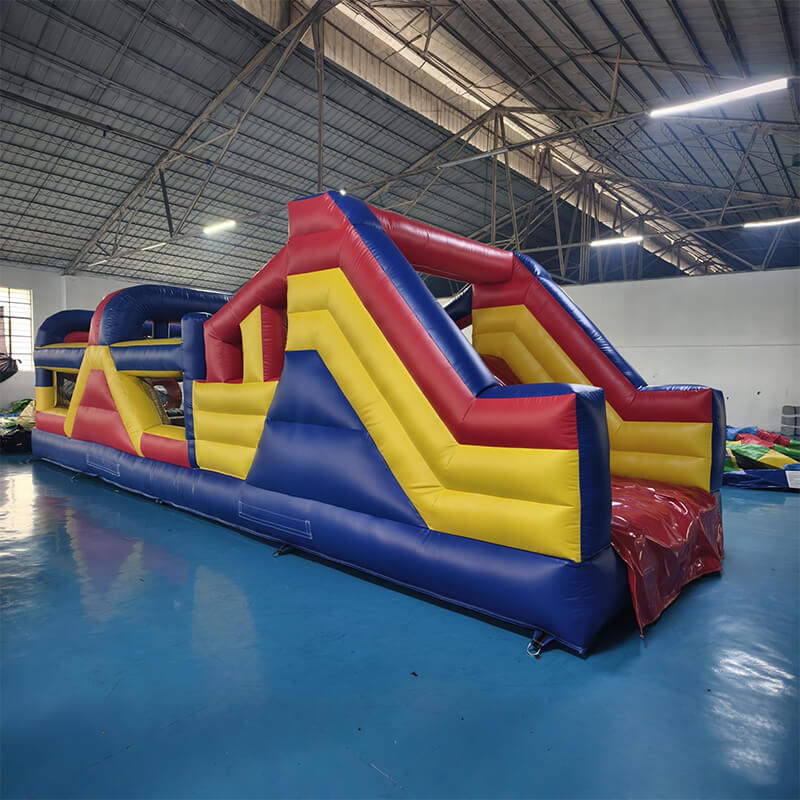
Conquer the Challenge: The Ultimate Red, Yellow & Blue Commercial Inflatable Obstacle Course
Get ready for action with our exhilarating Red, Yellow & Blue Multi-Challenge inflatable obstacle course! This visually striking and robust commercial-grade unit is engineered to deliver non-stop fun and thrilling competition for participants of all ages. Perfect for rental companies, event organizers, and family entertainment centers, its dynamic design and durable construction guarantee a memorable experience every time.
Design Highlights: The Starting Line Sprint, Tunnel Twists & Pop-Up Mazes, Central Climbing Wall Ascent, and a Dual Lane Slide Finish. The bold primary colors ensure maximum visibility. Manufactured with 0.55mm Plato PVC, YKK zippers, and equipped with a reliable HW Blower.
| Brand Name | CH Inflatables |
| Model | CH-0C041 |
| Size | L10*W3*H4m/L32.80xW9.84xH13.12ft |
| Weight | Depends on the actual situation |
| Capacity | 15-25 peoples |
| Material | PVC tarpaulin |
| Accessories | Repair kits、Blower |
| Certification | CE-EN14960、ROHS、UL |
| Usage | Shopping Shopping Mall/property promotion events, park activities |
View Product Details & Pricing ➔
29ft Jungle Inflatable Obstacle Course
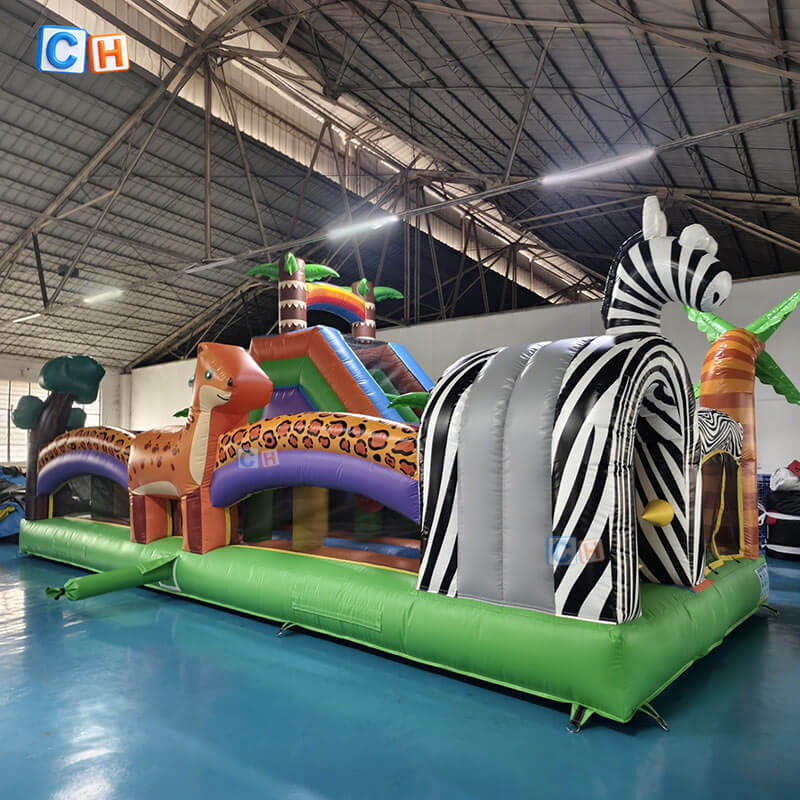
The Ultimate Jungle Inflatable Obstacle Course for Commercial Rentals
Unleash wild excitement with our premium Jungle inflatable obstacle course. Designed specifically for commercial use, this vibrant attraction features realistic 3D palm trees and immersive graphics that instantly grab attention. The challenging layout includes climbing walls, squeeze tunnels, and slides, creating a high-energy centerpiece for your inventory.
Design Highlights: Crafted using commercial-grade 0.55mm Plato PVC for superior tear resistance. High-strength YKK zippers ensure hassle-free deflation. Double-stitched throughout with upgraded webbing comparable to automobile safety belts at stress points. Customization services available for brand-specific color tweaks and logo placement.
| Brand Name | CH Inflatables |
| Model | CH-IB079 |
| Size | L9*W4*H4.2m/L29.52xW13.12xH13.77ft |
| Weight | Depends on the actual situation |
| Capacity | 10-20 peoples |
| Material | PVC tarpaulin |
| Accessories | Repair kits、Blower |
| Certification | CE-EN14960、ROHS、UL |
| Usage | Shopping Shopping Mall/property promotion events, park activities |
View Product Details & Pricing ➔
Deep-Dive FAQ: Commercial Inflatable Obstacle Course Operations
Are inflatable obstacle courses profitable for adult parties and events, or just for kids?
Beyond standard bounce houses, what inflatable attractions actually drive more rental bookings?
How do material specifications like 0.55mm PVC and YKK zippers impact long-term B2B maintenance costs?
What safety certifications and structural reinforcements should commercial buyers look for?
📚 References & Further Reading
- Industry Standard: ADIPS - Amusement Device Inspection Procedures Scheme
- Related Guide: Commercial Grade Inflatable Slides
- Historical Context: Wikipedia: Inflatable Castle