7 Hidden Truths: Inflatable Aqua Park Buoyancy

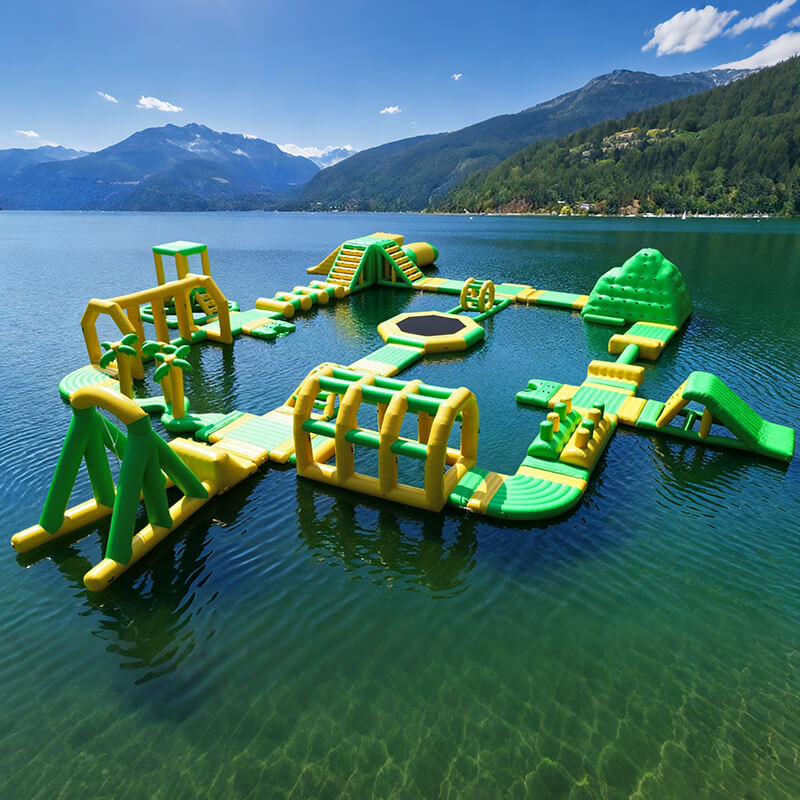
7 hidden truths: Inflatable aqua park buoyancy
Discover the insider secrets about inflatable aqua park buoyancy that keep your lake resort afloat and profitable. Learn how CH Inflatable’s engineering maximizes safety and ROI for serious B2B operators.
Running a successful lake resort or rental business depends on one invisible factor: inflatable aqua park buoyancy. Most folks just look at the bright colors or the height of a slide. But after 17 years in the B2B inflatable manufacturing game, I’ve seen that the physics of floatation is what actually decides if your park is a money-maker or a massive liability.
I’ve watched plenty of rental startups struggle with sagging obstacles or wobbly platforms. Truth is, understanding the mechanics of inflatable aqua park buoyancy is the line between a pro setup and an amateur mistake. We’re pulling back the curtain on material science and weight distribution to show you how we keep these massive structures rock-solid at CH Inflatable.
The secret of material density: 0.9mm PVC airtightness
To keep constant inflatable aqua park buoyancy, your material has to do a lot more than just hold air. It’s fighting a war against UV rays, saltwater, and a hundred jumping kids all at once. If the fabric stretches, the volume changes—and that's when your park starts to sink or sag.
Look, we only use 1300D fabric density for our heavy-duty parks. This internal mesh is the "skeleton" that prevents the PVC from ballooning when the sun hits it. By locking the shape, we keep a fixed air volume. If the shape doesn’t warp, your buoyancy stays consistent all summer long.
For operators in the UAE or Spain, the sun is brutal. Cheap residential-grade stuff won't last a month. Our 0.9mm PVC airtightness is designed for these jagged B2B conditions. It handles the heat without micro-leaks that slowly kill your park's performance during a busy weekend.
Pro Tip: "Skin Tension"
Industry vets talk about "Skin Tension" a lot. It’s how tight the PVC feels. High tension means a better bounce for the kids and a much more stable platform. If it’s soft, it’s unsafe.
If you're looking for the gold standard, check out our Giant inflatable floating aqua park which is built to handle these exact stresses.
Engineering stability: Buoyancy distribution physics
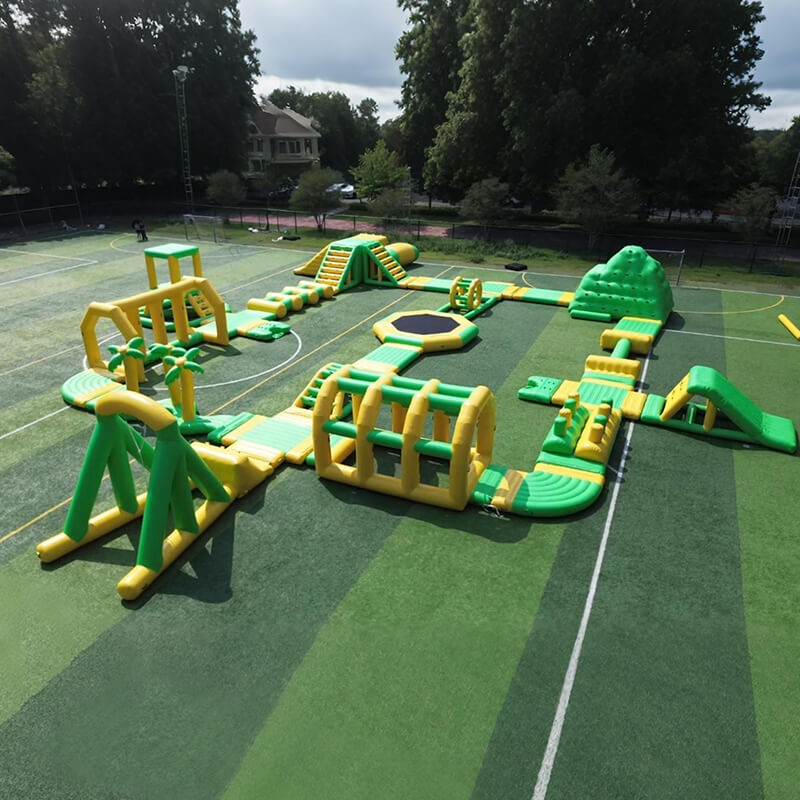
Good inflatable aqua park buoyancy isn't just about how much air is in the tube. It’s about where that air sits compared to the center of gravity. You can’t just stick a 15-foot slide on a thin base and expect it not to flip over when three adults jump on one side.
Here’s the kicker: we design wider underwater pontoon bases to fight directional force. When guests rush down a slide, it creates massive kinetic energy. We calculate the exact volume needed on the outer edges to prevent tipping. It’s simple displacement physics, but most cheap factories skip the math.
| Feature | Standard Grade (Residential) | CH Inflatable (B2B Commercial) |
|---|---|---|
| Material Thickness | 0.6mm PVC | 0.9mm - 1300D PVC |
| Seam Tech | Adhesive/Glue | Hot-air Precision Welding |
| Buoyancy Ratio | 1.5 : 1 Safety Margin | 3 : 1 Safety Margin |
| Hardware | Iron/Nickel Rings | Marine-grade Stainless Steel |
Bottom line is: you have to match the center of mass with the center of buoyancy. We use low-profile, high-volume bases to anchor the weight deep in the water. This keeps those tall obstacle segments from doing what we call "death rolls" during a sudden wind gust.
Manufacturing precision: Hot-air welding vs. glue
How you join the seams is the ultimate "hidden" truth. To be honest, glued seams have no business in a commercial lake. Glue softens in the sun and cracks in the cold. If those seams fail, your inflatable aqua park buoyancy vanishes in an afternoon.
We use hot-air welding precision. This isn't just sticking two things together; it’s melting them into one solid piece at the molecular level. This creates a permanent bond that keeps air pressure constant while 0.9mm PVC airtightness does its job. No leaks, no sagging, and no emergency pump-outs at 2:00 PM on a Saturday.
We also add double-stitch reinforcement at every stress point. Every corner gets extra layers of 0.9mm PVC because we know exactly where the most pressure hits when people are jumping. It’s this kind of craftsmanship that lets you sleep at night.
The role of anchor systems in apparent buoyancy
An aqua park that slides all over the lake feels unstable to guests, even if the inflatable aqua park buoyancy is technically fine. If it moves too much, it feels "cheap." Solid anchoring creates the illusion of solid ground, which is what your customers want.
We've swapped out standard iron D-rings for marine-grade stainless steel D-buckles. They don’t rust, and they don’t snap. When the wind picks up, you need to know those tethers will hold. To see how these systems look in a massive setup, check out Inflatable Aqua Park Systems for Waterfronts.
Our webbing is also a step up. We use stuff that matches automotive seatbelt standards. Standard nylon just won't cut it when the waves start pulling. This seatbelt-grade webbing spreads the load across the PVC hull, so you don't rip a hole in your expensive asset.
Comparing commercial quality vs. residential grade
Don't treat a B2B lake operation like a backyard pool party. Rental operators need to demand certified gear. It’s the only way to satisfy insurance companies and safety inspectors. Every CH Inflatable product hits the CE EN14960 and EU Test standards.
Wait, there's more. Achieving enough pressure for real inflatable aqua park buoyancy requires heavy-duty hardware. We ship every park with CE-certified HW brand blowers. These can hit the required PSI quickly so you have optimal skin tension before the first guest arrives.
Industry Slang: "PSI Creep"
Smart operators watch for "PSI Creep." As the sun warms the air inside, the pressure climbs. Our 1300D fabric handles this thermal expansion, while cheap PVC will literally warp or pop under the pressure.
Visualizing massive floating structures
To really get a feel for inflatable aqua park buoyancy at a massive scale, you need to see it in action. Seeing hundreds of people on one structure shows you exactly why displacement calculations have to be perfect.
To better understand inflatable aqua park buoyancy, this video tutorial is highly recommended:
https://www.youtube.com/watch?v=LyfG0y8J4OM
When a crowd moves to one side of a floating runway, the water displacement engineered into our pontoons absorbs that weight. If you don't have large-volume base tubes, that runway is going underwater. The video above shows exactly how pro-grade engineering handles the chaos.
Customization and ROI for global operators
Every lake is different. A resort in the Arabian Peninsula needs different UV protection than a park in a Canadian lake. We’ve spent 17 years customizing parks for folks in Russia, the USA, Poland, and Colombia. Inflatable aqua park buoyancy can be "tuned" to your specific water depth and guests.
If you want to maximize your ROI, you stay away from maintenance downtime. Even the best layouts, like those found at Splash-N-Dash | Inflatable Water Park, only work if the zippers don't break. That’s why we use authentic YKK zippers. They don't deform under pressure, so you won't be doing emergency repairs mid-season.
Expert Opinion:
"Spending 20% more on 0.9mm PVC instead of the cheap stuff will literally double your park's life. From a rental ROI perspective, you're basically cutting your long-term costs in half."
Frequently Asked Questions
How do you calculate buoyancy for an aqua park?
We use Archimedes' Principle. We take the dry weight of the PVC plus the max user load (we figure about 85kg per adult). Then we engineer the air chambers to provide at least a 3:1 safety ratio. You always want more air than you think you'll need.
Does water temperature change stability?
Absolutely. Cold water makes air contract. Your park will feel "soft" in the morning. You’ll need to use those HW blowers to top it off. As the sun comes up, the air expands, and you might even need to let a little pressure out to avoid stress on the seams.
Why are your products safer than the competition?
We don't just talk about inflatable aqua park buoyancy; we build for it with 1300D mesh, welded seams, and car-safety-grade webbing. We back it all with 17 years of B2B export experience and international UL/SGS certifications.
Wrapping it up
Long story short, you can't fake physics on the water. Understanding the technical truths behind inflatable aqua park buoyancy is the difference between a thriving business and a safety disaster. Stick to 0.9mm PVC, insist on hot-air welding, and use marine-grade hardware.
When you prioritize quality, you get a park that’s stable, safe, and wildly profitable. Let our 17 years of manufacturing experience take the stress out of your next big investment. We know what it takes to keep you afloat.
Ready to build a world-class floating destination?
Contact CH Inflatable today for a Custom Aqua Park Quote by visiting our Giant inflatable floating aqua park page. Claim your free 2024 Stability & Safety Handbook from our engineers right now.