5 Mastery Secrets for Inflatable Obstacle Course Anchorage

5 mastery secrets for inflatable obstacle course anchorage
Mastering inflatable obstacle course anchorage isn't just a technical requirement—it’s the backbone of your rental business. Secure your ROI with CH Inflatable's 0.55mm PVC and stainless D-rings today.
For commercial rental businesses operating everywhere from the USA to Poland, the ultimate nightmare isn't a little rain—it's the wind. Trust me, I’ve seen it happen.
Setting up an inflatable obstacle course anchorage system correctly is the thin line between a killer event and a total liability disaster. There’s no middle ground here.
In my 17 years running factory floors and working with global B2B clients, I've seen exactly what happens when substandard anchoring fails. It isn't pretty, and it's always expensive.
At CH Inflatable, we know your event ROI depends heavily on equipment that stays firmly grounded, regardless of the weather. We build for the real world, not the showroom.
In this guide, I'm revealing the elite engineering secrets that separate professional-grade setups from amateur "blow-aways." You need gear that actually holds when the wind picks up.
By mastering your inflatable obstacle course anchorage, you ensure your commercial fleet consistently meets strict CE EN14960 and EU TEST standards. Let’s get into the weeds of how it’s done.
1. The engineering behind stainless steel D-buckles
When you're managing high-capacity events, your hardware dictates your safety margin. Period. Many clients from Germany and Spain ask why we ditched galvanized iron years ago.
The truth is simple: a tie-down point is only as strong as its weakest link. Chrome-plated iron usually fails exactly when the tension is at its absolute highest. That's a risk you can't afford.
We specifically engineered our inflatable obstacle course anchorage points using heavy-duty 304 graded hardware. This is why stainless steel D-buckles are an absolute necessity for your fleet.
In humid coastal climates or when exposed to pool chemicals, standard metals corrode fast, often hiding microscopic cracks. Our stainless upgrade ensures 100% structural integrity year after year.
Load bearing distribution for large obstacles
Massive commercial structures require high-level math to stay safe. We construct our units using 8mm thick stainless steel D-buckles to prevent "point-load failure" during aggressive adult use.
Proper load distribution hardware achieves three main things. First, it eliminates sudden hardware snapping during severe wind. Second, it spreads force across the PVC base plate. Third, it hits those SGS material strength targets.
| Feature | Standard Hardware | CH Inflatable Stainless Upgrade |
|---|---|---|
| Material Grade | Galvanized Iron / Zinc | 304 Grade Stainless Steel |
| Corrosion Resistance | Low (Rusts in 6-12 months) | High (Salt-spray resistant) |
| Breaking Strength | Approx. 1200kg | Exceeds 2500kg |
| Lifespan | 1-2 Seasons | 5+ Years |
2. Elevating stability with reinforced webbing strength
Look, great hardware is useless if the fabric it attaches to tears under pressure. To get a flawless inflatable obstacle course anchorage, that connection has to be bulletproof.
In our manufacturing process, we don't just use standard nylon. We engineer for extreme survival. We focus on reinforced webbing strength that mirrors what you’d find in the automotive industry.
By using the same high-tenacity polyester found in car safety belts, our anchor straps won't stretch or snap. In the production room, we use a technique known as the "Gator-Stitch."
This is an aggressive, multi-row reinforced stitching pattern used to bite the webbing deeply into the primary PVC base. It’s built to stay put, no matter what happens on the field.
We sandwich this seatbelt-grade webbing between triple layers of our 0.9mm 1300D PVC. This prevents the "tear-out" effect under extreme kinetic force. Even our aquatic units rely on this tech.
You can see this high-tensile engineering applied perfectly in our Inflatable Obstacle Course on Water.
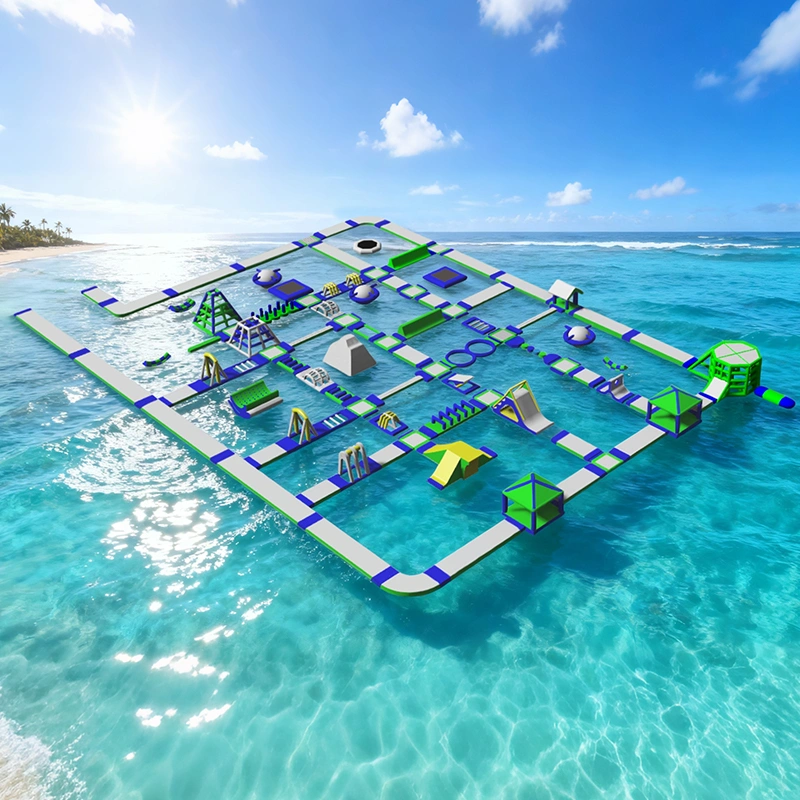
Whether you’re setting up on a lake in Canada or a park in Latvia, the anchoring holds firm. We don't do "good enough"—we do over-engineered.
3. Managing high-pressure wind resistance
Wind is the invisible enemy. When you neglect your inflatable obstacle course anchorage calculations, you’re basically inviting a disaster to your event. It’s that simple.
A solid wall of 0.55mm PVC acts like a giant sailboat sail. To combat this, you’ve got to calculate wind loads before you even think about inflating multi-section courses.
You can achieve optimal high-pressure wind resistance by using a strict 45-degree tethering angle for your straps. This forces the energy downward into the soil, rather than pulling the anchor sideways.
For commercial operators in windy regions like West Texas or the UAE, a 1-meter steel stake is the gold standard. I always tell rental owners: use secondary tethering once you pass 20 feet in height.
To understand the baseline requirements in tough markets, many operators review the Inflatable Obstacle Courses - USA made Commercial Inflatables - eInflatables safety benchmarks. But we aim higher.
Your inflatable obstacle course anchorage system needs to exceed these regional standards to protect your wholesale business. Staying "within code" is the bare minimum; staying safe is the goal.
4. Blower configuration and air pressure maintenance
Here’s the kicker: people often overlook internal air pressure when talking about inflatable obstacle course anchorage. If your unit loses pressure, it shifts its entire center of gravity like a deflating balloon.
This sudden shift can violently yank ground stakes right out of the turf. That’s why HW blower efficiency is actually a core part of your tie-down strategy.
We bundle our B2B orders with CE/UL certified HW blowers to ensure high-PSI internal environments. Keeping the structure rigid absorbs wind impact uniformly across all anchorage points.
When a storm hits rapidly in places like Colombia or Peru, you need to dump air fast. We guarantee YKK zipper reliability so operators can perform emergency releases without a hitch.
Our zippers won't jam or break, letting the unit drop flat before the wind wins the fight. We also use an "Air-Trap Flap" behind the YKK zipper to stop accidental air loss if a kid gets curious.
5. Professional installation protocols for rental success
The best manufacturing won't save a poorly installed unit. To be honest, I’ve seen enough bad setups to know that inflatable obstacle course anchorage is won or lost in the first ten minutes of setup.
There’s a massive difference between anchoring on soft grass versus solid concrete. For concrete, you need heavy sandbags tied perfectly to those stainless D-rings. No shortcuts allowed.
Local event companies have to stick to municipal regulations. Checking regional compliance like the standards at Tons of Fun Entertainment ensures your anchors meet local legal expectations.
Before any kid steps inside, my team does the "Shake Test." We look for "The Dead-Weight Drift"—that slight movement that shows anchors are absorbing energy safely. If it's too rigid, something's going to snap.
For a masterclass in anchoring dynamics, look at our 29ft Jungle inflatable obstacle course. This high-profile unit is a perfect example of a commercial asset that needs 12+ deeply secured anchors.
To better understand inflatable obstacle course anchorage in a real-world high-traffic setting, this video tutorial is highly recommended:
Proper anchoring allows thousands of attendees to interact safely with massive structures without fear of structural failure. It’s what keeps the party going and the lawsuits away.
Frequently Asked Questions (FAQ)
How do stainless D-rings improve inflatable obstacle course anchorage?
Unlike standard galvanized steel, our 304 stainless D-rings don't rust or weaken. When you're dealing with rain, mud, or pool chemicals, they maintain 100% integrity. This keeps your inflatable obstacle course anchorage at full capacity for years, preventing accidental detaching when the pressure is on.
What is the safest webbing material for commercial inflatable tie-downs?
The gold standard is automotive seatbelt-grade polyester. At CH Inflatable, we cross-stitch this into 0.55mm 1300D PVC reinforcements. This gives you a breaking strength that far exceeds EU EN14960 requirements, ensuring your inflatable obstacle course anchorage won't fail under load.
Conclusion: secure your business with CH Inflatable
Bottom line is this: getting your inflatable obstacle course anchorage right isn't about luck. It's about choosing a partner who knows the science of safety. We’ve spent 17 years figuring this out so you don't have to.
Choosing CH Inflatable means you're investing in deep manufacturing excellence. From double-stitched PVC to unbreakable YKK zippers and certified blowers, everything is engineered to hold the ground.
We build our inventory specifically for the harsh rigors of the global rental market. Whether you're in France or Saudi Arabia, our gear is built to take the heat—and the wind.
Don't compromise your ROI on weak tie-down hardware. Upgrade your fleet today with the most secure, CE-certified inflatable obstacle course anchorage systems in the industry.