Slash Repair Costs: 5 Inflatable Slide Webbing Fixes

Slash repair costs: 5 professional inflatable slide webbing fixes
Keeping a rental fleet profitable isn't about how many units you own; it’s about keeping them in the air instead of the repair shop. In my 17 years working with event operators across the US and Europe, I’ve seen one specific issue bleed budgets dry more than any other. When you are dealing with high-traffic units, the strength of your inflatable slide webbing fixes dictates exactly how long that unit stays in your inventory.
Whether it’s a massive 30-foot titanic slide or a backyard combo, webbing failure is the number one cause of structural instability. Most clients ask me how to avoid that mid-season blowout that ruins a weekend. Honestly? It comes down to the material grade and the maintenance grit you put in. In this B2B guide, we’re diving into industrial-strength inflatable slide webbing fixes that actually hold up under pressure.
1. Reinforcing high-stress seams with 1300D PVC
The "Achilles' heel" of any giant slide is the transition zone where the wall meets the floor. This area takes a beating. You’ll see "seam elongation" where the fabric stretches until the stitching starts to peek through. If you want a real fix, 1300D PVC reinforced seams are the only way to go for commercial operators.
At CH Inflatable, we use 0.55mm 1300D PVC as our baseline. For water parks, we beef that up to 0.9mm. Here’s a tip: never settle for cheap 1000D patches. That extra denier in the 1300D is the difference between a quick patch and a five-year structural solution. It’s about longevity, not just getting through the day.
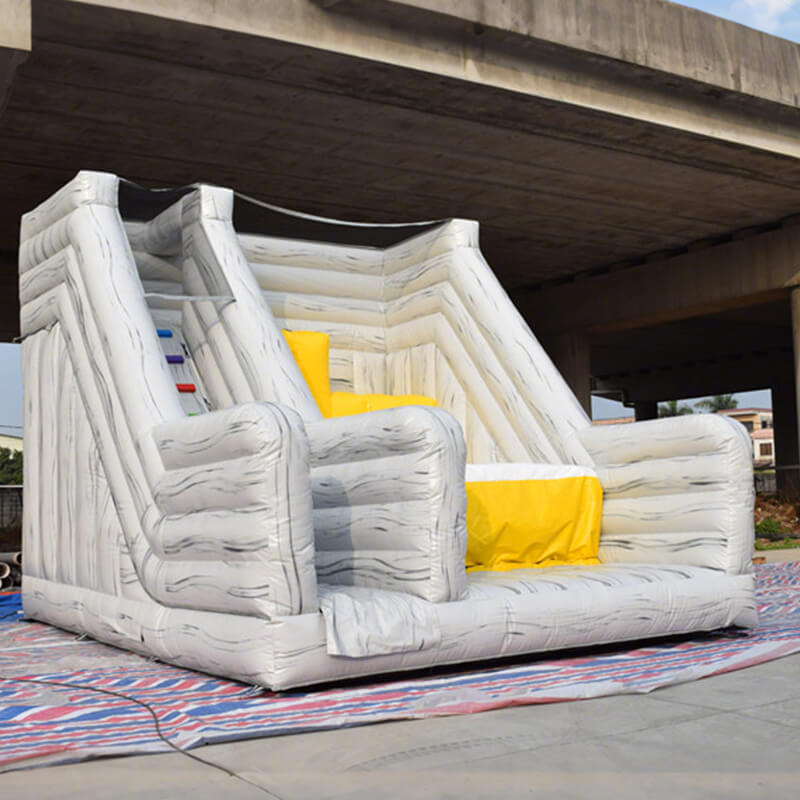
To do inflatable slide webbing fixes correctly, you need to overlay new webbing across the existing stress lines. This spreads the weight across more surface area. If you want to see how we handle these massive reinforced transitions, take a look at our Stitch large inflatable slide.

Table 1: Material Strength Comparison for Webbing Support
| Material Type | Typical Use Case | Lifespan Expectancy |
|---|---|---|
| Standard 1000D PVC | Residential/Light Commercial | 1-2 Seasons |
| 1300D PVC Reinforcement | Heavy Rental Units | 4-6 Seasons |
| Seatbelt-Grade Polyester | Main Structural Anchors | 7+ Seasons |
2. Restoring tension via stainless D-buckle upgrades
Rust is the silent killer of water slide inflatables. I’ve seen so many operators wonder why their anchor points snap, and nine times out of ten, it’s because a cheap galvanized ring corroded from the inside out. Upgrading to stainless D-buckle tension points is a total game changer for units exposed to chlorine or coastal salt air.
In the industry, we call it "Jump-Surface Sag." When those tension points fail, the sliding surface loses its "pop." It looks bad to customers and creates a massive safety hazard. Don't just replace a strap; replace the hardware. High-end inflatable slide webbing fixes require high-end stainless steel that won't flake or snap under a 200lb load.
Some guys try to get by with generic 1" BLACK webbing water slide tether straps as a quick band-aid. That’s fine for a weekend, but if you want to understand real hardware mechanics, check out this tutorial on heavy-duty sliders:
To better understand inflatable slide webbing fixes and professional hardware, this video tutorial is highly recommended:
https://www.youtube.com/watch?v=-RnyaJYcduU
3. Using seatbelt-grade webbing for load-bearing
Safety shouldn't just be a line on a certificate. At CH Inflatable, we stick to seatbelt-grade polyester webbing because the tensile strength is unmatched. This helps our units easily crush the EN14960 compliance standards. When your webbing is literally car-safety grade, you aren't doing inflatable slide webbing fixes every other month.
Another major enemy is "Sun-Rot." In places like Florida, Spain, or the Middle East, standard nylon webbing turns "crunchy" and brittle within months. Switching to high-density polyester—the same spec as a car seatbelt—stops UV breakdown cold. It keeps the fibers flexible so they don't snap when the wind picks up or the kids get rowdy.
Bottom line: if your webbing feels stiff or looks bleached, it's a disaster waiting to happen. We use this ultra-durable webbing in our high quality inflatable obstacle course for kids to ensure it survives years of sun exposure without losing its structural integrity.
4. Precision stitching for field repairs
If you have to do inflatable slide webbing fixes on-site, you need the right tools. A home sewing kit won't cut it. You need a heavy-duty awl and a double-needle lockstitch method. At our factory, we use a 4-layer sewing process, but in the field, you have to be careful not to create "Bite Grade" issues.
"Bite Grade" is just slang for how much material your needle can punch through before it snaps. If you use the wrong gauge, you'll leave massive holes in the PVC that eventually turn into a tear. You can see the struggle of DIY repairs over on the r/sewing on Reddit thread—it’s harder than it looks.
Always make sure the webbing "tail" is buried under a PVC strip. This small detail prevents fingers from getting caught and protects your business from a liability nightmare. It’s those small inflatable slide webbing fixes that separate the pros from the amateurs.
5. Zipper maintenance and webbing shields
Believe it or not, a jammed deflation zipper is usually a webbing problem. If the webbing around the air release port is distorted, the zipper won't track. That’s why we only use YKK zipper maintenance protocols and the YKK brand itself. A YKK zipper is only as good as the webbing housing it.
We use "Blow-out insurance"—which is just a fancy way of saying we double up on Velcro-secured webbing guards over every zipper. This keeps sand, grass, and mud out of the zipper teeth. It’s one of the cheapest inflatable slide webbing fixes you can implement, but it saves you from replacing a $100 zipper assembly every year.
Look, here's the kicker: clean your zippers. Use a bit of lube, check the webbing alignment, and make sure the Velcro flap is tight. These inflatable slide webbing fixes aren't rocket science, but they are the difference between a unit that lasts 2 years and one that lasts 8.
Frequently asked questions (FAQ)
How often should I inspect the webbing?
If you're running a busy rental shop, check it after every single weekend. For indoor parks, once a month is usually enough. Focus on the ladder entry and the slide exit curve—that's where the most "stress whitening" happens.
Can seatbelt-grade webbing handle the heat?
Absolutely. Unlike cheap nylon, polyester doesn't stretch out when it hits 100°F. This keeps your 1300D PVC reinforced seams tight so the unit doesn't get that "slushy" feel when the sun is beating down.
Are these repairs too hard for a small business?
Basic stuff like zipper guards and tension straps are easy. But for major structural inflatable slide webbing fixes, you’re better off buying from a manufacturer like us who builds these reinforcements in from day one. It saves you the headache later.
Conclusion
Mastering these inflatable slide webbing fixes is essential if you want to stay competitive. By sticking to stainless D-buckle tension systems and EN14960 compliance standards, you’re protecting your gear and your customers. At CH Inflatable, we don't just sell blow-up slides; we engineer them to last 17 years in the toughest rental markets.
Ready to upgrade your fleet with custom-built, ultra-durable units that actually last?
Contact CH Inflatable today for a custom wholesale quote!