5 Hidden Truths About Inflatable Obstacle Course Safety

5 hidden truths about inflatable obstacle course safety
The inflatable rental industry is booming globally, scaling fast from the USA to Germany. However, the line between a profitable season and a liability nightmare often rests on a single factor: inflatable obstacle course safety.
Most rental owners obsess over flashy colors or massive dimensions to lure in clients. After 17 years in the game, I can tell you that the hidden manufacturing details determine if your unit survives 500 rentals or blows a seam at 50.
In this guide, CH Inflatable reveals the engineering secrets every B2B buyer needs to know. From fiber density to structural reinforcement, we show you what makes a real commercial powerhouse. Prioritizing inflatable obstacle course safety is the ultimate way to boost your fleet's lifespan and ROI.
1. The 1300D PVC secret: Why 0.55mm thickness isn't enough
Many suppliers claim they use 0.55mm thickness, but the "D" (Denier) is where the truth hides. I’ve seen buyers misled by standard 1000D materials that suffer from high-pressure fatigue. To ensure inflatable obstacle course safety, we strictly use 1300D PVC for dry units.
For heavy-duty setups like an inflatable water park, we upgrade that to 0.9mm 1300D PVC. This higher Denier count means the internal fabric weave is much tighter. It provides vastly superior tear resistance compared to the cheap stuff.
Check the paperwork before you buy. To guarantee inflatable obstacle course safety, ensure your materials have UL or SGS certification. These tests verify the PVC is fire-retardant and lead-free. These safeguards are mandatory if you operate in Canada, France, or Spain.
| Feature | Standard Grade | CH Inflatable Heavy-Duty |
|---|---|---|
| Fabric Density | 1000D (Low lifespan) | 1300D (High tear resistance) |
| Thickness | 0.45mm - 0.50mm | 0.55mm - 0.90mm |
| Seams | Single/Double Stitch | Double/Quadruple + Reinforcement |
| Hardware | Plastic or Iron | YKK Zippers & Stainless D-buckles |
Look, in my years of manufacturing, the internal mesh structure (1300D) is more critical for shape retention than the coating. It completely changes how the unit handles pressure.
2. Structural integrity: Going beyond basic stitching
Standard single-line stitching will fail under the weight of teenagers and adults sprinting through a course. That is why we apply double-stitch reinforcement across all standard seams. But inflatable obstacle course safety demands more at high-impact areas.
We add quadruple stitching and supplementary reinforcement patches at all high-stress turn points. If you run a business in the EU, EN14960 compliance is non-negotiable. This standard dictates the height of containment walls and safe distances.
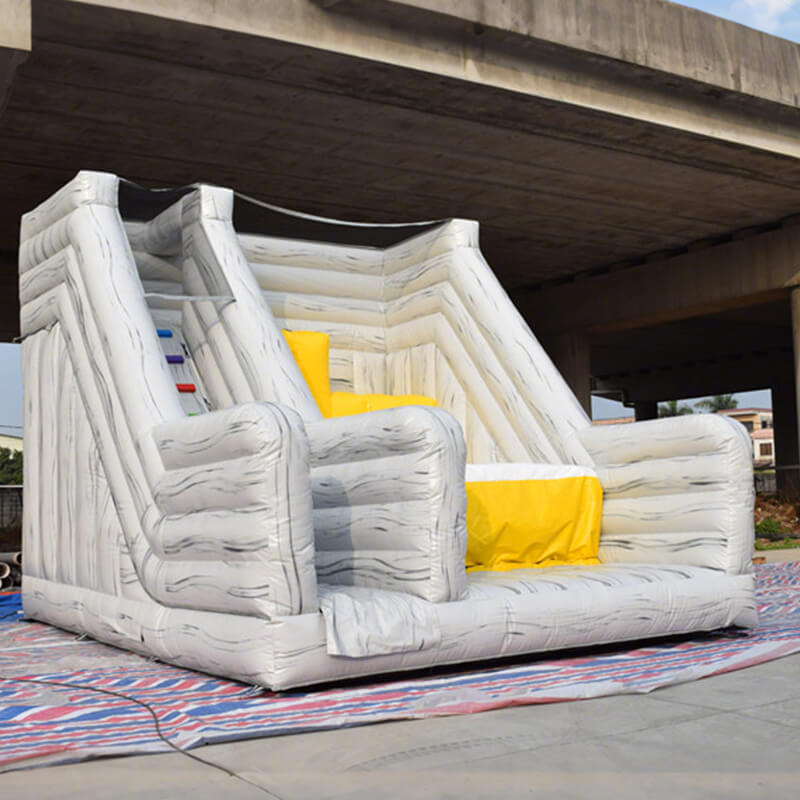
Meeting these standards protects users from falls and protects you from massive liability claims. To see this engineering in action, check out our
High quality inflatable obstacle course for kids.
For more reading on evaluating event setups, you can check out this guide on how to choose the perfect inflatable obstacle course for your event.
3. Hardware matters: YKK zippers and marine-grade anchors
Here’s the kicker: a broken deflation zipper means a dead unit. Many clients ask why we are so obsessive about hardware when optimizing inflatable obstacle course safety. The answer is simple: reliability equals profit.
We use authentic YKK zippers exclusively. They offer high tensile strength and resist deformation under the immense air pressure needed for massive courses. If your zipper fails mid-event, you've got "dead weight" taking up space in your warehouse.
Safety is also anchored from the ground up. Standard iron buckles rust and weaken anchor points. By upgrading to stainless D-buckles, our units resist corrosion. This is a life-saving feature for companies near the coast or running an inflatable water park.
4. The airflow logic: Certifications and webbing
Air pressure consistency is the lifeblood of these units. A sudden drop in PSI compromises inflatable obstacle course safety, causing walls to sag. To prevent this, we provide premium HW Blower certification on all our air pumps.
These blowers guarantee the unit stays rigid even during peak occupancy. Another hidden safety element is the internal webbing. We use seatbelt-grade materials for internal baffle reinforcement. This keeps the "bounce" where it belongs and prevents dangerous exterior stretching.
In the trade, we call a rapid loss of rigidity a "pressure drop." It’s usually caused by bad blowers or leaky seams. Avoid it at all costs if you want to keep your guests safe and your insurance premiums low.
To better understand inflatable obstacle course safety, this video tutorial is highly recommended:
5. Designing for safety and ROI
Beginners often view safety features as "extra costs." Seasoned B2B wholesalers know they are direct investments. A safer unit requires fewer repairs and commands a higher rental price. 17 years in exports has taught us that quality speaks for itself.
Whether you are in Canada, Russia, or Peru, elite manufacturing matters. Customization is also a big part of what we do. We tailor designs to meet your specific local municipal safety regulations and climate requirements.
Having the best hardware is great, but operator knowledge is the other half of inflatable obstacle course safety. Proper staking and wind monitoring are vital. Review these bounce house and inflatable slide safety tips for better operations.
Bottom line is: you want a "turnkey unit." That means a fully compliant, ready-to-rent inflatable that won't fail an inspection. It saves you time, money, and a whole lot of stress.
Frequently asked questions (FAQ)
How do reinforced seams improve obstacle course durability?
Using double-stitch reinforcement and quadruple stitching at corners prevents air leakage. It stops seams from separating during high-impact play. This can increase your unit's lifespan by up to 40%.
Why is CE certification vital for European rental markets?
EN14960 compliance ensures the product meets health and safety standards. Without it, EU rental companies face insurance denials. You could also face legal penalties if an accident happens.
Do the blowers really impact the safety of the unit?
Absolutely. Proper inflation is the foundation of inflatable obstacle course safety. We only use blowers with HW Blower certification to ensure the unit stays stable and trip-hazard free.
Can I customize the safety features for my region?
Yes. We provide deeply customized B2B support. Whether it's extra stainless D-buckles for high-wind areas or specific containment wall heights, we build to your local requirements.
Conclusion
Long story short, prioritizing inflatable obstacle course safety is the only way to win in this business. Upgrading to 1300D PVC, YKK hardware, and seatbelt-grade webbing eliminates the headache of constant repairs.
This foundation has secured 17 years of success for us at CH Inflatable. Don't settle for "cheap" and risky. Invest in "durable" and profitable. We build units that work as hard as your business does.
Contact CH Inflatable today for a custom quote on our CE and EN14960-compliant fleet!
High quality inflatable obstacle course for kids
Image by: Celil DOĞAN
https://www.pexels.com/@celildogan