
Block Accidents: 5 Inflatable Water Park Depth Rules

Block accidents: 5 inflatable water park depth rules
Prevent injuries and lawsuits easily. Master Inflatable Water Park Depth standards for lakes and pools to ensure guest safety. Consult CH Inflatable now!
Introduction
Let’s face a stark reality that keeps many B2B rental owners awake at night: a single injury lawsuit can bankrup an amusement business fast.
Whether you run a setup in Florida, USA, or a seasonal park in Germany, safety isn’t just about providing good vibes for your guests.
It is about the survival of your company.
In my 17 years in this industry, I have seen too many operators underestimate the complexity of water clearance. They often assume, "It looks deep enough," and toss the anchor overboard.
This casual approach is a recipe for disaster.
Understanding the correct Inflatable Water Park Depth is not a suggestion; it is a rigid requirement.
Whether you are operating in a natural lake or a commercial pool, adhering to depth rules is the foundation of a profitable, accident-free season.
This guide covers the 5 essential rules you must know. We will incorporate ISO 25649 safety standards and draw upon CH Inflatable’s deep manufacturing expertise to ensure your park remains compliant.
Understanding ISO 25649 safety standards and compliance
Why floating park compliance is non-negotiable
If you are importing inflatables to Europe, the US, or Canada, you are likely familiar with the CE EN14960 or specific EU TEST requirements.
However, depth goes beyond just the product certificate.
Specific Inflatable Water Park Depth regulations are often outlined in ISO 25649 safety standards. Ignoring these doesn't just put people at risk; it puts a target on your back legally.
In the industry, we have a slang term for those who ignore these norms: the "Cowboy Operator."
A Cowboy Operator sets up equipment without measuring, ignores wind ratings, and guesses depth. Don't be a Cowboy Operator.
What's more, most commercial liability insurance policies have strict clauses. If an accident occurs and you didn't meet floating park compliance regarding water depth, your coverage is often void immediately.
Calculating minimum water clearance
There is a critical distinction acting as a trap for new business owners. You must understand the difference between water depth and minimum water clearance.
- Water Depth: The distance from the surface to the bottom.
- Minimum Water Clearance: The distance a user needs to decelerate safely without hitting the floor.
Expert Tip: The calculation must factor in the height of the slide and the weight of the user.
A giant inflatable water slide generates much higher velocity than a simple walkway. Therefore, the Inflatable Water Park Depth required for a 5-meter slide is significantly different from a trampoline.
To better understand the scale and setup of safe water parks concerning Inflatable Water Park Depth, this video tutorial is highly recommended:
https://www.tiktok.com/@fantasylakeadventurepark/video/7616496085753744653
The 5 golden rules of inflatable water park depth
If you want to sleep soundly during your peak season, memorize these five rules. They are the backbone of aquatic safety.
Rule 1 - The height-to-depth ratio
The most fundamental rule in determining Inflatable Water Park Depth is the height-to-depth ratio.
ISO standards dictate that for every meter of free-fall height, a specific amount of water depth is required to absorb the impact.
Here is a quick cheat sheet for depth requirements based on industry best practices:
| Feature Type | Approx. Height | Required Water Depth (Min) | Risk Level |
|---|---|---|---|
| Walkways / Pods | < 1.0m | 1.2m - 1.5m | Low |
| Standard Slides | 1.0m - 2.0m | 2.0m | Medium |
| High Towers / Blobs | 3.0m+ | 2.5m - 3.5m+ | High |
When we manufacture custom parks at CH Inflatable, we analyze your water charts before we even begin cutting the 0.9mm PVC.
If you have a specific slide in mind, we calculate the trajectory to ensure your location can handle it.
Rule 2 - Establishing swimming pool safety zones
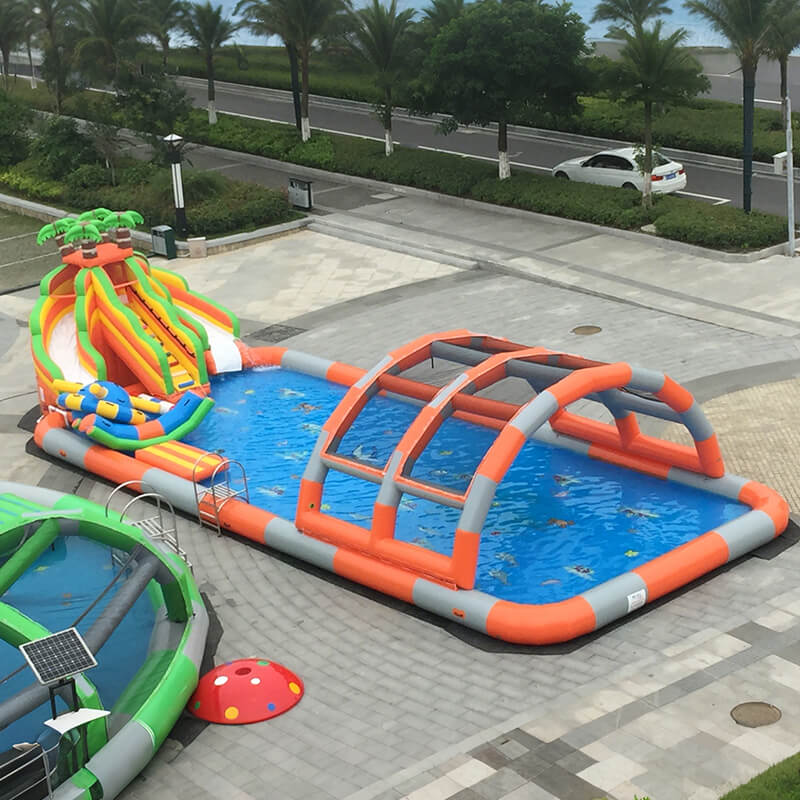
Many of our clients in the hotel and resort sectors operate in swimming pools. This environment is more controlled than a lake, but it presents unique challenges regarding swimming pool safety zones.
In a pool, the floor is hard concrete, not soft mud. The margin for error is zero.
You must establish buffer areas. Swimming pool safety zones are perimeters around the inflatable where no other swimmers or obstacles should be.
- Entry Zones: Where users climb on.
- Exit/Splash Zones: Where users land.
Never place a high-impact slide exit near the shallow end transition slope.
For facilities with depth limitations, looking for safer, specialized designs is smart. For safer, shallower options, check our Inflatable Pool Park for Kids.
These are engineered specifically for standard pool depths and tighter spaces.
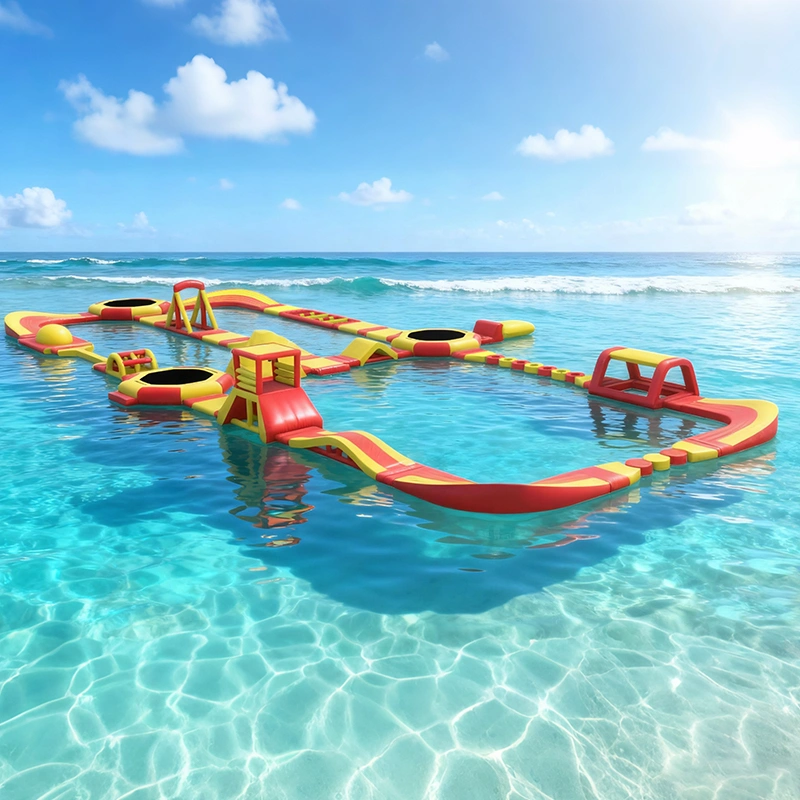
Rule 3 - Underwater obstacle detection
For our clients operating in lakes, quarries, or oceans, the seabed is your unknown variable. You might have the correct ISO 25649 safety standards depth on paper, but nature changes.
Underwater obstacle detection is crucial.
I have seen parks ruined because a submerged log drifted into the drop zone after a storm.
Expert Opinion: "Never rely on sonar alone; physical diving checks are mandatory before every season opening to prevent hull ruptures or foot injuries."
Before you inflate a single module, send a diver down. They need to check for:
- Jagged rocks.
- Construction debris (common in flooded quarries).
- Uneven seabed topography.
Ensuring your Inflatable Water Park Depth is clear of these hazards is just as important as the water level itself.
Rule 4 - Accounting for tide changes
If your project is in a tidal estuary or on the coast, the measurement of Inflatable Water Park Depth becomes dynamic.
I once consulted for a client in France who measured his depth at High Tide. When the tide went out six hours later, his tower slide was dumping guests into waist-deep water.
The Rule: Always set your park depth standards based on the Lowest Astronomical Tide (LAT).
The Buffer: Add a safety margin of at least 0.5m on top of the LAT.
Tides can shift the position of your park if your anchoring lines have too much slack. This brings us to the importance of specialized anchoring hardware, which we provide with every CH Inflatable order.
Rule 5 - The impact of air pressure on draft
Here is a technical nuance many overlook: air pressure affects how much the inflatable sinks (its draft).
If a product is under-inflated, it becomes "floppy." It sinks deeper into the water when a user stands on it. This effectively reduces the underwater clearance between the vinyl and the lake floor.
To maintain consistent Inflatable Water Park Depth performance, you must use high-quality blowers.
At CH Inflatable, we supply HW blowers that are CE certified. These units maintain optimal pressure.
Our products are built with specific valve systems that allow for pressure monitoring. A rigid track sits higher on the water, providing a safer distance from the bottom.
Equipment quality: how materials affect safety and depth
You might wonder, how does the PVC material change the depth requirement? It comes down to buoyancy and rigidity.
The role of 0.9mm 1300D PVC in buoyancy
Cheap inflatables made from thin material will sag under load. Heavy users might push a walkway down by 30-40cm just by walking on it.
At CH Inflatable, we use strictly 0.9mm 1300D PVC for our water parks. This commercial-grade material is significantly stiffer.
- Better Rigidity: The park stays flat on the surface.
- Less Sagging: Maintains the calculated safety depth.
- Consistent Safety: Predictable behavior for users.
When the platform provides a solid footing, the Inflatable Water Park Depth calculations remain accurate throughout the day, regardless of user traffic.
Anchoring and stability
Stability is the unsung hero of depth safety. If your park moves, it might drift into shallow waters.
In the industry, we call this "Scope Creep"—when anchor lines stretch or move, drifting the park out of its safe zone.
To prevent this, CH Inflatable has upgraded all our connection points. We use Stainless Steel D-buckles that are waterproof and rust-resistant.
We use automotive-grade webbing, the same material used in car seatbelts. This ensures your park stays exactly where you mapped the deep water.
See a perfect example of a stable, high-capacity setup here: Inflatable Floating Water Park.
Operational best practices and external resources
Safety is not a "set it and forget it" task. It is an ongoing operational habit.
Regular safety audits
A floating park is a living organism; it moves, shifts, and reacts to weather.
Expert Opinion: "If you aren't measuring depth weekly, you are negligent. Water tables in lakes evaporate in summer, and tides change."
Implement a daily logbook. Have your lifeguards check the depth markers at the base of every major slide before the park opens to the public.
If the Inflatable Water Park Depth has dropped below the limit, close that section immediately.
Learning from the industry
It is vital to look at successful business models to understand how they manage these risks.
For example, Splash-N-Dash runs a compliant operation that prioritizes safety zones effectively. They are a great example of doing it right.
Additionally, educate your staff on general facts and operational nuances.
Read this guide on 6 Things You Didn't Know About Inflatable Water Parks to broaden your operational knowledge.
Managing "Blind Spots"
There is a terrifying scenario in our industry slang known as the "Turtle."
This happens when a user falls and gets trapped under a flipped inflatable or a wide obstacle. While rare with modern designs, it is dangerous.
If the Inflatable Water Park Depth is too shallow, a user trapped underneath cannot push themselves down to swim out from under the obstacle.
Sufficient depth is not just for falling; it is for maneuvering underwater in emergencies.
Frequently asked questions (FAQ)
What is the minimum water depth for a commercial inflatable water park?
The absolute minimum generally starts at 1.2m (4ft) for simple walkways and low-impact obstacles.
However, for slides, towers, and jumping pillows, ISO 25649 safety standards usually require 2.5m (8ft) or more. Always check the specific manual provided by CH Inflatable for each module.
How does tide change affect inflatable water park depth requirements?
Tides are critical. You must calculate your Inflatable Water Park Depth based on the *lowest astronomical tide* (LAT).
If the tide drops 1 meter, your park must still meet the minimum safety depth at that lowest point. Never measure at high tide and assume you are safe.
Can I install a floating park in a swimming pool with variable depth?
Yes, but you must map the inflatables strictly to the pool's profile.
High-impact items like slides must be positioned over the deep end. Low-profile runways can be placed in the shallow end, provided they adhere to swimming pool safety zones.
Strict enforcement is required to keep the setup from drifting into the wrong depth zones.
Bottom line
Ignorance of Inflatable Water Park Depth rules is the fastest way to shut down a profitable business.
By adhering to ISO 25649 safety standards, meticulously checking for underwater obstacle detection, and accounting for tidal shifts, you build a fortress of safety around your business.
Remember, the equipment you choose plays a massive role.
Using high-buoyancy 0.9mm PVC and secure anchoring systems from CH Inflatable ensures that your calculations hold true in the real world.
We have spent 17 years perfecting these designs for clients in Germany, the USA, and beyond. We don't just sell inflatables; we sell peace of mind.
Don't gamble with guest safety. Contact CH Inflatable today to design a compliant, custom floating water park that meets all international safety depth standards.
Get your free quote now!
Image by: Godisable Jacob
https://www.pexels.com/@godisable-jacob-226636