
Inflatable Sandbags vs Stakes: 5 Critical Safety Truths

Inflatable sandbags vs stakes: 5 critical safety truths
Mastering the debate of Inflatable Sandbags vs Stakes is the only way to secure your fleet properly.
Here, you'll learn 5 critical safety truths and wind load facts to prevent accidents. Shop safe CH Inflatables now!
Introduction
It’s the scenario that wakes rental business owners up in a cold sweat. You’re at a packed event, music is blasting, kids are screaming with joy, and then—the wind shifts.
You watch in horror as a gust lifts the corner of a commercial bouncer. This happens despite having weights down. Whether you run a show in the USA, Europe, or South America, liability is the bottom line.
One bad accident? That can bankrupt a company overnight.
We argue about it constantly in this industry: Inflatable Sandbags vs Stakes. A lot of rookies think these anchoring methods are interchangeable.
They think, "If I can't drive a stake, I'll just throw a couple of bags down." Physics, unfortunately, doesn't care about convenience.
Securing a bounce house isn't just about throwing generic weight at the problem. It is about Soil holding capacity, friction coefficients, and strict rules.
If you don't get the science behind the anchor, you are gambling with your client's safety. Plain and simple.
I’m going to walk you through 5 specific safety truths. We’ll cover ASTM wind rating compliance, the math behind deadweights, and manufacturing quality.
Because frankly, the reinforced D-rings used by manufacturers like CH Inflatable matter just as much as the anchor you choose.
Truth #1: The physics of holding power (soil vs. deadweight)
When we break down the Inflatable Sandbags vs Stakes argument, we have to look at how the earth interacts with your gear. The physics are night and day.
Why heavy duty steel stakes are the gold standard
Stakes are king for outdoor setups on grass or dirt. That's not just my opinion; it’s mechanics. When you drive a stake, it relies on shear strength.
It uses the Soil holding capacity of the earth itself. In my years running B2B operations, I’ve seen that in 90% of grass scenarios, nothing beats a stake.
A 40-inch stake creates a wedge of resistance that no portable deadweight can match pound-for-pound.
- The wedge effect: The soil compresses against the stake, creating friction along the entireshaft.
- Shear strength: To pull a stake out, the wind basically has to rip a cone of earth out of the ground.
To get a real hold, you must use Heavy duty steel stakes drove at a 45-degree angle. You want the top pointing away from the inflatable.
This maximizes the resistance against the lift and drag forces the wind throws at you.
For a deeper dive into what other veterans say, check this discussion on Stakes Vs Sandbags - Training, Safety & Insurance!.
The "deadweight" reality of sandbags
On the flip side of the Inflatable Sandbags vs Stakes discussion, we have sandbags. Unlike stakes, sandbags don't mechanically lock into anything.
They rely solely on gravity and friction. That's a tougher battle to win.
When you use Commercial ballast weights, the wind pushes the inflatable, and the inflatable pulls the bag. If the friction is low—like on a gym floor—that bag is going to slide.
We call this "Walking." The unit shifts because the bags slide due to a low friction coefficient, even if they don't lift off the ground.
- Sandbags are often the only option for indoor use or prohibited surfaces like parking lots.
- But here is the kicker: they require way more mass than most operators realize to equal a single stake.
Truth #2: Surface dictates strategy (concrete vs. grass)
The Inflatable Sandbags vs Stakes debate is usually settled by the ground beneath your feet. Concrete means no stakes.
But simpler tossing down a couple of bags isn't enough; you need to do the math.
Calculating deadweight for concrete setups
Let's get into the numbers. A standard 1-inch thick, 40-inch long steel stake in good soil can hold 500 to 1,000 lbs of load.
To match that holding power with sandbags, you cannot just use two 50lb bags. You would theoretically need enough Commercial ballast weights to equal that resistance.
When performing a Deadweight anchor calculation, act like an engineer:
- Wind Load: The force the wind applies to the surface area of the unit.
- Safety Factor: Usually, we apply a 50% wind load rule or follow the manufacturer's specific engineering report.
If a bounce house needs 4000 lbs of total hold-down force, and you have 8 anchor points:
- Stakes: 8 stakes likely cover this easily.
- Sandbags: You might need 500 lbs per anchor point. That is ten 50lb sandbags at every corner.
To visualize the differences, look at this quick comparison:
| Anchor Method | Primary Physics | Typical Load Capacity (Per Point) | Best Surface |
|---|---|---|---|
| Heavy Duty Steel Stake (40") | Shear Strength & Friction | 700 - 1,200 lbs | Grass, Dirt, Clay |
| Standard Sandbag (50lb) | Gravity (Deadweight) | 50 lbs (plus friction variance) | Indoors, Concrete, Gym Floors |
| Water Barrel (55 gal) | Gravity (Massive Mass) | Approx 460 lbs | Parking Lots, Large Events |
The danger of "checking the box"
I see operators using light household sandbags for heavy commercial units just to "check the box" for safety all the time.
This is dangerous. In the Inflatable Sandbags vs Stakes comparison, improper sandbagging is the #1 cause of "blow-over" accidents on hard surfaces.
To better understand Inflatable Sandbags vs Stakes technology and preventing water damage, this video tutorial is highly recommended:
You need professional-grade equipment. Generic hardware store bags often burst under UV exposure.
High-quality 50lb Sandbag for Inflatables are designed to withstand the rigors of the rental industry. Don't cheap out here.
Product spotlight: anchoring massive inflatables
When setting up a massive Commercial inflatable amusement park, the rules for Inflatable Sandbags vs Stakes change again.
You cannot rely on standard bags alone. Large footprint items require a customized approach to ensure the wind load is distributed across dozens of points.
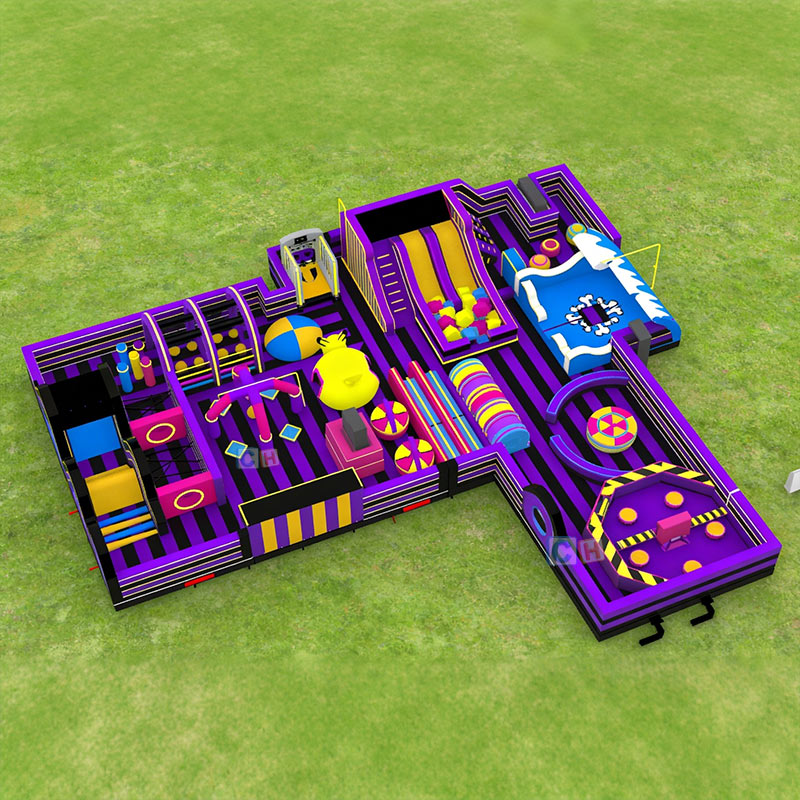
For these giant setups, we often recommend a strategic anchoring plan combining:
- Water barrels (which are heavier than sandbags).
- Concrete blocks (Jersey barriers).
- Tying off to existing fixed structures (fences, vehicles, or lamp posts) where safe.
Truth #3: Regulatory standards matter (ASTM & EN14960)
If you fit the profile of a pro in the US, Europe, or Australia, your opinion on Inflatable Sandbags vs Stakes matters less than what the law says.
Understanding ASTM wind rating compliance
In the United States, ASTM wind rating compliance (Specifically ASTM F2374) dictates safety practices. While ASTM sets the standard, here is the catch.
It emphasizes that the unit must be anchored according to the manufacturer's manual. Most manufacturers, including CH Inflatable, provide wind ratings up to 15-25 mph.
However, these ratings assume perfect anchoring. If you substitute stakes for insufficient sandbags, you void that wind rating compliance immediately.
EU standards and global safety
For our clients in Germany, France, and Spain, the CE EN14960 certification is the bible.
CH Inflatable holds this certification, ensuring our units meet global safety benchmarks. European standards are often stricter.
They look closely at the number of anchor points per meter of the inflatable’s perimeter.
- They require specific calculations for anchor pull-out force (usually 1600 Newtons per point).
- This makes the Inflatable Sandbags vs Stakes choice critical. Achieving 1600N with sandbags requires massive ballast that most small vans cannot even transport.
This is why "Blow-over"—the catastrophic failure event rental companies fear—is often a result of ignoring these standards on hard surfaces.
Truth #4: Your anchor point is only as strong as the inflatable
You can win the Inflatable Sandbags vs Stakes debate by having the heaviest anchors in the world.
But it means absolutely nothing if the attachment point on the bouncy castle rips off.
Why manufacturing quality impacts anchoring
I heard an expert say once: "You can have a concrete truck as an anchor, but if your D-ring rips off the vinyl, the unit is still flying away."
This is where manufacturing quality becomes a safety feature. At CH Inflatable, we have spent 17 years perfecting the anchor points:
- Stainless Steel D-buckles: We upgraded from standard steel. They act as the bridge between your Heavy duty steel stakes and the unit. Rust-proof and waterproof.
- Automotive Webbing: The strap holding the D-ring is the same quality material used in car seatbelts.
- Double Reinforced Stitching: Every corner and stress point features multilayer sewing so the vinyl doesn't tear under load.
Case study: slides vs. bouncers
The profile of the unit affects the Inflatable Sandbags vs Stakes decision. High-profile units like the Large Cartoon Inflatable Trampoline Castle with Pool exert significantly more lift force.
Slides act like giant sails. The taller the slide, the more leverage the wind has to tip it over.
- We use 0.55mm 1300D PVC for standard bouncers.
- For water slides and parks, we upgrade to 0.9mm 1300D PVC.
This heavier material adds deadweight to the unit itself, but it also requires stronger anchor points to handle the increased stress.
Truth #5: The redundancy rule (safety factors)
Professional operators know that safety is about redundancy. The debate of Inflatable Sandbags vs Stakes shouldn't be about doing the bare minimum.
The 45-degree rule & spacing
When using Heavy duty steel stakes, the angle of insertion is critical. A stake driven straight down (vertically) has weak holding power.
You need to drive it at a 45-degree angle away from the inflatable. This maximizes the soil grip.
- Crucial Tip: Ensure the stake head is driven flush to the ground to prevent kids from tripping.
- For sandbags: They must be taut. A loose strap allows the inflatable to gain momentum before it hits the resistance, snapping the strap.
When to cancel the event
There is industry slang we use called "Calling it." This is the decision to shut down operations due to wind speed.
Regardless of whether you use Inflatable Sandbags vs Stakes, if wind speeds exceed the manufacturer’s rating, you must deflate.
Typically, this is around 15-20 mph. No amount of stakes or sandbags can safely hold a commercial inflatable in a 40 mph gale. Don't risk it.
Frequently Asked Questions (FAQ)
How many sandbags are needed for a standard commercial bounce house?
This is the most common question in the Inflatable Sandbags vs Stakes debate. It depends on the wind rating and size.
Typically, if stakes are not used, you need approx 4-6 sandbags of 50lbs+ per anchor point. One bag per corner is negligent.
You must use the Deadweight anchor calculation to match the holding power of stakes.
Are steel stakes always superior to sandbags for outdoor setups?
Yes, generally speaking. For grass, dirt, or soil surfaces, 18-inch to 40-inch Heavy duty steel stakes provide superior resistance.
They combat lift and drag far better than portable weights. They mechanically lock into the earth, utilizing Soil holding capacity to create a secure hold.
How do I anchor an inflatable slide on concrete surfaces?
You must use Commercial ballast weights, water barrels, or concrete blocks tied to the low anchor points. Since you cannot penetrate the ground, you rely on friction.
Ensure the friction is high—use rubber mats under bags—to prevent sliding. Never use light household weights for a slide; the wind load is too high.
Conclusion
The debate of Inflatable Sandbags vs Stakes isn't really a debate—it is a choice dictated by terrain and physics.
While Heavy duty steel stakes are scientifically stronger for ground holding due to shear strength, sandbags are a necessary tool for hard surfaces.
The bottom line is that neither method works if the equipment itself is cheap. Safety starts with the manufacturing quality.
CH Inflatable’s 17 years of experience, CE/UL certifications, use of YKK zippers, and HW blowers ensure the unit stays intact under stress.
When you combine Stainless Steel D-buckles with the correct anchoring strategy, you secure your fleet and your reputation.
Don't risk your reputation on poor equipment. Equip your rental business with the safest, reinforced inflatables on the market.
Browse our inventory of commercial-grade slides and castles supported by 1300D PVC strength.
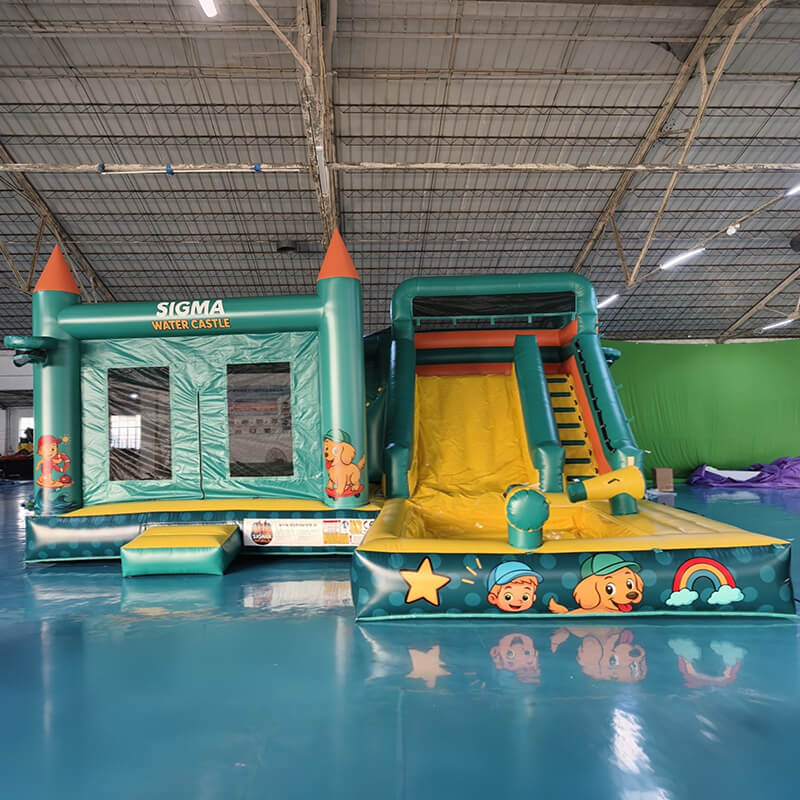
Image by: Matheus Bertelli
https://www.pexels.com/@bertellifotografia