
Repair Inflatable Slide Baffles: 3 Expert Stability Fixes

Repair Inflatable Slide Baffles: 3 expert stability fixes
Internal structure failure? Learn how to Repair Inflatable Slide Baffles quickly. Our 1300D PVC internal reinforcements prevent sagging. Request a quote!
Introduction
Picture this scenario. It is the absolute nightmare for any rental business owner. You are at a customized event, maybe a high-stakes corporate party or a jam-packed carnival.
You look over at your centerpiece attraction. Instead of a sharp, structured slide, you see a shapeless, ballooning mess. The slide floor has bubbled up, blocking the sliding lane entirely.
This isn't just an aesthetic issue; it is a serious safety hazard and a total reputation killer. In the industry, we call this a "blown baffle," and it turns your ROI machine into dead weight.
Knowing how to Repair Inflatable Slide Baffles is a crucial skill for maintaining profitability on your inventory. While minor tears can be patched, internal structural failures require a surgeon's steady hand and specific knowledge of I-beam mechanics.
In my 17 years of experience at CH Inflatable, I’ve seen this happen countless times with cheaper units. While repairs are possible, investing in high-quality manufacturing—like our 1300D PVC internal reinforcements—drastically reduces these occurrences.
Below, I will walk you through 3 expert methods to fix this, ranging from adhesive fixes to structural sewing, so you can get your unit back in rotation.
Diagnosing internal structural failures
Before you grab your sewing awl or glue, hold on. You must confirm the diagnosis first. Not all distortion means a leak, and not all soft spots are puncture wounds.
Identifying "vinyl mattress bulging"
Visually, a blown baffle is unmistakable once you know what to look for. We often refer to vinyl mattress bulging as a "hernia" on the inflatable.
The Symptom: Instead of a flat slide lane or a flat jumping surface, the area balloons outward into a round cylinder.
The Cause: The internal fabric wall (the baffle) that holds the top and bottom layers of vinyl equidistant from each other has torn away.
The Result: Without that internal tether, the air pressure forces the vinyl to expand to its maximum capacity, creating a round shape rather than a flat one.
If your slide looks like it has a giant tumor growing in the middle of the lane, you have a baffle issue on your hands.
Distinguishing between seam leaks and baffle blowouts
It is vital to distinguish between an air leak and a structural failure.
Air Leak: You hear hissing. The unit feels soft overall. The shape is generally correct, but it lacks firmness.
Baffle Blowout: The unit is firm (and holds air well), but the shape is distorted.
Diagnosing this correctly saves you hours of hunting for a nonexistent hole. As discussed in community forums, identifying the specific internal tear can be tricky because you cannot see inside while it is inflated.
For a deeper look into the frustrations of community members dealing with this, take a look at this discussion on r/CampingGear on Reddit: Any way to repair blown baffles?. It highlights exactly why professional manufacturing matters.
Anatomy of a blowout: why baffles fail
To effectively Repair Inflatable Slide Baffles, you have to understand the physics of what went wrong inside.
Understanding internal cross-link failure
Inflatables are built using I-Beam construction. Imagine thousands of fabric strips connecting the floor to the ceiling inside the mattress.
Internal cross-link failure occurs when:
- The thread connecting these strips rots due to moisture.
- The fabric strip itself tears under pressure.
- The glue/weld fails (in heat-sealed units).
When one link breaks, it puts extra stress on the neighboring links. Like a zipper unzipping, the neighboring baffles often fail in rapid succession, turning a small bump into a massive bulge.
The role of material quality (0.55mm vs. cheap vinyl)
I cannot stress this enough: "Paper-Thin Internals" are the enemy of longevity.
Many budget manufacturers use high-quality vinyl for the shell (what the customer sees) but use scrap, off-color, or thinner material for the internal baffles to save cost.
At CH Inflatable, we do not cut corners.
- Our Standard: We utilize 0.55mm 1300D PVC for internal baffles in our dry slides.
- Water Slides: For wet units, we step up to 0.9mm 1300D PVC to withstand the extra weight of water and movement.
This ensures the inside is as tough as the outside. When you attempt to Repair Inflatable Slide Baffles on cheap units, you often find the internal material is too brittle to even hold a new stitch.
| Parameter | Budget Manufacturers | CH Inflatable Standard |
|---|---|---|
| Internal Material | Scrap vinyl or thin 420D nylon | 0.55mm - 0.9mm 1300D PVC |
| Stitching Type | Single stitch, cotton thread | Double/Quadruple stitch, bonded nylon |
| Failure Risk | High (Chain reaction tearing) | Low (Reinforced stress points) |
| Repairability | Difficult (Fabric rips easily) | High (Rugged material holds stitches) |
Method 1: The "internal surgery" technique
This is the most invasive but most permanent fix. It involves physically entering the unit to sew the baffle back together.
Accessing the interior chamber
To perform this "surgery," you need access.
First, check for Deflation Zippers. High-end units usually feature large YKK deflation zippers. Open these fully.
Safety comes first with this. Never enter a deflated unit alone. I always advise having a "spotter" outside to hold the fabric open for airflow and to assist you in exiting.
If there are no zippers near the damage, you may have to cut a slit in the bottom or side of the unit to crawl in—a "C-Section" of sorts. You will patch this exit wound later.
I-Beam construction restoration
Once inside, locate the torn baffle.
- Prep: Clean the area. Remove old, rotted threads.
- Stitch: You are performing I-beam construction restoration. You must sew the baffle material back to the floor or ceiling vinyl.
- Thread: Do not use cotton thread. Use high-tensile, rot-resistant bonded nylon thread (Tex 90 or higher).
This is back-breaking work in a confined space, but it is the only way to restore the original flat shape perfectly and Repair Inflatable Slide Baffles permanently.
Method 2: Chemical bonding with commercial adhesives
If sewing is impossible due to the location, chemical bonding is your next best option to Repair Inflatable Slide Baffles.
Choosing the right commercial PVC adhesives
Put down the Superglue. Consumer-grade glues will turn brittle and crack under the constant flexing of an inflatable.
You need commercial PVC adhesives designed for flexible vinyl. Look for rapid-curing vinyl cements (like HH-66 or similar industrial grades).
As noted in industry repair guides, selecting the wrong glue can actually melt your vinyl or fail immediately under pressure. For more on general damage repair, check out Repair The Common Damage of Bounce House.
Applying the patch from the inside
The "Sandwich Method" works best here.
Apply glue to the torn baffle flap. Apply glue to a new strip of 18oz vinyl (the patch). Press them together firmly.
Ideally, apply a second patch on the reverse side to "sandwich" the tear, doubling the strength.
Method 3: Structural seam reinforcement
Sometimes the baffle hasn't torn, but the seam connecting it to the outer wall has unraveled.
Reinforcing high-stress zones
For slides that take heavy abuse (adults or teenagers), simple stitching isn't enough. You need structural seam reinforcement.
This involves using heavy-duty webbing (similar to seatbelt material) to back the repair. When you sew the baffle back on, you sew through the Baffle + Vinyl + Webbing.
This distributes the tension across a wider area, preventing the thread from slicing through the vinyl like a cheese wire.
External stitching techniques
If you absolutely cannot access the inside, you will have to work from the outside.
Pinch the bulging vinyl from the outside of the unit to recreate the baffle shape. Use a heavy-duty sewing awl to stitch through the top layer, catching the loose baffle inside. This requires extreme skill and luck to catch the internal fabric.
Seal the needle holes with liquid PVC.
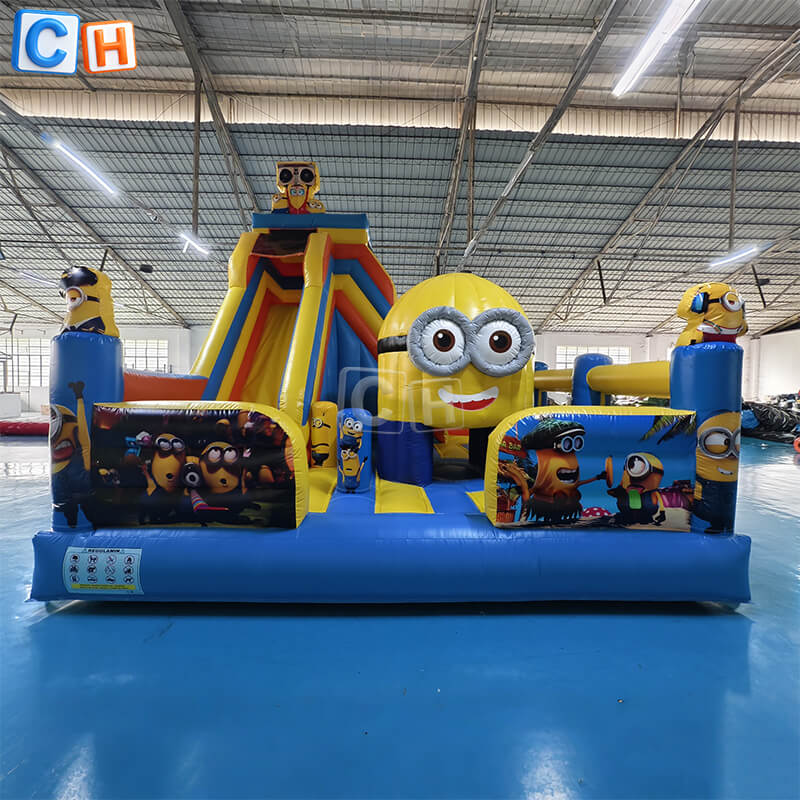
High-quality units mitigate this risk entirely. For example, our Minions Inflatable Bounce with Slide utilizes double stitching at these stress points and internal reinforcement strips to prevent the need for these difficult external repairs.
Video tutorial: visualizing the repair
To better understand how to identify leaks and Repair Inflatable Slide Baffles, this visual guide is highly recommended:
Preventing future failures: the CH Inflatable standard
The best way to fix a baffle is to never have it break in the first place. At CH Inflatable, we build our units for the rental trenches.
Material specs: 1300D PVC & webbing upgrades
We don't use generic vinyl. We use verified 1300D PVC with high tear resistance.
0.55mm Thickness: This is our standard for all bounce houses and dry slides.
0.9mm Thickness: Used for inflatable water slides and inflatable water parks to handle extreme stress.
We apply what the industry calls "Bomb-proof Stitching." Every internal stress point is reinforced with extra webbing strips, ensuring the baffle tears before the seam fails (which is actually easier to fix).
Hardware reliability (YKK, HW blowers, stainless D-buckles)
Believe it or not, your blower affects your baffles. Cheap blowers have inconsistent pressure, causing the unit to sag and surge, flexing the baffles unnecessarily.
We supply HW Blowers (CE certified) which provide stable, consistent air pressure.
Also, we use upgrading Stainless Steel D-Buckles. Secure anchoring prevents the unit from twisting in the wind, which destroys internal geometry.
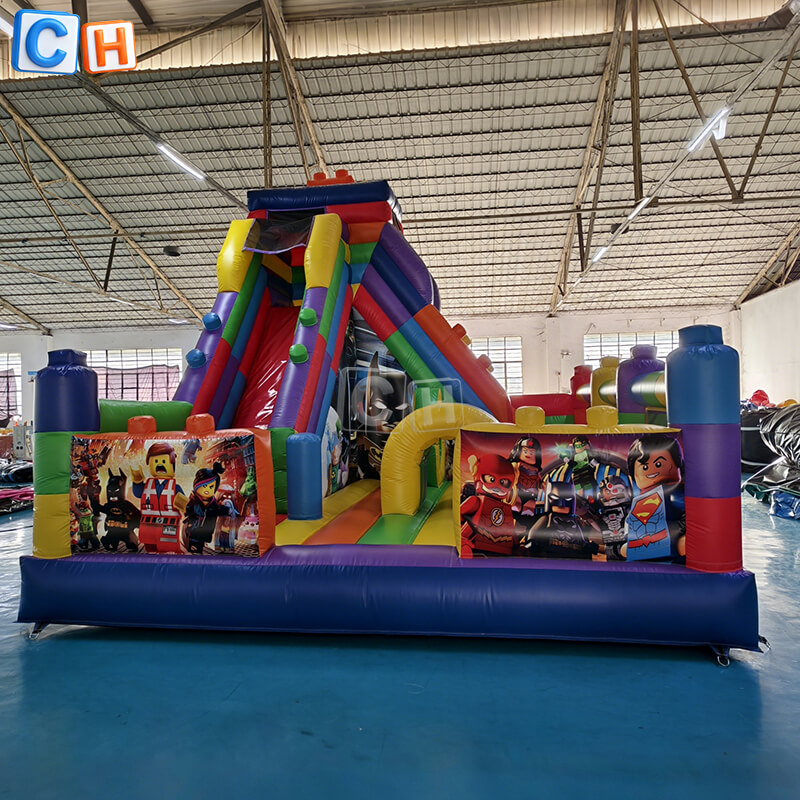
For larger commercial units which face immense pressure, such as our Inflatable Bounce with Double Slides, we feature reinforced corners to distribute tension evenly, protecting those critical internal cross-links.
Frequently asked questions (FAQ)
How do I identify a broken internal baffle in a giant slide?
You will see it immediately. Look for the signature "bulge" or distorted shape where the slide floor should be flat. Instead of a smooth ramp, it often looks like a "hernia" or a large bubble protruding from the surface. This confirms the internal wall has failed and you need to Repair Inflatable Slide Baffles.
Can broken cross-beams be fixed without cutting the outer vinyl?
Only if the unit is equipped with adequate service zippers. High-end units, like those from CH Inflatable, use YKK zippers to allow internal access. If your unit lacks these, you will have to perform a "C-Section"—cutting an access hole in the bottom or side—to reach the damage, which then must be patched.
Why do my baffles keep blowing out?
This is usually a sign of "High-pressure fatigue" combined with poor materials. If you are using powerful blowers on a unit made with weak internal fabric (lower than 1000D), the internals cannot handle the tension. Upgrading to CH Inflatable units with 1300D PVC internals resolves this.
Conclusion
A blown baffle doesn't have to be a death sentence for your inflatable, but it is a massive wake-up call regarding equipment quality.
Whether you choose the "Internal Surgery" method, chemical bonding, or structural reinforcement, ensuring you know how to Repair Inflatable Slide Baffles is essential for your business continuity.
However, let's be honest: constant repairs are a drain on your time and profits. The real solution is durability from the start.
Don't let equipment downtime kill your rental income again. If you are tired of patching cheap vinyl and dealing with unhappy clients, it is time to upgrade your inventory.
Contact CH Inflatable today for a quote on custom slides built with reinforced 1300D PVC, UV-resistant coating, and automotive-grade webbing. We have been supporting rental businesses globally for 17 years—let us help you build a fleet that lasts.
Image by: 85 LENS (Ngô Hoàng Auth)
https://www.pexels.com/@longlens