Zero Gaps: 5 Expert Tips for Connecting Modular Inflatables

Zero gaps: 5 expert tips for connecting modular inflatables
Let's be real for a second. Every rental business owner’s biggest nightmare is receiving that specific phone call.
You know the one: a child has slipped through a gap in your massive setup. It’s a gut-wrenching scenario.
As the industry shifts toward massive "Fun Cities," the safety risks multiply with every single seam.
If you don't master Connecting Modular Inflatables correctly, you aren't just risking expensive air loss.
You play a dangerous game with participant safety and your business reputation. That's a risk you can't afford.
From the USA to the Middle East, "Fun Cities" are the new gold standard in event rentals.
However, they introduce a tough challenge: ensuring multiple units function as one cohesive, safe structure.
This is where real expertise counts. At CH Inflatable, we have spent over 17 years perfecting the seamless joint.
We use 0.55mm 1300D PVC and industrial design standards. Once units are linked, they stay linked.
Whether you run a rental business in Germany or an event company in California, this guide is your blueprint.
Here are 5 expert tips to eliminate gaps, ensure air retention, and master the art of Connecting Modular Inflatables.
The "sandwich style" velcro system: industry standard
The most critical component of Connecting Modular Inflatables is the bonding system itself.
If you are relying on a single strip of Velcro to hold two massive 500lb units together, you are asking for trouble.
In the professional sector, we utilize what is known as sandwich velcro bonding.
Forget the standard hook-and-loop setup you find on a backyard jumper entrance. This is different.
How the "sandwich" works
Think of it as a multi-layer security system for your vinyl.
First, you have the Male Velcro located on the edge of Module A.
Second, we use a Connector Strip, a double-sided heavy-duty adapter that bridges the gap.
Third, the Female Velcro located on the edge of Module B locks it in.
Finally, a Cover Flap made of 0.55mm PVC goes over the entire connection to seal it.
This method creates multiple layers of redundancy. Even if the internal connector slips, the external cover flap maintains the seal.
Material matters
At CH Inflatable, we have seen competitors try to save a buck by using 2-inch wide Velcro.
That is simply insufficient for commercial use. We use industrial-grade fastening materials that are significantly wider.
Our Velcro is tested to withstand thousands of attach-detach cycles without losing its "grip."
This is vital because Connecting Modular Inflatables involves constant setup and teardown.
To better understand Connecting Modular Inflatables, this video tutorial is highly recommended:
https://www.youtube.com/watch?v=wabwimTMIB4
Why heavy-duty is standard
When you look at massive setups, standard bonding fails every time. We implement this heavy-duty sandwich system on all our large-scale units.
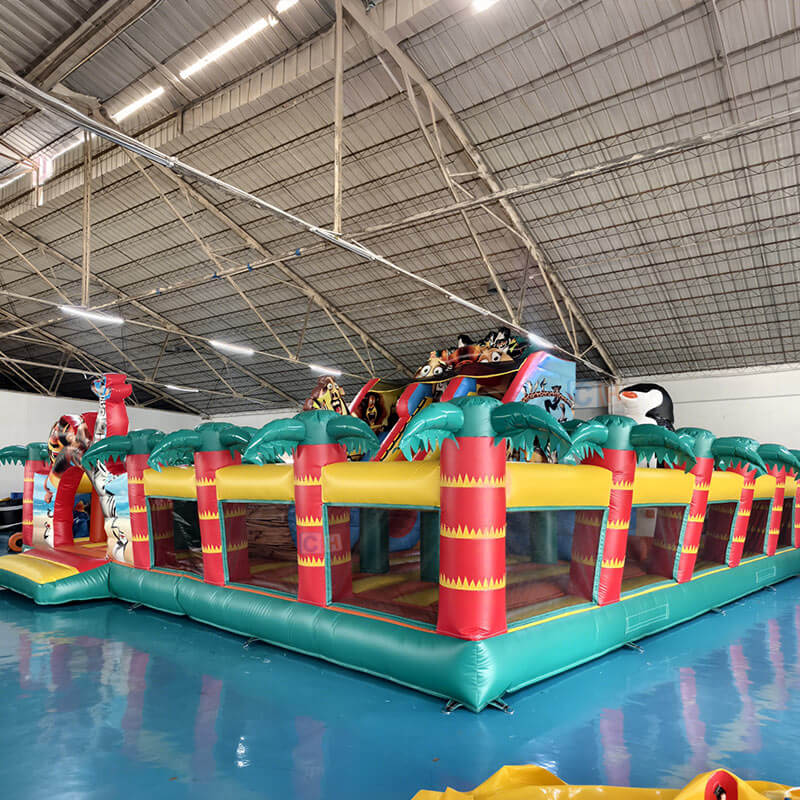
You can imagine the tension forces at play in a massive setup like our Madagascar-themed Giant Inflatable Fun City.
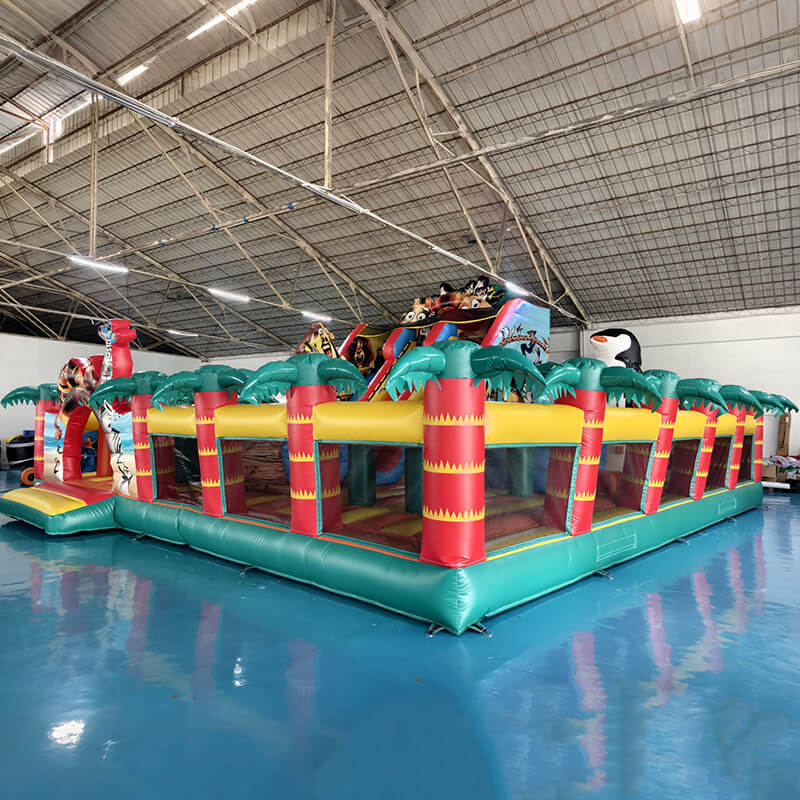
Without sandwich velcro bonding, a unit of that size would separate under the weight of dozens of users.
Aligning airflow for seamless inflatable transition
A common mistake I see among new operators is treating modules like separate islands.
Even though they may have separate blowers, they must act as one pneumatic system.
When Connecting Modular Inflatables, you are essentially trying to create a seamless inflatable transition.
The "butt-wait" phenomenon
If the airflow pressure isn't balanced or the connection isn't flush, you get what we in the industry call the "Butt-Wait."
This is that awkward "dead spot" or dip between two sections where the user steps down into a soft, squishy seam.
It kills the momentum of the run and poses a significant trip hazard.
To prevent this "Squishy Seam," ensure both units are fully inflated before finalizing the Velcro seal.
Push the units tightly together so the internal walls press against each other firmly.
Also, double-check that the blower capacity is equal for both sections.
Technical detail: YKK zippers
Pressure management is key here. We utilize high-quality YKK zippers on our deflation flaps, often located near connection points.
These allow for rapid air release during teardown, which is a huge time saver.
More importantly, they ensure the unit holds strong pressure right up to the connection edge.
A firm edge makes Connecting Modular Inflatables much easier and safer for the end-user.
Anchoring hardware: D-rings vs. tension
Velcro handles the gap closure, but it should never be the only thing holding your park together.
In my experience, relying solely on Velcro is the number one cause of separation during high winds.
Hardware plays the structural role in the process of Connecting Modular Inflatables.
Stainless steel for longevity
At CH Inflatable, we have upgraded our anchoring hardware to Stainless Steel D-buckles.
Many cheaper manufacturers use galvanized steel, which eventually rusts, stains the vinyl, and weakens.
Our stainless steel options are waterproof, rust-proof, and designed for rigorous outdoor use.
Automotive standard webbing
The D-ring is only as good as the strap holding it.
We use upgrading webbing technology that is on par with automotive seatbelt standards.
When you connect two modules, you should be strapping the bottom D-rings of Module A to Module B.
Using a heavy-duty ratchet strap or carabiner takes the tension off the Velcro.
Don't let the wind win
I always tell my clients: "Never rely on Velcro alone to hold modules against wind loads."
The D-rings provided at the base are your primary defense against separation.
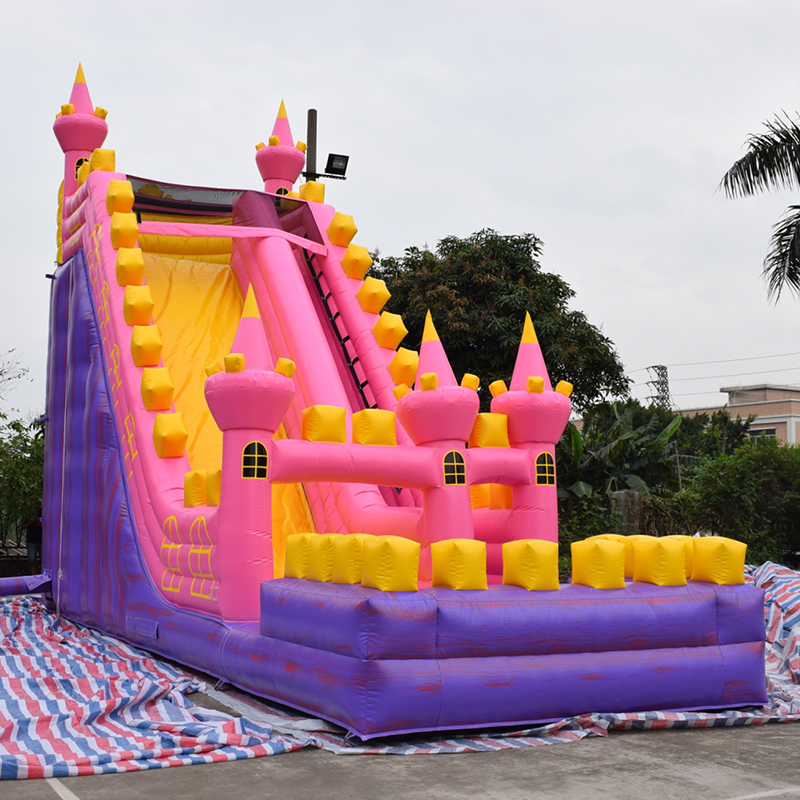
This rigorous hardware standard is essential for a Long-Lasting commercial water slide inflatable, where safety is non-negotiable.
Preventing air leakage at connection points
One of the most frustrating aspects of Connecting Modular Inflatables is hearing that tell-tale hiss.
Preventing air leakage is all about precision. Leaks usually happen specifically at the joints of inflatable section linking.
The anatomy of a leak
If you hear air escaping, it usually points to a few specific culprits.
Here is a quick breakdown of what to look for when inspecting your connections:
| Symptom | Likely Cause | Quick Fix |
|---|---|---|
| Loud Hissing | Wrinkled internal connector strip | Detach and smooth out the Velcro flat. |
| Soft Sinking | Zipper slightly open near joint | Check YKK zippers under the flaps. |
| Visible Gap | External flap not centered | Re-align the cover flap to overlap evenly. |
The "bleed-out"
In industry slang, we call excessive air loss at the joints "Bleed-out."
If you have too much bleed-out while Connecting Modular Inflatables, your blowers have to work overtime.
This generates unused heat and wastes electricity, hurting your bottom line.
The flap overlap solution
To minimize this, examine the geometry of the cover flap. It must be wide enough to cover the Velcro line completely.
When performing inflatable section linking, smooth out the Velcro with your hand flat against the vinyl.
Any microscopic wrinkle provides a tunnel for air to escape. Be meticulous here.
Furthermore, ensure that any zippers near the connection are fully closed.
Pat down the velcro cover over the zipper securely to seal the deal.
Modular obstacle course assembly best practices
Organizing a 500ft run requires strategy. Modular obstacle course assembly starts before you even unroll the units.
Planning the layout
Layout is everything. You need to verify the ground is absolutely flat.
A dip in the terrain at a connection point will force the Velcros to pull apart.
Top manufacturers globally, similar to principles found in Wibit Inflatable Modules – Build Your Perfect Waterpark, rely on modular consistency.
Material consistency
A major issue in Connecting Modular Inflatables arises when operators mix units from different suppliers.
If you connect a unit made of 0.55mm PVC (like ours) to a cheaper nylon unit, trouble follows.
They will expand at different rates in the sun, tearing your connection apart.
Understanding the fabric properties, as discussed in Modular Inflatables - Chemprene, helps in predicting expansion.
Inconsistent materials lead to dangerous ridges and tripping hazards you want to avoid.
Inflating strategy
Here is an expert opinion you won't find in many manuals regarding Connecting Modular Inflatables.
"When connecting modules for an obstacle course, always inflate from the center module outwards."
Why? This reduces friction drag on the ground. If you start at one end, you fight gravity.
By the time you reach the fifth module, you are dragging thousands of pounds of vinyl to make the Velcro meet.
Center-out expansion allows for a more natural alignment and easier Connecting Modular Inflatables.
Troubleshooting and maintenance of connection systems
Your connection points are the highest wear areas on the unit.
To maintain the integrity of Connecting Modular Inflatables, routine inspection is required.
The enemy: fuzzing and dirt
Velcro relies on the "Hook" and the "Loop." Over time, the loop side can get "fuzzed" out.
More importantly, sand is the enemy. It kills the grip instantly.
If you operate on beaches or dusty fields, sand grains get stuck in the hooks preventing a lock.
Tip: Use a stiff wire brush or a simple plastic comb to regularly clean out debris.
"Velcro burn"
We also watch out for "Velcro Burn." This happens when the connection is sloppy.
If the rough "hook" side of the Velcro is exposed, it can scrape the user’s skin.
If you don't align the cover flap perfectly while Connecting Modular Inflatables, a child sliding across can get an abrasion.
This is a safety hazard that is easily preventable with a quick visual check.
The CH Inflatable advantage
Our manufacturing process includes double-stitching and corner reinforcement at every Velcro attachment point.
We know these areas are pulled, yanked, and stepped on constantly.
By reinforcing the stitching, we prolong the life of the connection points, so your investment lasts.
Frequently asked questions (FAQ)
How do I secure gaps between modular inflatable sections to prevent injury?
You must utilize the "Sandwich Velcro" method for securing gaps. This involves connecting the central heavy-duty strip that bonds the two units internally first. Then, secure the safety cover flap over the seam. Crucially, ensure ground stakes on both units are staked down tightly to minimize movement when Connecting Modular Inflatables.
Why is my modular inflatable losing air at the connection points?
This is usually a setup error. To succeed in preventing air leakage, check for misaligned Velcro strips or wrinkles in the bonding tape. Also, inspect the deflation zippers located near the connection. Ensure the "sandwich" is tight, flat, and flush to stop the leak.
Can I connect inflatable units from different manufacturers safely?
Generally, no. Different manufacturers utilize different Velcro widths and connection heights. For maximum safety and seamless Connecting Modular Inflatables, stick to a single ecosystem like CH Inflatables. This ensures 100% compatibility in height, pressure, and bonding strength.
Bottom line
Mastering the art of Connecting Modular Inflatables is what separates the amateur rental guys from the pros.
By utilizing the Sandwich Velcro system and verifying your airflow alignment, you win.
Relying on heavy-duty stainless steel anchoring creates a Zero Gap environment.
This keeps the setup safe for children and profitable for you. Safety starts at manufacturing.
With CH Inflatable, you are partnering with a company that boasts 17 years of experience.
We build our units with 0.55mm 1300D PVC and reinforced seams specifically to prevent connection failures.
Don't let a gap ruin your business reputation.
Ready to expand your rental inventory with safe, seamlessly connecting units? Contact CH Inflatable today.
Get a quote on our customized, heavy-duty modular fun cities and obstacle courses. Let's build your success together.
Image by: Saviesa Home
https://www.pexels.com/@saviesa-home-1098995