Dominate Sales: 5 Inflatable Park Capacity Management Tips

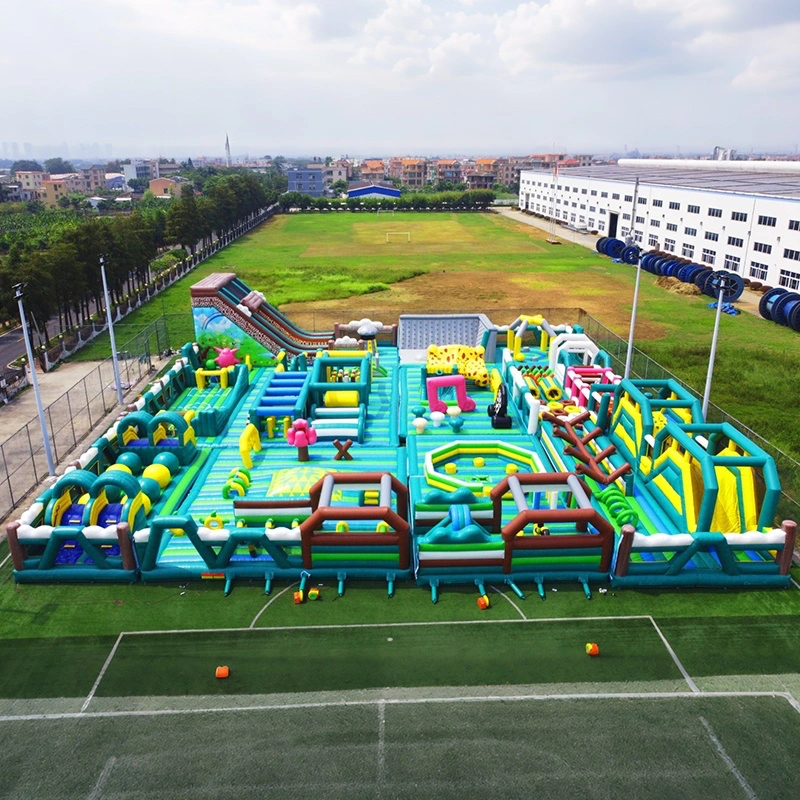
Dominate sales: 5 inflatable park capacity management tips
Master inflatable park capacity management to handle high traffic wisely. Boost safety and hourly revenue with CH Inflatable solutions. Inquire now!
Introduction
Picture the "nightmare scenario" for any rental business owner. It is a sunny Saturday, your venue is packed, and kids are screaming with excitement.
But then, chaos strikes.
Lines are stagnating. Parents are grumbling about wait times. Your staff looks totally overwhelmed.
While high traffic is the goal, poor management turns this dream into a liability fast. Crowded venues without a plan lead to safety risks and bad reviews that stick forever.
The solution isn't just hiring more bodies; it is mastering inflatable park capacity management.
Optimizing the flow of guests effectively is your key lever to scaling revenue. When you manage capacity effectively, you process more ticket sales per hour while actually increasing safety.
At CH Inflatable, we have spent 17 years watching our clients succeed. We build commercial-grade units using 0.55mm to 0.9mm 1300D PVC specifically engineered to support high-occupancy operations.
Here is the kicker: turning a crowded park into a profit machine is easier than you think if you follow these steps.
Strategic layout design for guest throughput optimization
The foundation of successful inflatable park capacity management lies in your floor plan.
I have seen brilliant parks fail simply because they placed a popular, slow-moving attraction right at the entrance.
Conducting a choke point analysis
Before you inflate a single unit, map out the flow. You need to identify potential bottlenecks.
In the industry, we call this choke point analysis. You are looking for specific areas where guests are likely to get stuck.
Common culprits include:
- Single-lane slides in high-traffic zones.
- Narrow entryways between giant units.
- "Dead ends" where kids have to turn around against the flow of traffic.
If you don't address these, you get "traffic jamming." This frustration kills the user experience.
Your goal is simple: create a layout where movement is continuous.
Selecting high-capacity modular units
To solve bottle-necking, your equipment choice matters as much as the placement. You need units designed for guest throughput optimization.
Small bounce houses are great for backyard parties. But for a commercial park, you need "people eaters"—units that accept multiple users simultaneously.
To maximize space and user flow, consider integrating a massive centerpiece like the Large Inflatable Water Park.
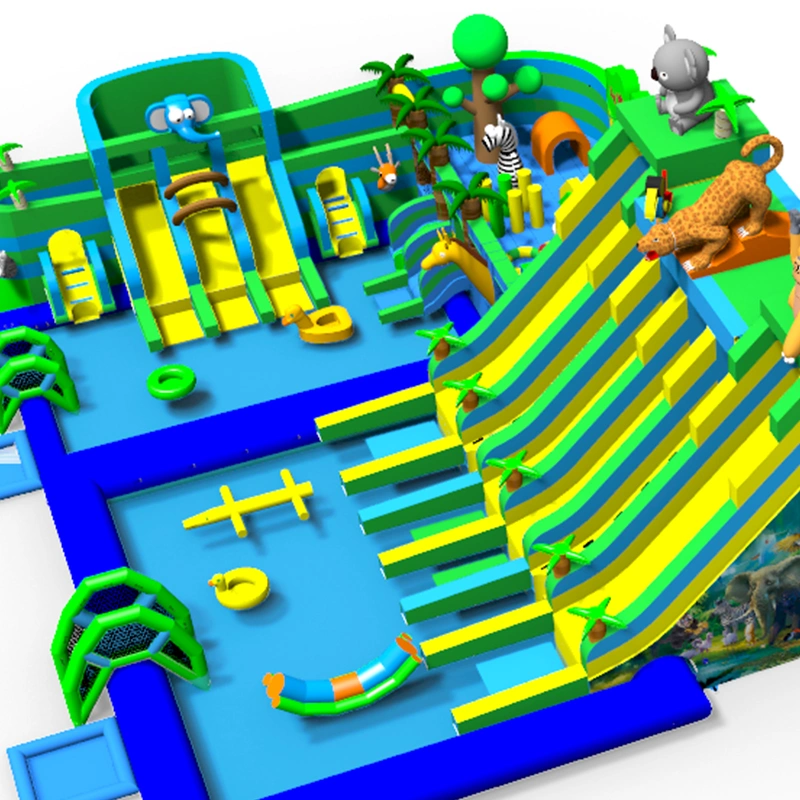
These large-scale layouts allow users to disperse across different sections rather than waiting in a single line for one slide.
Zoning for different age groups
Another secret to effective inflatable park capacity management is standard zoning.
Mixing teenagers with toddlers is a recipe for injury and slow-downs. Teenagers play aggressively; toddlers play tentatively.
Try splitting your park like this:
- Zone A (Toddlers): Soft play, smaller bounces, open sightlines.
- Zone B (General): Large obstacle courses and slides.
- Zone C (Teens/Adults): Extreme wipeout zones and high slides.
By separating these groups, you ensure the "fast lane" users don't run over the "slow lane" users.
Operational crowd control and staffing protocols
Even the best layout fails without human intervention. This is where operational crowd control comes into play.
Implementing active monitoring systems
A common mistake I see in startup rental businesses is "passive staffing." This is where the attendant stands by the blower, just watching.
Operational crowd control requires active direction. Staff should trigger movement like traffic cops.
They need to keep the line moving and encourage kids to exit the slide area immediately after landing.
Rule of thumb: Ensure a staff-to-guest ratio that provides 100% eyes-on coverage of high-risk areas.
Timed sessions and wristband coloring
You cannot let everyone stay forever. To maximize revenue, you must cycle groups effectively.
The most successful parks use a colored wristband system to manage timed sessions (e.g., 60 or 90 minutes). Every hour, a color is called to exit.
This allows you to clear the floor and perform a quick safety sweep. It creates a rhythm for your business.
You can learn from successful operational models like Infinity Funpark regarding park management. They have mastered rotating guests to maintain high energy.
Maximizing hourly turnover rate with "flow" attractions
Your inflatable park capacity management strategy is directly tied to how fast users move through an attraction.
This is your hourly turnover rate.
The role of obstacle courses
Static bounce houses have a low turnover rate because kids just jump in one place. Obstacle courses are superior for revenue.
It is linear: Start -> Obstacle -> Slide -> Exit.
This keeps users moving forward. It prevents loitering and allows you to pulse large groups through the unit efficiently.
For continuous movement that prevents lines from stalling, deploy units like the 36ft Alien theme inflatable obstacle course.
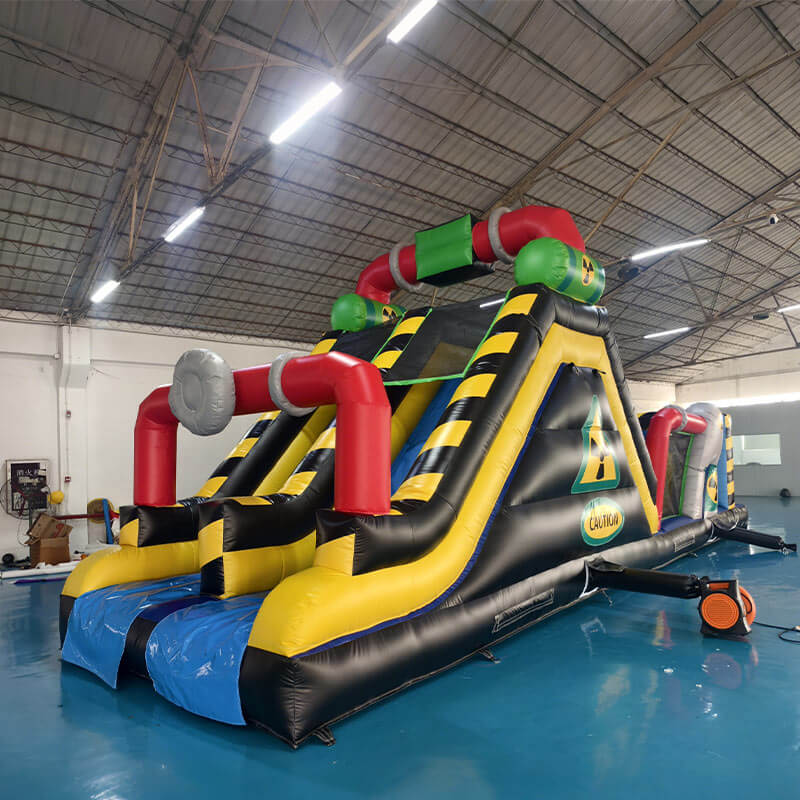
When guests are constantly moving, they feel like they are getting more value. Meanwhile, you are processing more people per hour.
Rapid entry and exit procedures
The entry and exit points are the valves of your business.
I often advise clients to create a "positive flow" where the exit of one attraction naturally leads to the queue of the next.
This keeps the crowd dispersed rather than clustering in the center of the park.
Mastering queue system efficiency
Nobody likes waiting. However, if they must wait, queue system efficiency determines whether they stay happy.
Designing the waiting experience
You need to define the space. If lines are undefined, they become mobs.
- Use snake-line barriers (stanchions) to save space.
- Place signage indicating estimated wait times.
- Keep the line visible to the action so anticipation builds.
See how venues like Super Llama Parties manage indoor flow. Their setup ensures the fun begins visually before the child even steps onto the inflatable.
Digital vs. physical queuing
In the age of technology, some parks use virtual buzzers. However, for inflatable park capacity management, physical lines often work better.
Why? Because of social proof.
When passersby see a line, they assume the attraction is amazing. A physical line attracts more customers.
Maintenance and cleaning during high traffic
You cannot ignore hygiene just because you are busy. But how do you clean without stopping the money flow?
Quick-clean protocols between sessions
Between wristband sessions, execute a "spot-check" protocol.
| Action Step | Standard Protocol | High-Traffic Turbo Protocol |
|---|---|---|
| Sanitize | Full unit spray down (20 min) | Target "High Touch" zones: Handrails & Entries only (5 min) |
| Inspection | Detailed seam check | Anchor check & quick visual scan for stress points |
| Staffing | 1 Cleaner | "Swarm" team of 3 for rapid turnaround |
Focus strictly on high-touch areas. This builds trust with parents who are watching.
To better understand inflatable park capacity management cleaning routines, this video tutorial is highly recommended:
Material safety under load
This is where equipment choice is non-negotiable. When you have max capacity, the internal air pressure of cheap units will fail.
At CH Inflatable, we do not cut corners regarding safety.
- Materials: We use 0.55mm 1300D PVC for dry units and 0.9mm for water parks.
- Blowers: CE-certified blowers ensure that even when 20 kids are bouncing, the unit stays firm.
Why equipment quality dictates capacity limits
You can have the best plan in the world. But if a seam bursts, your park is closed.
The importance of stitching and reinforcement
Capacity limits are not just suggestions; they are based on structural integrity.
We use double stitching as standard on all our units. We also add extra layers at high-stress points.
This allows our clients to run at higher capacities safely. Cheap units require you to lower your capacity to avoid damage, which directly cuts your revenue.
Hardware reliability
Imagine a zipper failing during a fully booked 2 PM slot. That is a disaster.
We use YKK zippers—the gold standard—to ensure deflation only happens when you want it to.
Reliable hardware is the silent backbone of inflatable park capacity management.
Frequently Asked Questions (FAQ)
How do I calculate the maximum safe occupancy for my inflatable park?
Calculating safe occupancy is a vital part of inflatable park capacity management. Start by checking the manufacturer's tag (CH Inflatable follows EN14960). Generally, allow 1 square meter per user, but always adjust for user size (teens vs. toddlers).
What is the most efficient layout to prevent overcrowding during peak hours?
To really nail inflatable park capacity management, try a circular flow (counter-clockwise). Always separate your entry and exit points. Place your highest demand units at the back to draw people through the entire venue.
Bottom line
Mastering inflatable park capacity management is what separates a chaotic, stressful Saturday from a record-breaking sales day.
Focus on strategic layout design. Implement strict operational crowd control. Maximize your hourly turnover rate and refine your queue system efficiency.
Remember, high traffic should be a celebration, not a safety hazard.
Are you ready to upgrade your park with high-capacity, custom-built inflatables that can handle the crowds?
Contact CH Inflatable today.
With 17 years of experience, we support custom designs for clients in the USA, EU, and beyond. We provide CE-certified, heavy-duty commercial units featuring reinforced stitching and 0.55mm-0.9mm PVC materials. Let's build your park together.
Image by: Pixabay
https://www.pexels.com/@pixabay