
Stop Tilting: 5 Tips for Leveling Commercial Inflatable Slides

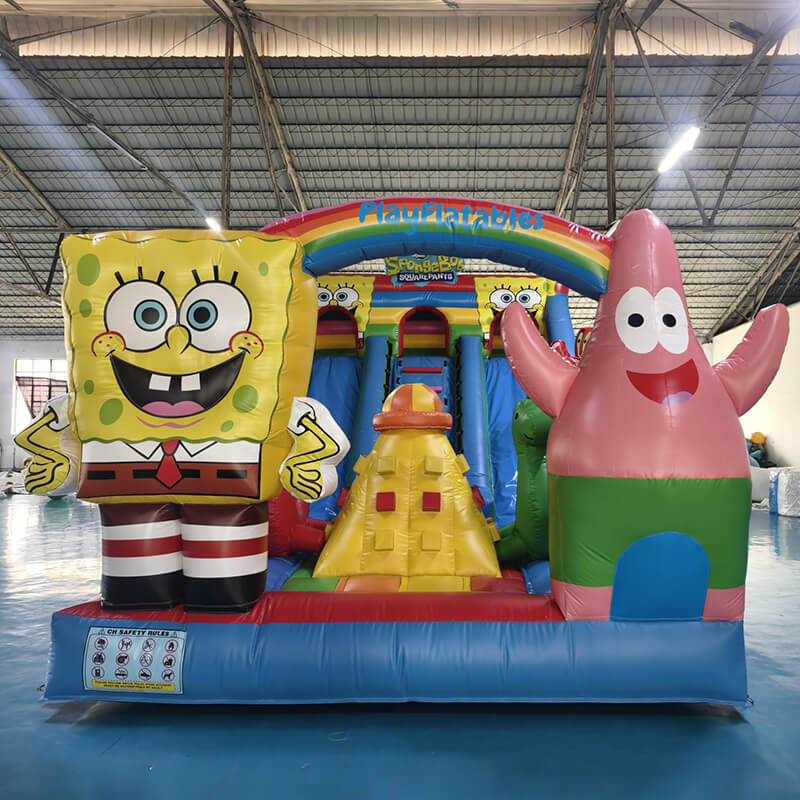
Stop tilting: 5 tips for leveling commercial inflatable slides
Uneven ground creates a messy setup. Master the art of Leveling Commercial Inflatable Slides to prevent tipping and keep your event safe. Get 5 stability hacks now!
Introduction
Picture this scenario. It is Saturday afternoon at a high-stakes corporate gig. You have deployed your best 20-foot dual-lane slide.
Suddenly, you notice the unthinkable. The massive structure is leaning dangerously to the left. The slide cover is bunching up bad.
This is the nightmare of every rental business owner. It creates immediate liability issues and flat-out ruins the customer experience.
Let's be real. In the event industry, finding "perfectly flat grass" is like finding a unicorn. Most backyards have hidden slopes.
Leveling Commercial Inflatable Slides isn't just about making the unit look pretty. It is a critical safety protocol.
If a slide tilts, the center of gravity shifts. This stresses the anchor points and risks a catastrophic tip-over. Standards like EN14960 are strict about this.
At CH Inflatable, we have spent 17 years manufacturing heavy-duty units. We use 0.55mm and 0.9mm 1300D PVC for rigidity.
But here's the kicker: even the best manufacturing can't defy gravity. Proper setup on the ground is on you.
Here are 5 essential tips to conquer uneven terrain and master Leveling Commercial Inflatable Slides.
1. Master ground preparation techniques before unrolling
Scouting and clearing the zone
Before you even drop the dolly, walk the site. Most operators kick away rocks to save the tarp, which is standard.
However, for Leveling Commercial Inflatable Slides, you must hunt for "soft spots." I've seen slides sink 3 inches into mud.
This creates an artificial tilt that wasn't there five minutes ago. Use your heel to test the soil density. Soft soil needs wider base plates.
Effective ground preparation techniques involve spotting molehills or tree roots. A high point acts like a fulcrum.
This makes the unit rock like a seesaw, making it nearly impossible to secure properly.
Grading vs. shimming
There is a big difference between fixing the ground and fixing the unit. In backyards, you can't start digging (grading).
So, shimming is your primary weapon. This involves placing materials under the low side to raise it.
If you are at a festival, minor grading might be allowed. Always ask the site manager first.
For a broader guide on setup, check this resource on How To Setup A Commercial Inflatable Water Slide. It gives a solid baseline.
2. Equip your team with proper slope assessment tools
Moving beyond the "eyeball test"
Don't trust your eyes. Optical illusions are everywhere, especially in parks where trees hide the horizon.
I’ve known veterans who swore a site was flat. Later, they realized they were on a 4-degree slope.
When Leveling Commercial Inflatable Slides, guessing is negligence. A twisted slide won't inflate right.
The internal baffles will torque. This can tear the vinyl over time, even with our double-stitched reinforcements.
You need professional slope assessment tools in your kit. If the unit twists, zippers jam or pop open.
Digital levels and laser line levels
Forget the tiny torpedo levels. Every truck needs a 4-foot spirit level or a digital angle finder.
These tools give you an exact degree reading. No guessing games.
For big slides, a rotating laser level is the gold standard. It checks all four corners instantly.
Industry Slang: "The Fall Line"
Identify "The Fall Line." This is the direction a ball rolls downhill. Never set up sideways across this line.
3. The art of blocking: proper stabilizing blocks usage
Choosing the right shim materials
I have seen operators grab random bricks or firewood to level a unit. That is just asking/begging for trouble.
Bricks crumble under jumping kids. Wood often has sharp edges that hate vinyl.
Proper stabilizing blocks usage requires pro materials. Use interlocking plastic stabilizer pads or marine-grade plywood.
Here is a quick breakdown of what to use versus what to avoid:
| Material | Verdict | Why? |
|---|---|---|
| Plastic RV Pads | ✅ Best Choice | Interlocking, won't rot, smooth edges. |
| Marine Plywood | ✅ Good | Distributes weight well, durable against moisture. |
| Cinder Blocks | ❌ Dangerous | Abrasive surface destroys webbing; cracks easily. |
| Firewood/Logs | ❌ Avoid | Unstable shape, sap issues, splinters. |
In our manufacturing, we use reinforced stainless steel D-buckles. Rough blocks will fray the webbing attached to these.
Strategic placement under stress points
Placement matters. You must support the heavy spots, usually under blower tubes and base corners.
If you don't support the corners, the unit sags. This is vital for heavy units like the Durable inflatable bounce house slide.
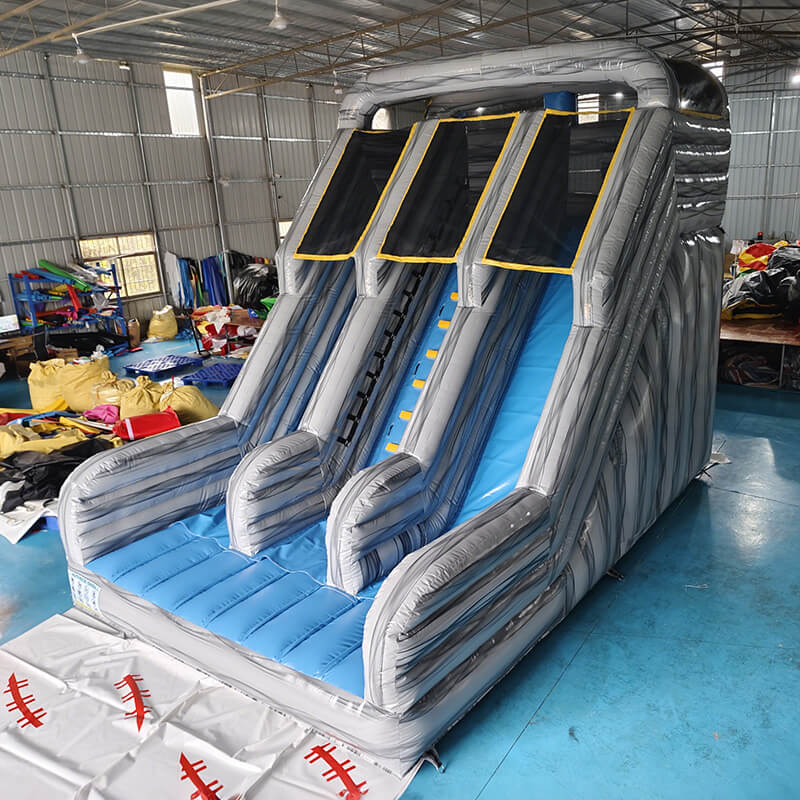
Expert Opinion: "Using our D-buckles with proper blocking stops webbing wear. Put a scrap carpet layer between the shim and the PVC base."
4. Executing an uneven terrain setup for heavy slides
Handling massive units on hills
When dealing with an uneven terrain setup, orientation is everything. Aim the slide down the slope.
This increases the stopping distance needed, sure. But the unit stays stable side-to-side.
If you set up across a slope, Leveling Commercial Inflatable Slides gets hard. You are fighting the unit's desire to roll over.
Moving the beast into position
Moving a 350lb rolled-up inflatable on a slope is a workout. You risk injury before you even start.
To better understand maneuvering techniques for Leveling Commercial Inflatable Slides, this video tutorial is highly recommended:
Anchoring on slopes
Standard stakes often fail on slopes. The soil is looser, or the angle is wrong.
Industry Slang: "Deadman Anchors"
On steep terrain, use "Deadman Anchors." Bury a heavy object (like a log) deep horizontally.
This gives way more holding power than a straight stake when you are Leveling Commercial Inflatable Slides.
5. Adhering to gradient safety limits
The 5-degree rule
Safety standards like EN14960 dictate strict gradient safety limits. For most, the max slope is 5 degrees.
Exceed this, and air pressure can't hold the shape against gravity. Walls bulge. Lanes distort.
Leveling Commercial Inflatable Slides beyond this point is straight-up negligent.
Water slide specifics
Water adds a ton of weight. A pool can hold thousands of pounds.
If you aren't level, water pools on the low side. This shifts the center of gravity fast.
Our water slides use 0.9mm PVC. It's tough, but tons of water pressing one wall causes stress.
When to cancel the job
Sometimes, saying "no" is the best move. If the slope is 10 degrees, walk away.
A cancelled job costs a few bucks. A lawsuit costs your business. Know your limits.
6. Advanced stability tips for rental businesses
Utilizing ratchet straps for fine-tuning
Don't rely just on shims. Use heavy-duty ratchet straps on the upper D-rings.
At CH Inflatable, we use seat-belt quality webbing. Crank down on the high side to pull the unit straight.
This creates tension that actively fights the tilt.
Community wisdom
You aren't alone. The rental community is huge. I check forums to see how others handle nightmare setups.
See how others handle it at the Inflatable slide business discussion on Reddit. It's gold for local solutions.
Continuous monitoring
Leveling Commercial Inflatable Slides isn't a "set it and forget it" thing. Vibration settles the unit.
Industry Slang: "Kick-out"
Watch for "Kick-out." The bottom of the slide walks downhill. Check your stakes every hour.
Frequently asked questions (FAQ)
Can I set up a commercial inflatable slide on a severe slope?
Generally, no. Leveling Commercial Inflatable Slides on slopes over 5 to 7 degrees is unsafe. It stresses baffles and risks tipping. Orienting the unit "with" the slope is safer, but check your manual. If it looks sketchy, it probably is.
How do you stabilize a large water slide on uneven grass?
It takes three steps. First, remove high spots. Second, use "stabilizing blocks usage" like plywood under the low side. Third, use extra-long stakes or "Deadman Anchors" on the high side. Keep the pool level or water will overflow.
What tools are best for checking inflatable slide balance?
Go digital. A 4-foot digital smart level gives a precise reading. It removes the guesswork. A laser line level is great for checking vertical uprights to ensure the slide isn't twisting.
Wrapping things up
Leveling Commercial Inflatable Slides separates the pros from the amateurs. It protects your gear and the kids.
At CH Inflatable, we build units with reinforced corners and stainless steel D-buckles. We give you a strong foundation.
But proper setup on the field? That last mile is up to you.
Need slides tough enough for rough terrain? Contact CH Inflatable today. Check out our High quality commercial inflatable water slides for kids and get factory-direct pricing.

Image by: Markus Winkler
https://www.pexels.com/@markus-winkler-1430818