
Slash Risks: 5 Indoor Bounce House Inspection Steps

Slash risks: 5 indoor bounce house inspection steps
Running an indoor inflatable park or a mall-based rental business usually means you are playing for extremely high stakes.
For professional B2B rental operators, the safety of your amusement gear is absolutely not just a bunch of legal red tape.
Look, it is directly tied to your daily business continuity, your crazy insurance premiums, and your bottom-line ROI.
Executing a legit Indoor Bounce House Inspection is your main line of defense against those business-killing liability claims.
In my 17 years dealing directly with foreign trade and massive custom manufacturing, I've seen bad gear destroy companies overnight.
Equipment failing in the middle of a weekend rush actively murders your profit margins and brand reputation.
Here is the deal: we are diving deep into the raw protocols you need to keep your assets up to global safety standards.
Knocking out a solid Indoor Bounce House Inspection prevents operational downtime long before it even gets a chance to start.
Whether you push units into the US, Germany, Spain, or Arab markets, nailing these inspection steps is simply non-negotiable.
Step 1: Material and certification checks
To keep the cash flowing, the foundation of every single Indoor Bounce House Inspection starts right at the base materials.
Validating CE EN14960 validation for global compliance
For you B2B wholesalers operating in highly regulated areas like Poland or France, compliance is literally your entry ticket.
You absolutely must verify your CE EN14960 validation during every single warehouse or mall audit.
This specific European protocol tests things like vital indoor airflow parameters, real structural integrity, and hardcore fire resistance.
If a kid takes a tumble and you lack this paperwork, insurance providers will laugh you out of the room and deny the claim.
I always tell operators: running a massive commercial unit without CE EN14960 validation is like driving a semi-truck entirely without brakes.
Testing the guts of commercial 0.55mm PVC
During your daily or weekly Indoor Bounce House Inspection, you need to get your hands dirty and physically feel the fabric.
Always hunt for authentic commercial 0.55mm PVC, heavily leaning on 1300D reinforced grades for any dry jumping surface.
Standard consumer-grade nylon will shred to pieces under the brutal, non-stop foot traffic of a packed shopping mall.
At CH Inflatable, we build our dry units exclusively with premium commercial 0.55mm PVC so they actually survive the chaos.
If we are talking wet environments like a massive inflatable slide, we instantly upgrade our builds to 0.9mm 1300D PVC.
Industry heads up: keep your eyes peeled for "Delamination" during your routine Indoor Bounce House Inspection.
That is when the outer coating peels off the mesh, and if you spot that, you need to sideline the unit immediately.
Step 2: Structural reinforcement and stitching audits
A commercial jumper is honestly only as tough as its weakest seam, so this part of the Indoor Bounce House Inspection is highly critical.
Examining stainless steel D-ring anchors
Even when you are safely set up inside a climate-controlled mall, these units demand heavy-duty anchoring via floor hooks or sandbags.
You have to check every single stainless steel D-ring anchor point for webbing detachment or weird physical bending.
Low-grade iron rings rot and rust fast, especially if you set up near a humid indoor pool zone or rainy entryways.
Since we export heavily to coastal spots globally, CH Inflatable upgrades everything to a premium stainless steel D-ring setup.
Stress-testing double stitching reinforcement
Single-stitched seams are basically guaranteed to blow out under the stress of heavy adults bouncing at the exact same time.
Your routine Indoor Bounce House Inspection has to confirm that every high-stress corner rocks proper double stitching reinforcement.
We strictly mandate double-line stitching tech across the board, bumping it up with specific corner patches on the massive joints.
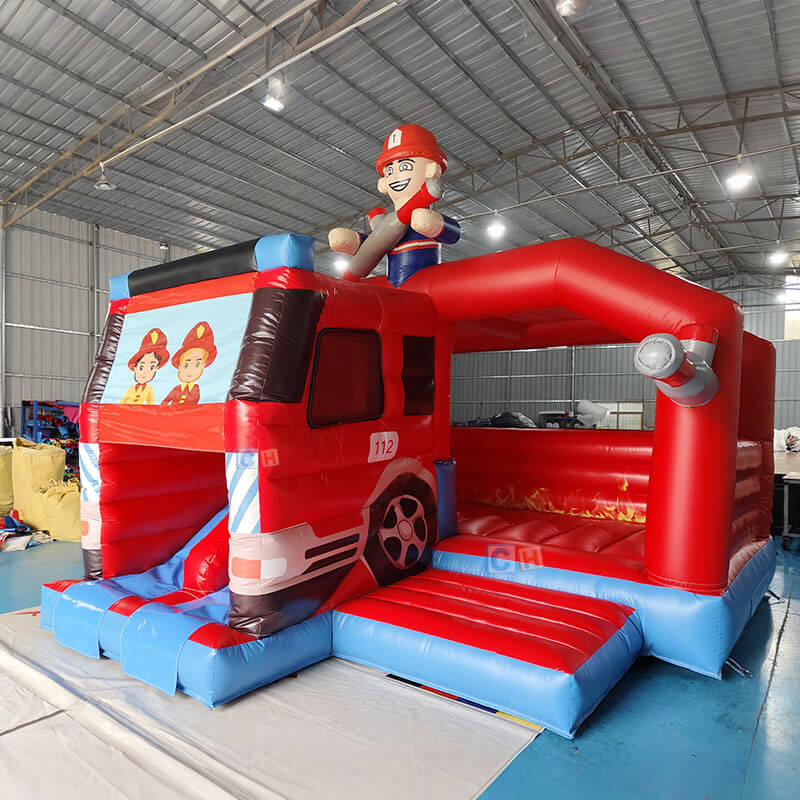
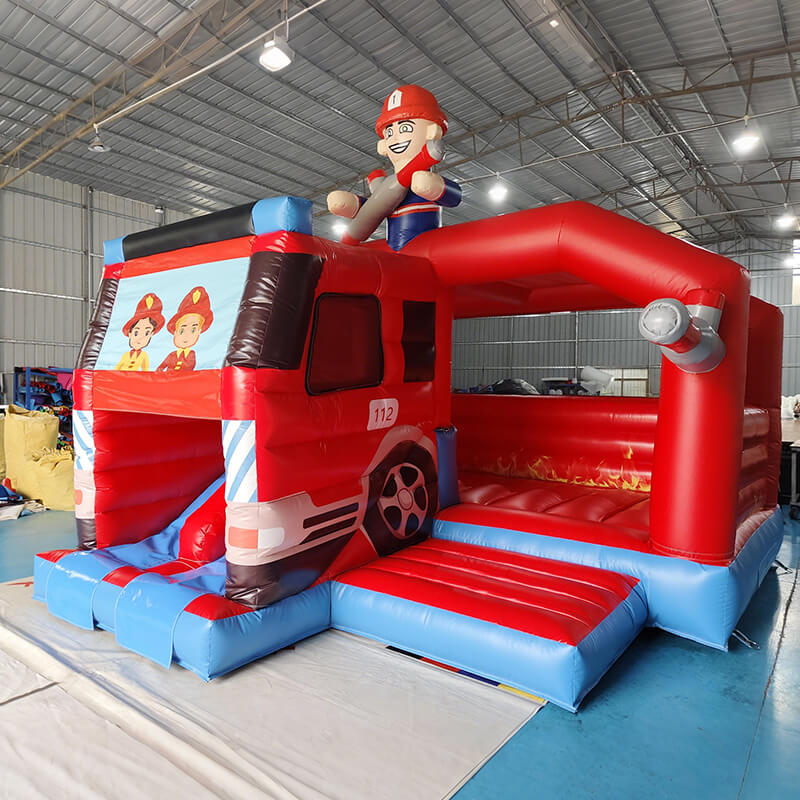
This level of craftsmanship locks in real reliability. Want to see a beast built with this engineering? Check out our Firefighting Theme Inflatable Combo Bouncy.
That customized structural setup ensures zero sudden air loss during a wild birthday party session.
Step 3: Mechanical systems and airflow safety
The blowers and zippers are basically the heart and veins of your equipment, meaning a failure here is a fast track to a disaster.
A huge chunk of your ongoing Indoor Bounce House Inspection requires testing the raw hydrostatic pressure from those daily blowers.
Are your blowers built for the local power grid in places like Peru or Colombia? You really have to know this upfront.
We standardized our entire B2B fleet with HW brand blowers that pack full CE certification for steady, high-pressure output.
Noise and ventilation matter big time inside mall atriums. To dive deeper on constraints, check out Can Bounce Houses Be Used Indoors?.
Verifying zippers and deflation flaps
High-pressure commercial units drastically need rapid deflation systems so you can shut them down fast during an emergency.
When you perform an Indoor Bounce House Inspection, yank on every single zipper to ensure a smooth, entirely snag-free zip.
Trash-tier zippers will easily derail or bend outwards the second you crank up to 4000Pa of internal air pressure.
That is exactly why CH Inflatable strict-specs authentic YKK zippers, making sure the deflation flaps actually work when things get crazy.
Step 4: Internal safety features and webbing analysis
Inside the main play zone, the containment netting and physical climbing blocks take wild amounts of daily physical abuse.
Checking webbing strength vs automotive standards
A veteran-level Indoor Bounce House Inspection takes a literal microscope to the webbing used on slide covers and anchor plates.
Basic webbing frays easily. We caught onto this glaring flaw years back and started completely upgrading the material.
Now, CH Inflatable utilizes webbing materials matched to the exact safety levels of high-end automotive seat belts.
Watch out for "Webbing Burn" during your Indoor Bounce House Inspection, which looks like melted edges signaling an impending failure.
Slide and netting containment checks
You better believe mall compliance officers are going to heavily nitpick your safety netting parameters.
If you have holes any bigger than a child's finger, you are sitting on massive entrapment accident liabilities.
You have to wrap this netting check heavily into your daily Indoor Bounce House Inspection to prevent any nasty elevated falls.
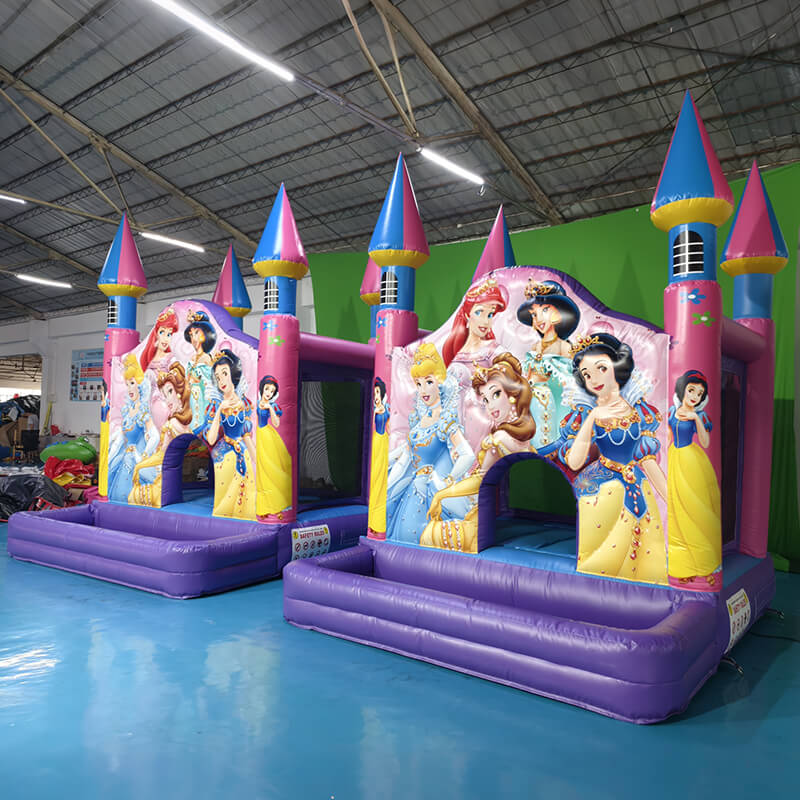
For a solid look at how pro safety netting is integrated right into complex designs, take a peek at our Disney Princess Inflatable Bounce Castle House.
Step 5: Routine documentation and maintenance logs
For big B2B event planners, having a rock-solid paper trail is just as vital as the physical check itself.
Never trust your memory on this stuff. A highly successful Indoor Bounce House Inspection must be actively documented every single time.
Keep a strict log of the inspector's name, the date, specific blowout pressure levels, and the actual zipper track conditions.
This paperwork is how you easily prove to tight-fisted mall management that your rental business prioritizes hardcore safety.
To help guide your warehouse crew on this, downloading an INFLATABLE AMUSEMENT SAFETY CHECKLIST is a total genius move.
Indoor bounce house inspection failure table
| Hardware component | Primary inspection checkpoint | Action if component fails |
|---|---|---|
| commercial 0.55mm PVC | Check for delamination or deep surface mesh cuts | Immediate heat patching or full section replacement |
| stainless steel D-ring | Look for bad webbing tear or metal ring deformation | Take unit offline entirely; re-stitch anchor plates |
| double stitching reinforcement | Inspect for thread blowout on heavy jumping joints | Mandatory factory-level or professional seam repair |
Knowing exactly when you should slap a patch on a unit versus totally scrapping it is a skill you have to master.
Plus, routine cleaning is a uniquely huge part of the whole Indoor Bounce House Inspection process.
Malls trap crazy amounts of humidity, which lets brutal mold eat your commercial gear alive if you get lazy with maintenance.
Customization and manufacturing quality control
The honest truth? A lightning-fast Indoor Bounce House Inspection actually starts at the factory floor, long before it ships.
With 17 years deep in this high-stakes game, CH Inflatable runs a heavily brutal internal QA testing gauntlet.
Our heavy in-house testing massively cuts down the on-site inspection headaches for our global B2B partners.
Every single unit sits through a ruthless 24-hour inflation test before we ever think about packing it onto an export container.
Because we support full customization completely, we map out exact tolerances for huge indoor obstacle setups down to the fraction.
Avoiding dead spots in customized gear
When you strictly tailor custom wholesale inflatables to fit tight indoor mall floors, structural geometry controls the total airflow.
If a builder uses garbage internal baffling, your jumper effortlessly develops what we call "Dead Spots" in the field.
These are super sketchy localized zones on the bounce area lacking pressure, which makes jumping kids sink in way too deep.
Our engineering squad maps out volumetric airflow perfectly, so your Indoor Bounce House Inspection yields a pass every single time.
Frequently asked questions (FAQ)
Why is CE EN14960 validation so incredibly critical for these mall setups?
It is the absolute top-tier EU safety standard, and malls demand massive insurance coverage policies simply to let you operate.
Without properly documented CE EN14960 validation, your local insurance company will straight up deny any casualty claims.
It serves as hard, tangible proof that your rig survived extreme third-party fire retardancy and heavy structural load abuse.
How often should you physically test zippers on a commercial unit?
If you run a heavy high-traffic indoor park, you absolutely must check those deflation flaps every single day.
Indoor mall setups pull in wild amounts of dust and floor lint that can aggressively jam the metal zipper tracks.
A fast daily Indoor Bounce House Inspection focusing heavily on zippers guarantees you can kill the air fast in a real emergency.
Bottom line: locking down your rental ROI
Pulling off a killer Indoor Bounce House Inspection is way more than just checking off a basic legal safety box.
It is a highly strategic business play that aggressively defends your heavy B2B financial investments against lawsuits.
By heavily validating your CE EN14960 validation, checking the health of your commercial 0.55mm PVC, and stress-testing every stainless steel D-ring, you win.
Ensuring rock-solid double stitching reinforcement keeps your massive rental fleet churning out big profit for years to come.
At CH Inflatable, we bring 17 years of heavy manufacturing firepower to help you easily exceed these exact global standards.
Our high-end commercial gear ships worldwide, packing insane quality and totally flexible support for full customization limits.
Ready to massively upgrade your rental fleet with inspection-ready commercial bounce houses? Hit up CH Inflatable for a custom quote today!
To better understand the required protocols for a standard Indoor Bounce House Inspection, this video tutorial is highly recommended:
N/A
Image by: RDNE Stock project
https://www.pexels.com/@rdne