
Master Inflatable Slide Wind Ratings: 3 Safety Secrets

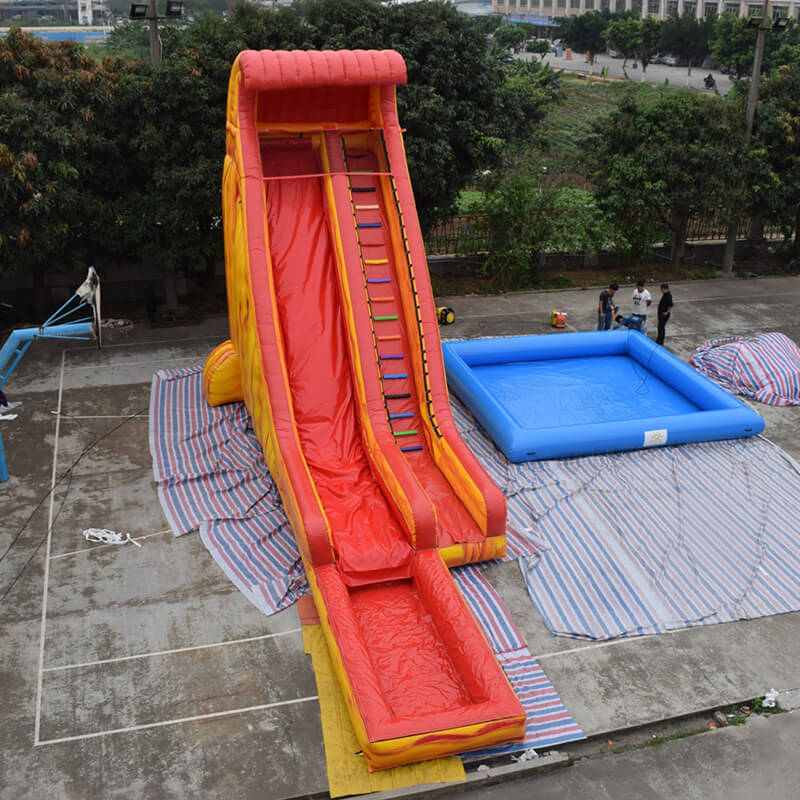
Master inflatable slide wind ratings: 3 safety secrets
Master Inflatable Slide Wind Ratings to prevent liability claims. Discover key safety metrics for commercial rentals and boost ROI. Contact us today!
Picture this scenario: It involves a sunny afternoon, a crowded event, and a sudden, unexpected gust of wind.
Theoretical risks don't define this situation.
Instead, it represents the nightmare that keeps rental business owners awake at night.
As someone who has spent 17 years in the manufacturing trenches at CH Inflatable, I have seen how quickly a profitable weekend can turn into a liability claim if safety protocols are ignored.
Many operators jeopardize their business licenses by relying on "feeling the breeze" or outdated rules of thumb.
The difference between a safe event and a disaster often lies in truly understanding Inflatable Slide Wind Ratings.
However, Inflatable Slide Wind Ratings act as more than just compliance numbers found in a user manual. They serve as your operational lifeline.
In this guide, I'm going to spill the tea on three specific safety secrets used by industry veterans.
These strategies will help you calculate risks, secure massive units, and ensure your inventory remains the safest in the market.
Secret #1: Decoding ASTM F2374 compliance and wind loads
What is ASTM F2374 compliance really?
For our B2B clients in the US and Europe, ignoring standards isn't an option. You've got to wrap your head around ASTM F2374 compliance.
This standard dictates the design, manufacture, operation, and maintenance of inflatable amusement devices.
It provides the heavy lifting regarding structural integrity.
When we manufacture a slide at CH Inflatable, ASTM F2374 compliance ensures the unit is engineered to withstand specific wind gusts without collapsing.
The critical threshold: 15 vs. 25 MPH
Most manufacturers will list Inflatable Slide Wind Ratings with a maximum operational speed of 15 to 25 mph.
But here is the secret most won't tell you.
Do not treat the manual's maximum limit as a target to hit.
You should treat the max rating as a "point of failure."
If a manufacturer rates a unit for 25 mph, your operational cutoff should be 20 mph. Safety buffers save lives.
I always tell my clients: "Your operational cutoff should always be 5 mph lower than the manufacturer's maximum rating."
The science of wind load response
Giant slides are essentially massive sails.
The aerodynamics involve complex drag coefficients that change as the unit deforms under pressure.
To understand the physics better, for a deeper engineering analysis, read this report on Wind-Load Response and Evacuation Efficiency Analysis of Marine Evacuation Inflatable Slide.
Proper Inflatable Slide Wind Ratings account for this deformation.
If the wind load exceeds the internal air pressure, the slide buckles, and that is a situation you never want to see.
Secret #2: Precision monitoring with anemometers and the Beaufort scale
Why "feeling the breeze" is negligent
I have visited countless event sites where operators guess the wind speed. To be honest, this approach is negligent.
Wind speed at ground level significantly differs from wind speed at the top of a 20ft slide. Your perception is flawed.
To adhere to strict Inflatable Slide Wind Ratings, you need hard data, not guesses.
Implementing Anemometer monitoring
You must equip every crew chief with a handheld or mounted anemometer.
Anemometer monitoring should be logged every 30 minutes during an event.
If gusts pick up, increase that frequency to every 10 minutes.
Documentation saves you in court. Showing a log of precise Anemometer monitoring proves you were diligent if an incident occurs.
Interpreting Beaufort scale limits for inflatables
For rental operators, the Beaufort scale offers a quick reference. However, you must know where the line is drawn.
Beaufort scale limits dictate that a Force 4 (13-18 mph) requires extreme caution.
A Force 5 (19-24 mph) usually demands immediate evacuation.
Industry Slang: "Wind Uplift"
We use the term "Wind Uplift" to describe the aerodynamic force that lifts the base of the inflatable off the ground.
When Inflatable Slide Wind Ratings are exceeded, "Wind Uplift" breaks the friction seal between the vinyl and the ground, making the unit unstable.
Secret #3: Advanced anchoring and ballast calculation
The ballast calculation formula
Knowing the wind speed is half the battle; keeping the giant unit on the ground is the other half.
You need the Ballast calculation formula.
A general rule of thumb used by pros is to apply 50% more weight to windward sides.
The Ballast calculation formula changes based on soil.
- Grass: 18-inch steel stakes at 45 degrees.
- Concrete: Sandbags or water weights.
Never assume one sandbag per anchor is enough.
For high Inflatable Slide Wind Ratings, you might need 400lbs per anchor point on concrete to be safe.
Mastering tie-down tensioning
You can have heavy weights, but they are useless without proper Tie-down tensioning.
The tether strap must form a 45-degree angle. If the strap is loose, the inflatable gains momentum before it hits the anchor limit.
This "shock load" can snap D-rings instantly.
Improper Tie-down tensioning renders even the heaviest concrete blocks useless.
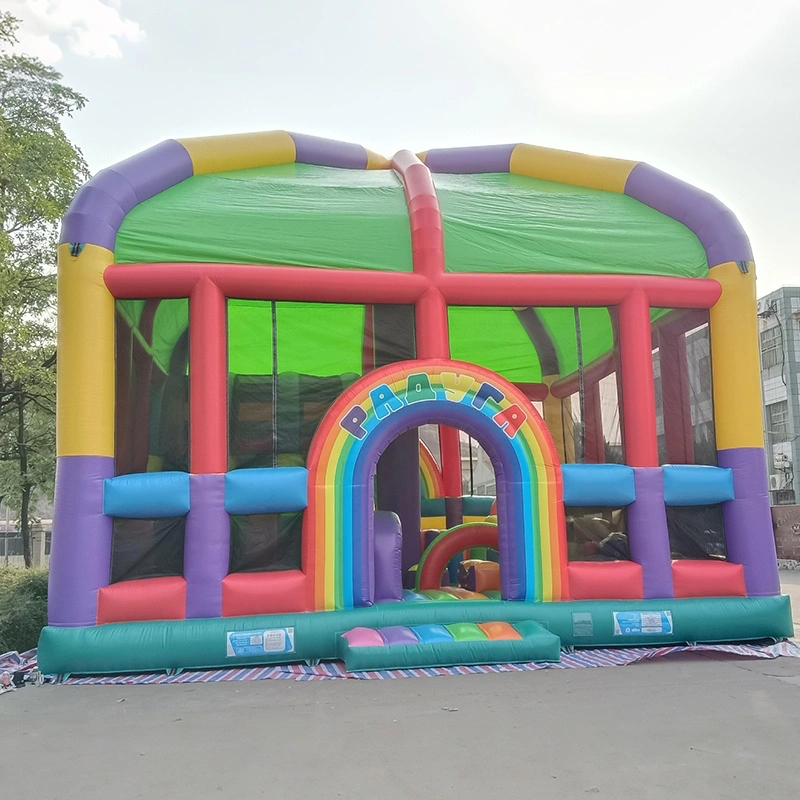
For complex hybrid units, such as our Bouncy Castle Inflatable Slide, ensuring 360-degree tension is vital due to the asymmetrical shape.

If the tension is uneven, the wind will find the weak side and twist the unit.
| Feature / Action | Standard Protocol | CH Inflatable Premium Standard |
| Anchor Points | Standard D-Rings | Stainless Steel D-Buckles (Rust-Proof) |
| Wind Limit (Ops) | Max 25 MPH | Max 20 MPH (with 5 MPH buffer) |
| Stitching | Single/Double | Double Stitching + Corner Reinforcement |
| Material | 1000D PVC | 1300D PVC (High Wind Shear Resistance) |
The hardware factor: Why manufacturing quality dictates safety
Material integrity: 1300D PVC vs. wind shear
Your Inflatable Slide Wind Ratings are heavily dependent on the material capability.
At CH Inflatable, we do not cut corners.
We use 0.9mm 1300D PVC for water parks and 0.55mm for dry slides.
Cheap competitors might use 1000D or lower. When high winds hit, low-denier vinyl stretches and tears.
Our 1300D material resists wind shear, maintaining structural rigidity even when gusts approach the limit.
Reinforced D-buckles and webbing
The anchor point is usually the first thing to fail.
We have upgraded our manufacturing to use Stainless Steel D-buckles.
These are rust-proof and offer immense load-bearing capacity.
What's more, we use automotive-grade webbing. This is the same material used in car seatbelts.
We also utilize double stitching and corner reinforcement technology. This prevents anchor rip-outs when the wind fights back.
Industry Slang: "Anchor Point Failure"
This refers to the catastrophic event where the D-ring rips entirely from the vinyl.
CH Inflatable prevents this through multi-layer vinyl patches at stress points, protecting your investment.
Operational protocols: When to call it quits?
Assessing dynamic vs. static stability
A wet slide reacts differently than a dry bouncer.
Water adds weight, which helps stability, but it also reduces friction on the slide surface.
You must assess stability dynamically.
Expert Opinion: "If the CE-certified HW blower is struggling to maintain pressure against the wind, or the walls are bowing inward significantly, immediate evacuation is mandatory regardless of what the anemometer says."
This visual check often supersedes written Inflatable Slide Wind Ratings.
The "Go / No-Go" decision matrix
Create a checklist for your rental staff. Define the difference between sustained wind and gusts.
If you are unsure about the thresholds, check out this guide on How Windy Is Too Windy to Set up Inflatable Jumpers? for more operational thresholds.
Industry Slang: "Squaring Up"
We use the term "Squaring Up" to describe ensuring the unit is perfectly square during setup. A twisted unit has compromised structural rigidity.
If you don't square up, your Inflatable Slide Wind Ratings are effectively lowered because the unit is already under stress.
Larger units, especially a tall inflatable water slide for sale, act as massive sails and require stricter wind protocols.
Frequently asked questions (FAQ)
What is the maximum safe wind speed for commercial inflatable slides?
Typically, Inflatable Slide Wind Ratings allow for 15-20 mph. However, CH Inflatable recommends a rigorous safety buffer. Always consult the manufacturer's dedicated manual and use an anemometer. Never exceed reliable Beaufort scale limits regardless of the manual's absolute max.
How do operational wind ratings affect insurance premiums?
Insurers love documentation. They often require proof of staff training on ASTM F2374 compliance and Anemometer monitoring. Adhering to strict Inflatable Slide Wind Ratings can significantly lower liability risk, effectively protecting your policy rates and business longevity.
Can reinforced D-rings improve wind resistance on giant slides?
Yes, absolutely. Standard rings may fail under high tension caused by "Wind Uplift." CH Inflatable uses upgraded stainless steel D-buckles and automotive webbing to ensure the anchor points hold strong during unexpected gusts, maintaining the integrity of the Inflatable Slide Wind Ratings.
Bottom line
Understanding Inflatable Slide Wind Ratings is likely the most critical skill for a rental business owner.
It's not just about avoiding fines; it's about protecting children and your professional reputation.
By implementing strict Anemometer monitoring, mastering the Ballast calculation formula, and investing in premium manufacturing, you secure your ROI.
At CH Inflatable, we have spent 17 years perfecting our craft.
With CE/EN14960 certifications, UL/SGS certified materials, and upgraded stainless steel hardware, we build units that last.
Don't compromise your business or client safety with inferior inflatables.
Contact CH Inflatable today to customize your inventory with wind-tested, commercial-grade slides designed for maximum ROI and safety.