
Effortless Inflatable Slide Transport Tips: 5 Pro Hacks

Effortless inflatable slide transport tips: 5 pro hacks
Master rental logistics with our Inflatable Slide Transport Tips. Move heavy 0.55mm PVC units safely and reduce labor costs. Boost efficiency now!
Introduction
Running a successful rental business isn't just about the booking. Honestly, it is about the physical grind happening behind the scenes.
Every event professional knows the dread of the "Sunday night pickup." You know the feeling. Hauling a 500lb wet unit into a trailer when you are already dead on your feet.
I've spent 17 years in this industry. I have seen way too many good rental owners burn out because they tried to muscle through the work instead of working smarter.
This guide gets straight to the point with Inflatable Slide Transport Tips that will save your back and your bottom line.
It doesn't matter if you are dealing with a massive commercial unit made of 0.55mm 1300D PVC or a standard combo. Mastering logistics is the only way to scale.
We're going to dive into how to move heavy units efficiently, slash labor costs, and keep your CH Inflatable products looking brand new.
The art of the "tight roll": foundation of easy transport
Look, if you don't get the roll right, the rest of your night is a nightmare. A sloppy roll means a wider diameter.
That means it won't fit through gates. It won't fit on the dolly. It’s a disaster.
Mastering PVC rolling techniques is the absolute first step in our handbook of Inflatable Slide Transport Tips.
Preparation is key: deflation and zipper management
Before you even touch the unit, getting the air out is non-negotiable. You cannot roll a unit that still has air pockets.
At CH Inflatable, we use high-quality YKK zippers to speed up air release. You need to open every zipper and outlet tube available.
We actually call this "Burping the bag." It’s just walking on the inflatable in socks to force residual air out before you start folding.
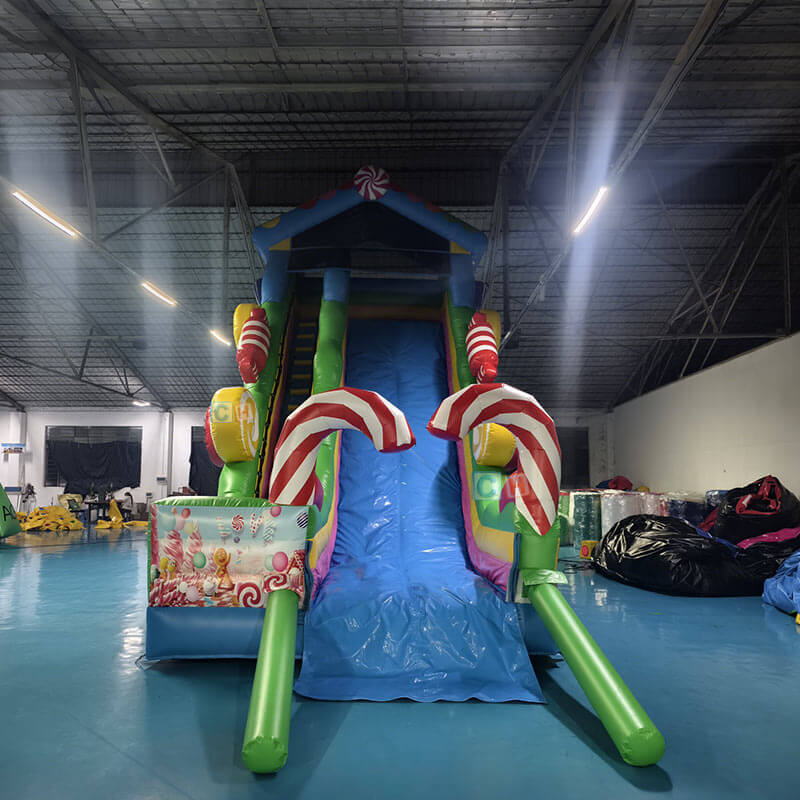
Complex shapes are tricky. Take a look at our Candy theme inflatable dry slide. You have to walk the air out of the candy canes and decorative popsicles first, or they will trap air and ruin your roll.
The "taco fold" vs. the roll: which works best?
We need to talk about folding styles. While the roll is standard, specific proper folding methods make sure the unit actually fits on your dolly.
Many veterans swear by the "Taco Fold." This is where you fold the sides in to meet in the middle before the final fold. It creates a cleaner edge.
Here is an expert take: "A loose roll is a heavy roll. If the cone isn't tight from the very start, the diameter will double, making it impossible to fit through standard gates."
Securing the roll: webbing and strap placement
Once it's rolled, you have to lock it down.
One of the most overlooked Inflatable Slide Transport Tips involves the quality of your strap.
CH Inflatable uses automotive seatbelt-grade webbing on our units. This lets you crank down the strap and compress the unit for transport without tearing the material.
Gear that saves your back: heavy-duty dolly usage
You cannot run a pro rental shop with a $50 hardware store hand truck. Forget about it. You need professional gear.
Implementing correct heavy-duty dolly usage is the difference between a 10-minute seamless setup and an hour-long struggle.
Pneumatic vs. solid tires for rental delivery
Not all dollies are built the same. Here is a quick breakdown of what you need for different terrains:
| Tire Type | Best Terrain | Pros | Cons |
|---|---|---|---|
| Pneumatic (Air) | Grass, Gravel, Mud | Great shock absorption, easier over bumps. | Can go flat on the job site. |
| Solid (Flat-free) | Warehouse, Pavement | Zero maintenance, handles heavy loads well. | Jarring vibration on rough ground. |
For a deeper dive on equipment maintenance, check out this guide on How to Transport and Store Inflatables to Keep them Pristine. It aligns perfectly with how we do things.
Electric dollies: are they worth the investment?
If you are moving units over 400lbs solo, an electric dolly is a game-changer. It gives you a powered advantage for Inflatable Slide Transport Tips regarding uphill driveways.
To better understand the scale of handling commercial versus cheap retail units, this video tutorial is highly recommended:
https://www.youtube.com/watch?v=cCdv0cgQ7_8
Using winches and ramps for solo operations
For the "one-man show" rental owner, loading a 500lb slide without help requires reliable equipment.
Install a heavy-duty electric winch at the front of your trailer. Also, use extra-long ramps to decrease the incline angle.
This setup lets you simply hook the strap to the rolled unit and let the motor do the heavy lifting.
Mastering rental delivery logistics and vehicle loading
Once the unit is on the dolly, getting it to the event is the next hurdle. Rental delivery logistics requires actual planning, not just guessing.
Trailer weight distribution for safety
One of the critical Inflatable Slide Transport Tips involves safety on the road.
Place the heaviest units—like water slides—directly over the trailer axles. Put lighter items like blowers and sandbags towards the nose.
If you load too much weight in the rear, your trailer is going to sway dangerously at high speeds. It's not worth the risk.
Protecting the PVC: avoiding friction burns
The vibration of a moving trailer acts exactly like sandpaper. You need to protect the 0.55mm PVC from rubbing against metal walls.
Always place a tarp or carpet between the inflatable and the trailer wall.
Take our Inflatable Slide Bounce House as an example. This popular compact unit has mesh netting that can easily snag if not stacked carefully against smooth surfaces.
Handling commercial grade materials (0.55mm vs 0.9mm PVC)
Understanding your material is a massive part of professional Inflatable Slide Transport Tips.
CH Inflatable uses premium 0.55mm 1300D PVC for dry slides. However, we use thicker 0.9mm PVC for water parks.
The weight difference: dry slides vs. water parks
We need to explain why heavy-duty dolly usage changes when moving 0.9mm PVC water park items versus 0.55mm dry slides.
The 0.9mm material is significantly denser. A folded water park piece might look the same size as a bounce house, but it can weigh 30% more.
Adjust your body mechanics. Keep the dolly closer to your center of gravity when moving these denser items.
Protecting hardware during transport
CH Inflatable upgrades all D-buckles to stainless steel. While they are waterproof and rust-proof, they are also hard metal.
If not folded inside the unit, these buckles can scrape the vinyl of adjacent units in the truck.
We call these "Road Rashes." These are abrasions caused on the inflatable surface due to poor securing during transport.
Always fold the unit so the anchor points are tucked inside the roll.
Rolling and folding strategies for specific slide types
Different units behave differently. Your list of Inflatable Slide Transport Tips needs to adapt to the unit type.
This section targets specific proper folding methods for difficult items.
How to roll an inflatable water slide
Water slides are stiffer and heavier than dry slides. Rolling a wet or recently dried unit is tough because the material grips itself.
Use baby powder—or talc—on the liners to reduce friction during the roll.
For specific techniques on wet units, read about How to Roll an Inflatable Water Slide.
Managing slide lanes and wall heights
The tall walls of a slide tend to "bulb out" or mushroom when you roll them.
Here creates a good strategy: As you roll, have a second person walk on the edges (the walls) to keep them compressed.
If you are solo, stop every three turns and tuck the edges in with your foot. This keeps the roll cylinder uniform.
Labor efficiency and team coordination
Implementing these Inflatable Slide Transport Tips isn't just about tools; it's about team habits.
The "pivot point" technique
Learning how to move a vertical roll by using its center of mass is a crucial skill. You shouldn't lift; you should pivot.
We call this "Walking the Dog."
This involves tilting the heavy rolled inflatable on its edge. You roll it like a wheel to move it short distances inside a warehouse.
It saves you from having to use the dolly for movements of only a few feet.
Standardization for growing teams
Creating a Standard Operating Procedure (SOP) for your crew implies that every slide is folded the same way, every time.
Here is the reality: "Inconsistency in rolling is the number one time-waster at a warehouse. If it doesn't fit on the shelf because it was rolled loosely, you enter a cycle of double-handling."
Teach your team the CH Inflatable standard: Deflate, Fold, Walk, Roll, Strap.
Frequently Asked Questions (FAQ)
How do you transport a 500lb commercial slide efficiently?
To transport a 500lb commercial slide efficiently, you have to use mechanical leverage. Heavy-duty dolly usage with a strap-back feature is mandatory.
Always aim to roll the unit tightly to reduce its footprint. Use a ramp or lift gate for vehicle loading. Finally, check your Inflatable Slide Transport Tips list and position the unit centered over the trailer axle for stable towing.
What is the best way to fold an inflatable specifically for transport?
The best way to fold an inflatable for transport is the "thirds" or "fourths" method, depending on your dolly width.
First, ensure all air is out using the YKK zipper outlets. Fold the jagged edges inward to create a perfect rectangle before beginning the roll.
This ensures the final roll is uniform. It also protects the 0.55mm PVC from dragging on the ground.
Can I transport a wet inflatable slide?
Yes, but it is going to be much heavier. One of the most vital Inflatable Slide Transport Tips is to drain as much water as possible before rolling.
However, you must unroll it and dry it completely within 24 hours to prevent mold. Transporting it wet is temporary; storing it wet is a disaster.
Conclusion
Mastering these Inflatable Slide Transport Tips is about more than just muscle; it is about protecting your investment.
By using the proper techniques, leveraging heavy-duty dolly usage, and understanding the needs of CH Inflatable’s robust 0.55mm PVC units, you avoid logistical nightmares.
Long story short, efficient transport leads to faster setups and lower labor costs.
Ready to upgrade your inventory with slides that are built to last and designed for professional use? Contact CH Inflatable today for a quote on our custom commercial inflatables or to discuss your specific bulk order needs.
Image by: Roderick Salatan
https://www.pexels.com/@rico