Maximize Inflatable Water Park Lifespan: 5 Proven Tactics

Maximize Inflatable Water Park Lifespan: 5 proven tactics
Extend your inflatable water park lifespan with our 0.9mm PVC mastery. Learn 5 proven tactics to secure your investment. Inquire now!
Introduction
In the rental business, Return on Investment (ROI) is everything. It doesn't matter if you operate in the US, Germany, or the glittering coasts of Dubai. The math remains the same.
A cheap, generic aqua park might survive two seasons if you're lucky. However, a commercial-grade, customized asset is designed to generate revenue for years.
The nightmares of any aqua park operator are premature wear, sudden seam failures, and corrosion. When your equipment fails, you face downtime. You face refunded tickets. And worst of all, a damaged reputation.
Maximizing your Inflatable Water Park Lifespan isn't just about luck. It's about rigorous material science and manufacturing precision.
It requires a proactive approach to how you buy, install, and maintain your fleet. At CH Inflatable, we have spent over 17 years perfecting this craft.
With CE EN14960 certifications and a client base spanning from France to Peru, we understand the shift toward heavy-duty customization. I'm going to walk you through 5 proven tactics to secure your money.
Tactic 1: Invest in superior materials: 0.9mm PVC vs the rest
The foundation of a long Inflatable Water Park Lifespan lies in the fabric itself. Let's be real—if the base material is weak, no amount of maintenance will save it.
Why marine-grade vinyl is non-negotiable
I have seen countless new business owners make the mistake of buying recreational-grade inflatables for commercial use. The difference is night and day.
Standard PVC degrades rapidly when exposed to chlorine, saltwater, and intense UV radiation. For a water park, you must insist on Marine-grade vinyl.
This material is specifically engineered to resist fading and brittleness. It ensures that the tensile strength of the inflatable remains high, even after hundreds of hours in the sun.
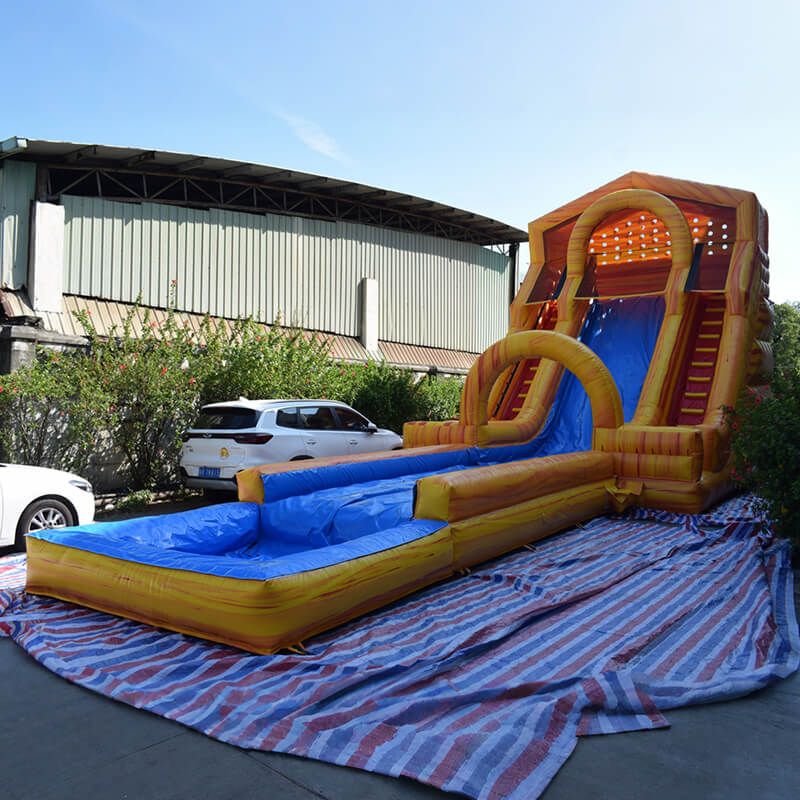
When you look at high-end products like our Durable 49ft water slide outdoor inflatable, the longevity is directly tied to this material specification.
The 1300D standard: understanding denier and thickness
Let's talk specs. At CH Inflatable, we use a specific standard: 0.9mm 1300D PVC for water parks.
Many manufacturers use 0.55mm PVC. While this is excellent for dry bounce houses, it is insufficient for the high-stress environment of a floating park.
The "1300D" refers to the denier—the linear mass density of fibers. A higher denier means a tighter, stronger internal mesh.
Industry Slang Note: You want to avoid "Delamination." This is a dreaded condition where the outer PVC coating peels away from the internal mesh fabric.
This usually happens with low-quality fabrics after sun exposure. Our materials are chosen specifically to prevent delamination, ensuring your Inflatable Water Park Lifespan extends well beyond the industry average.
Tactic 2: Embrace advanced manufacturing: heat welding technology
Once you have the right material, the next critical factor is how that material is joined.
The science behind heat welding technology
In the early days, glue was the standard. But here is the kicker: glue has a major weakness. It breaks down.
Water, heat, and chemicals eventually dissolve the adhesive bond. For air-sealed games and water parks, Heat welding technology is far superior.
This process uses high heat and pressure to melt the PVC coatings of two sheets together. They are not just stuck together; they become one single piece of material.
This creates a bond that is impervious to water and air leaks. The result is a significant boost to your overall Inflatable Water Park Lifespan.
Reinforcement at every corner
A chain is only as strong as its weakest link. In inflatables, that link is usually a corner or a stress point.
At CH Inflatable, we employ double stitching techniques and add extra reinforcement strips at every corner and joint.
Expert Opinion: "Look, in over 15 years, we found that 90% of failures occur at the seams, not the fabric surface. If it's not heat-welded or double-reinforced, it won't last."
This attention to detail prevents the catastrophic blowouts that can ruin a rental season.
Tactic 3: Upgrade your hardware: the anti-corrosion defense
Water parks face constant moisture. If you upgrade your vinyl but ignore the hardware, your park will fail.
To give you a better idea of what you should be looking for, check out this comparison table:
| Feature | Budget/Standard Park | Commercial Pro Park |
|---|---|---|
| Anchor Rings | Galvanized Iron (Rusts quickly) | Anti-corrosion D-rings (316 Stainless) |
| Seams | Glued or Single Stitched | Heat welding technology |
| Zippers | Generic Plastic | YKK High-Strength |
| Lifespan Estimate | 1-2 Seasons | 3-5+ Years |
The critical role of anti-corrosion D-rings
Anchoring is essential, and anchors attach to D-rings. Standard iron rings will rust within weeks in a marine environment.
Rust stains the PVC and eventually snaps the ring. To protect the Inflatable Water Park Lifespan, we upgrade all anchor points to 304/316 Stainless Steel D-buckles.
These Anti-corrosion D-rings generally ignore saltwater and humidity. They ensure your park stays anchored safely without the risk of metal fatigue.
Zippers and blowers: YKK and HW standards
Longevity also depends on the moving parts. We strictly use YKK zippers. They are high-strength, resist deformation, and don't jam easily when wet.
Plus, our blowers are HW brand with CE certification. A reliable blower prevents the inflatable from losing pressure, which causes unnecessary drag on the seams.
While researching, you might see various options. For example, listings on Custom Inflatable Water Parks For Sale – inflatableisland.co show market variety.
However, as a buyer, you must rigorously verify if their hardware specs match the stainless steel and YKK standards we provide at CH Inflatable.
Tactic 4: Master the installation and anchoring process
A poorly installed park is a damaged park. Movement causes friction, and friction kills PVC.
Best practices for anchor system maintenance
A floating park is subjected to wind, waves, and the weight of users. If it moves too much, the D-rings can rip out of the vinyl.
We use webbing material that is upgraded to automotive safety belt grade. This ensures the connection points can handle the load.
Proper Anchor system maintenance involves checking these lines daily. You must ensure the weights on the lake bed or sea floor have not shifted.
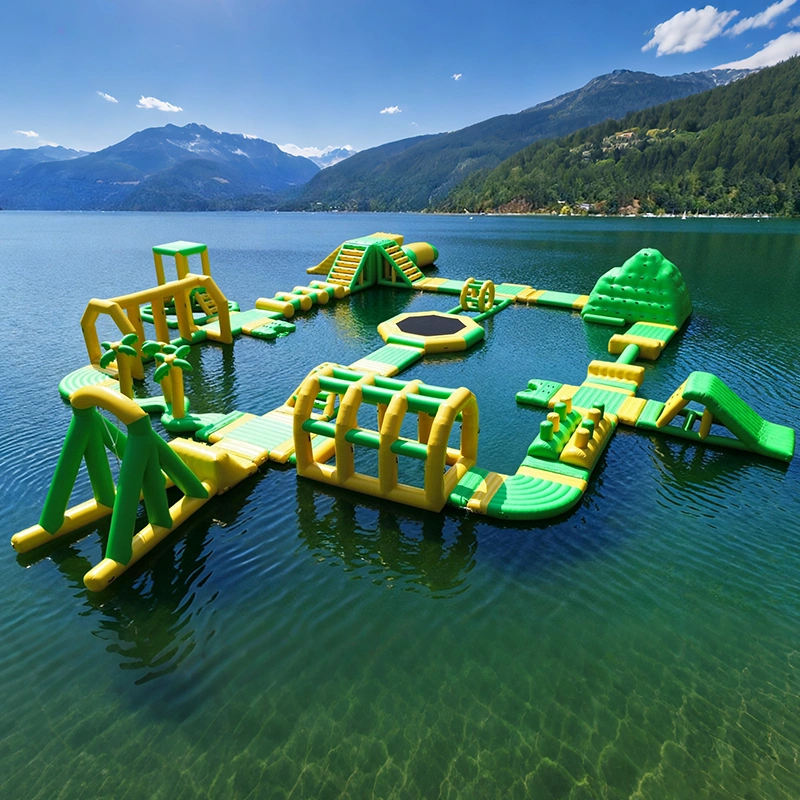
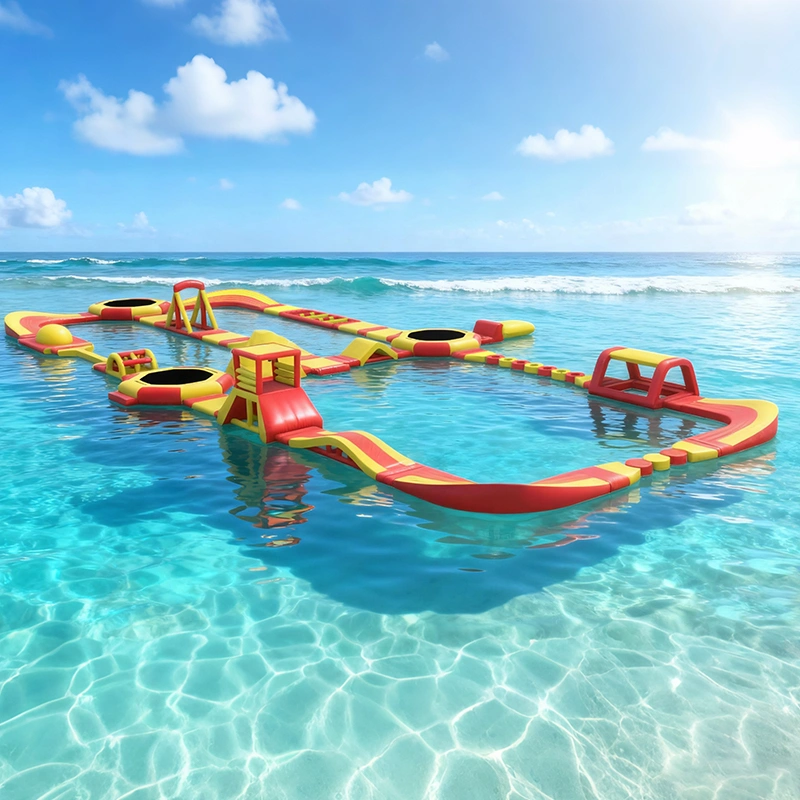
A complex setup, like our Inflatable Floating Water Park, requires precise tension.
If the lines are too tight, waves will tear the park. If they are too loose, the park creates friction against itself.
Visualizing the scale of commercial setup
Understanding the magnitude of strict installation protocols is vital for preserving your Inflatable Water Park Lifespan.
To better understand the scale and durability discussed regarding Inflatable Water Park Lifespan, this video setup is highly recommended:
https://www.youtube.com/watch?v=7dFgMdTPgno
Tactic 5: Professional maintenance and storage protocols
The way you treat your equipment off the water is just as important as how you treat it on the water.
Cleaning tactics: saltwater vs freshwater
Salt is abrasive. When saltwater dries, it forms sharp crystals. If these are left on the PVC, they act like sandpaper when the inflatable is folded.
To maximize your Inflatable Water Park Lifespan, you must rinse the entire unit with freshwater after use in the sea.
Industry Slang Note: You need to master "Winterizing." This represents the process of deep cleaning and drying the inflatable before long-term storage.
Inspecting wear points and valve integrity
Regular inspections capture small issues before they become expensive repairs.
Expert Opinion: "Never pack a water park wet. Trapped moisture is the silent killer of PVC coatings, leading to inevitable hydrolysis."
Hydrolysis occurs when water chemically breaks down the plastic coating, making it sticky and weak.
You can see examples of operations that run tight ships at places like Splash-N-Dash | Inflatable Water Park. Their equipment longevity is largely due to rigorous daily maintenance routines.
Frequently Asked Questions (FAQ)
How many years does a commercial water park last?
The Inflatable Water Park Lifespan varies based on quality. With CH Inflatable’s 0.9mm 1300D PVC and heat welding, you can expect 3-5+ years of commercial use.
Does saltwater damage inflatable water parks?
Yes, saltwater can be damaging if not cleaned. However, using Marine-grade vinyl and stainless steel D-rings significantly minimizes this risk. You just have to rinse it.
What maintenance extends aqua park life?
Daily pressure checks are vital. Also, practice Industry Slang: "Spot Welding." This means doing patches immediately. Regular Anchor system maintenance is also key.
Conclusion
Long story short, maximizing your Inflatable Water Park Lifespan is directly tied to the decisions you make regarding materials and care.
By choosing 0.9mm 1300D PVC, utilizing Heat welding technology, and switching to Anti-corrosion D-rings, you secure your investment.
A longer lifespan means fewer replacements. It means higher profit margins for your rental business. It is that simple.
Ready to build a water park that lasts?
Contact CH Inflatable today. We provide free quotes on custom designs featuring our UL/SGS certified materials. Whether you are in the USA, Europe, or the Middle East, we are ready to supply you.
- Email: [Check Website]
- WhatsApp: [Check Website]
Image by: Helena Jankovičová Kováčová
https://www.pexels.com/@helen1