Unlock Commercial Bounce House Durability: 5 Pro Secrets

Unlock commercial bounce house durability: 5 pro secrets
Let’s be real for a second. In the inflatable rental game, your Return on Investment (ROI) dies the moment a seam rips.
You know the drill. You buy a unit that looks great online, but three months later, it’s a massive liability. A unit that tears early is a money pit; a unit that lasts five years is a pure profit machine.
I talk to business owners across the USA and Europe every week. The biggest complaint? Buying "commercial" units that are really just residential quality in a disguise. These cheap knock-offs lead to midnight repairs, angry clients, and a tanked reputation.
This guide cuts through the noise. We are going to break down exactly what Commercial Bounce House Durability actually looks like, so you stop wasting money on disposable assets.
At CH Inflatable, we’ve got 17 years in the trenches. We don’t just glue plastic together; we engineer it. From 0.55mm 1300D PVC tarpaulin to proper stitching, here are the manufacturing secrets that separate the toys from the tools.
1. The material core: why 0.55mm 1300D PVC tarpaulin is king
Understanding the specification
When we talk about true Commercial Bounce House Durability, the conversation starts and ends with the fabric. If the seller isn't using 0.55mm 1300D PVC tarpaulin (think Plato brand quality), walk away.
But why does that spec matter for your bottom line?
- 0.55mm: This is the thickness sweet spot. It’s tough as nails but light enough that your delivery crew won't quit on you.
- 1300D (Denier): This is the fiber density. High denier means high tear resistance.
- PVC vs. Oxford: Never buy Oxford cloth for rentals. That stuff is for backyard birthdays, not commercial abuse.
I’ve seen plenty of "paper-thin imports" flooding the market. They use low-grade PVC that cracks the second it sees UV exposure. Real commercial-grade stuff is UV resistant, waterproof, and fire-retardant.
Water sales vs. dry slides material differences
Here is the kicker: not all inflatables need the same gauge. While 0.55mm is the industry standard for bouncers, we beef up the specs for water units.
If you are eyeing an inflatable water park, we switch to 0.9mm 1300D PVC. Water adds massive friction and weight. You need that extra layer of toughness to handle it.
For standard dry slides, the 0.55mm spec ensures the unit rolls up tight but handles the friction of a thousand rug-rats.
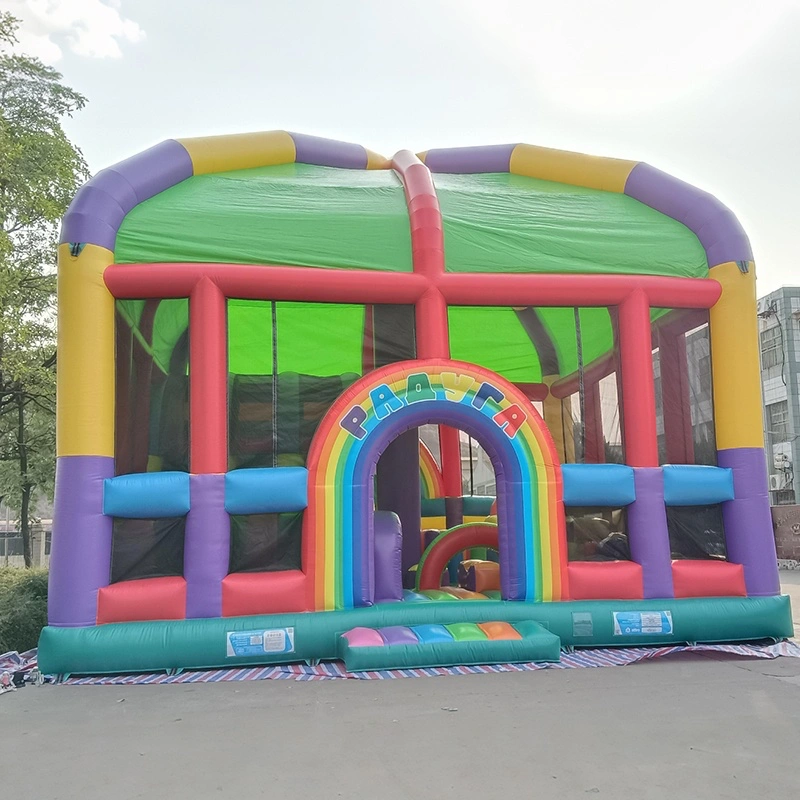
If you want to see how high-quality material translates to structural integrity, check out our durable Bouncy Castle Inflatable Slide. The finish and texture of the material are evident even in photos.
2. Reinforcement engineering: double stitching and corner logic
The double stitching standard
Material is just the canvas. The thread is the frame. Commercial Bounce House Durability relies heavily on Double stitching reinforcement.
At CH Inflatable, we don't cut corners. We apply double stitching everywhere—inside and out.
Plus, at the high-stress points—like the bottom capabilities and where the floor meets the walls—we use quadruple stitching. This ensures the unit holds air pressure even when capacity is maxed out.
Webbing and corner reinforcements
In my experience, stitching is only as strong as the material it bites into. Without internal webbing strips, strong thread will slice through PVC like wire through cheese.
We’ve upgraded our webbing material to automotive seatbelt standards. We reinforce every corner and joint to stop that annoying "needle hole expansion" that kills older units.
| Feature | Cheap "Commercial" Unit | True Commercial Grade |
|---|---|---|
| Base Stitching | Single stitch | Double stitching reinforcement |
| Stress Points | Double stitch (if lucky) | Quadruple stitching |
| Internal Webbing | Scrap vinyl | Automotive Seatbelt Webbing |
| Air Retention | Soft/Saggy after 1 year | Firm bounce for 5+ years |
This level of detail is why our units survive the rough handling of rental logistics in markets like France, Germany, and the USA.
3. Hardware hygiene: heavy-duty YKK zippers and anchors
Deflation systems that don't fail
You probably don’t think about zippers until one fails at 2 PM on a Saturday. A broken zipper means the unit loses air, and you lose a customer.
We utilize Heavy-duty YKK zippers. YKK is the global leader for a reason.
Cheap brands suffer from zipper separation after one season. Our YKK zippers stay closed, maintaining the internal pressure critical for Commercial Bounce House Durability.
Anchoring systems for safety vs. rust
An inflatable that moves is an inflatable that tears. Proper anchoring is non-negotiable.
We ditched standard iron rings ages ago. We use Stainless steel D-buckles.
- Rust-proof: Crucial for wet climates.
- Corrosion-resistant: A must-have for coastal regions with salt air.
- Water-resistant: No mold issues at the anchor points.
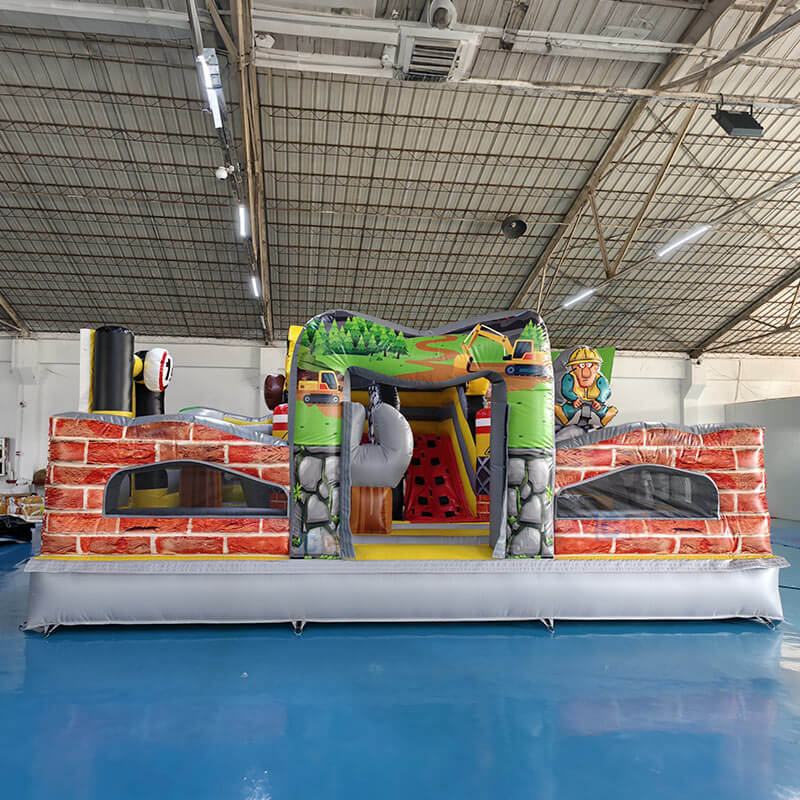
To see an example of a unit where robust anchoring is absolutely vital due to its sheer size, see the anchoring on our Construction team inflatable fun city.
The heart of the unit: HW blowers
A bouncy castle breathes. It needs constant airflow. We pair our units with HW blowers.
These are CE-certified powerhouses. A consistent blower reduces strain on the seams. It prevents the unit from getting "soft," which causes massive material fatigue.
4. Certified longevity: the EN14960 safety standard
Why certification equals durability
Clients ask me all the time why we stick to the EN14960 safety standard. Look, it’s not just a safety rule; it’s a durability benchmark.
To pass EN14960, a unit has to survive specific load-bearing tests. You literally cannot pass these tests using cheap thread or thin PVC.
So, when you see that compliance, it guarantees superior materials were used.
For a broader look at commercial specifications and industry standards in the US market compared to global norms, check out this guide on Commercial Bounce Houses for Sale Wholesale. It highlights the massive gap between regulated and unregulated manufacturing.
Global compliance
Whether you operate in Lithuania, Poland, or Peru, having UL/SGS material certificates matters.
Our materials meet these rigorous standards. Investing in certified products isn't just about avoiding lawsuits; it’s about ensuring Commercial Bounce House Durability through verified processes.
5. Operational maintenance: preventing wear and tear
Proper folding and storage
Even the best Commercial Bounce House Durability can be ruined by bad habits. The cardinal sin? "Putting it away wet."
This leads to mildew, which rots the stitching from the inside out. Always dry it out. Also, watch how you roll it. Creasing the same lines repeatedly weakens the coating.
To better understand proper handling to maintain Commercial Bounce House Durability, this video tutorial is highly recommended:
https://www.youtube.com/watch?v=vuMi1ikliUc
Field repairs and prevention
Tear resistance maintenance starts with the setup.
Honestly? 90% of structural damage happens during transport, not jumping. Dragging a unit across concrete without a dolly or protective bag destroys the bottom panel faster than 100 kids ever could.
- Sandbags: Stop wind uplift to reduce seam stress.
- Ground Sheets: Always place a tarp under the unit.
- Dollys: Never drag the unit raw.
Curious about the exact timeline of wear and what to expect as your unit ages? Read about How long does a bounce house last? to gauge your maintenance schedule.
6. Frequently asked questions (FAQ)
How long does a commercial bounce house last in rental business?
Typically, a decent unit lasts 3-5 years. But with CH Inflatable’s reinforced features like seatbelt webbing and 0.55mm PVC, we often see units last 7+ years. It really depends on your storage habits (Keep it dry!).
Why is 0.55mm PVC superior for inflatable durability?
The 0.55mm 1300D PVC tarpaulin offers superior tear resistance in both directions compared to lighter fabrics. It holds stitching tension significantly better than Oxford cloth and has way better UV resistance.
How can I prevent seam tearing during high-traffic events?
To ensure Commercial Bounce House Durability, strictly avoid "Capacity Overload." Use protective ground sheets to prevent abrasion from below. Also, ensure your blower is powerful enough to maintain firm pressure; soft bouncers tear easier than firm ones.
Bottom line
True Commercial Bounce House Durability isn't an accident. It’s a deliberate choice.
It comes from combining 0.55mm 1300D PVC tarpaulin, strict EN14960 safety standard compliance, Heavy-duty YKK zippers, and serious manufacturing expertise.
Don't let repair costs eat your rental profits. Invest in gear that pays you back.
Contact CH Inflatable today for a quote on our custom-designed, long-lasting inflatable slides and castles. We are ready to help you build an inventory that actually lasts.
Image by: Taiye Salawu
https://www.pexels.com/@taiyesalawu