5 Hidden Truths About Commercial Beach Water Slides

5 Hidden truths about commercial beach water slides
Uncover durability secrets of commercial beach water slides. Features 0.9mm PVC and anti-rust hardware for seaside success. Buy now!
Introduction
Investing in commercial beach water slides can be a goldmine. If you are running a rental business in coastal spots like Florida, Southern Europe, or the Middle East, the ROI is huge.
There is strictly nothing like the visual punch of a massive inflatable against a blue ocean backdrop. It draws crowds like magnets.
But let's be real for a second. The seaside environment is deceptive. It looks pretty, but it’s brutal.
You are dealing with corrosive saltwater, scorching sun that reflects off the water, and sand that acts like sandpaper. In my 17 years in this manufacturing game, I've seen the coast become a graveyard for standard units.
Too many business owners don't realize that a slide built for a backyard party will fall apart in weeks on a beach.
Dragging a standard bounce house to the coast is basically throwing money into the ocean.
In this post, we are going to strip back the marketing fluff. We will look at the hidden manufacturing standards you actually need for beach resilience.
To better understand the high-traffic appeal and mechanical stress placed on commercial beach water slides, this video tutorial is highly recommended:
Truth #1: Material thickness matters usually (0.55mm vs. 0.9mm)
Why standard "commercial" vinyl fails at the beach
Most bounce houses you see on the market use 0.55mm PVC. For a backyard setup or an indoor park, that works just fine.
But for commercial beach water slides or floating parks? That industry standard is surprisingly insufficient.
Here is the kicker: water saturation combined with rider friction needs a much denser material.
When cool ocean water hits hot plastic baking in the sun, the air inside contracts fast. Thinner materials just can't handle that thermal shock without losing shape.
We utilize marine grade vinyl specifically engineered at 0.9mm thickness (1000D/1300D) for any unit touching the water.
This ensures the unit holds air pressure tight, regardless of how much the temperature swings.
Industry Slang: "Delamination" – This is when the PVC coating peels off the base mesh. It looks like sunburnt skin peeling, and it happens fast with thin saltwater-exposed gear.
The tensile strength rating of 1300D PVC
It isn't just about how thick the slice is; it is about the internal weave. Our 1300D PVC offers a superior tensile strength rating.
Why does this matter? Because dragging a 500lb inflatable across sand is brutal.
Sand is abrasive. It chews up low-quality vinyl bottoms like a belt sander.
A lower denier rating creates micro-leaks almost immediately. Our high-grade PVC resists tearing during setup and takedown.
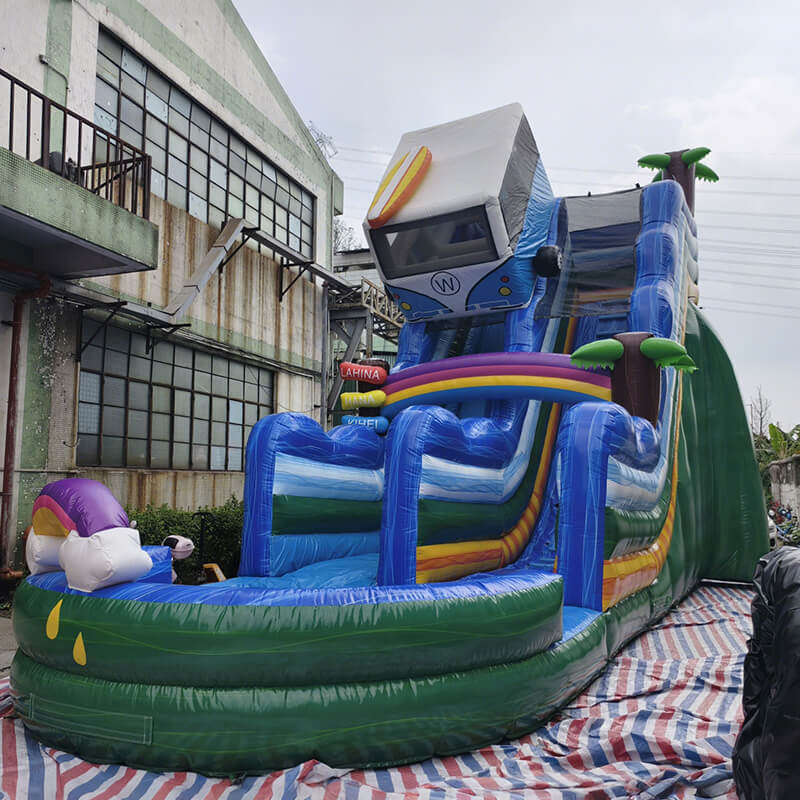
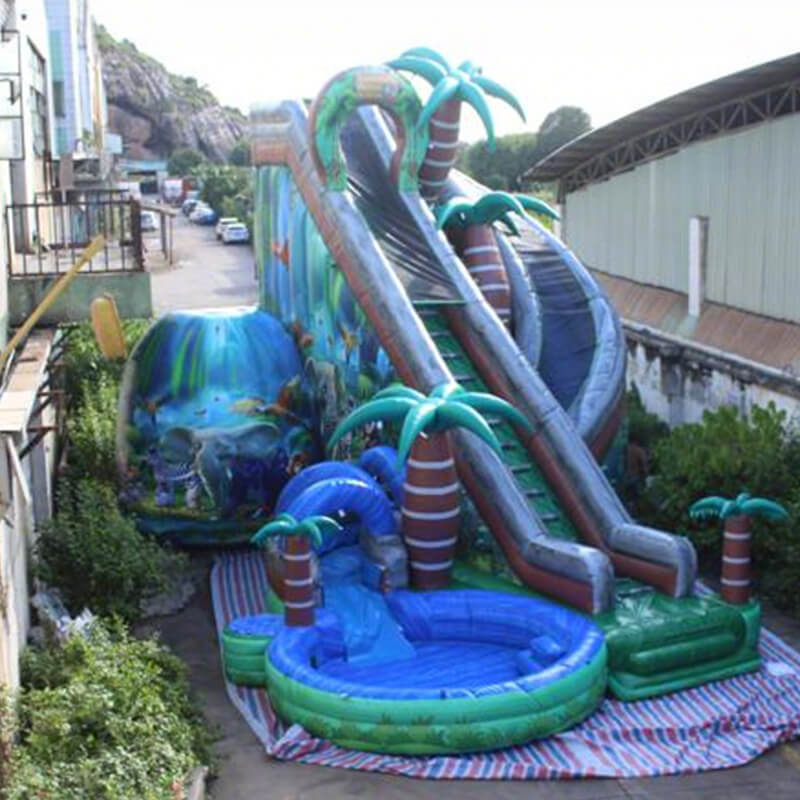
For a perfect example of beach-ready durability, check out our Giant Coconut Tree Inflatable Water Slide. It is built specifically to handle these abrasive conditions.
Truth #2: Saltwater destroys standard hardware in weeks
The necessity of stainless steel anchoring
One of the most overlooked aspects of commercial beach water slides is the hardware. I really cannot stress this enough: salt air is relentless.
Standard units generally use zinc-plated D-rings. In a saline beach environment, these will rust and stain your vinyl within a month.
Once rust sets in, it eats the metal. That weakens your anchor point and creates a massive safety liability.
If your manufacturer isn't explicitly stating they use stainless steel anchoring (304 or 316-grade), walk away. Assume the unit is not "beach-ready."
At CH Inflatable, we have upgraded all D-buckles to stainless steel. They are waterproof, rust-proof, and corrosion-resistant.
| Feature | Standard Inflatable | Beach-Ready Inflatable |
|---|---|---|
| Base Material | 0.55mm Standard PVC | 0.9mm Marine Grade Vinyl |
| Anchor Points | Zinc-Plated D-Rings (Rusts) | Stainless Steel Anchoring |
| Seam Tech | Stitched (Absorbs Water) | Heat Sealed Seams |
| UV Resistance | Standard Coat | High Ultraviolet Degradation Protection |
Zipper failure points (YKK solutions)
Salt crystals are another hidden enemy. When saltwater dries, it creates crystals that jam standard zippers.
If you cannot close your deflation flaps, you cannot inflate your slide. It is that simple.
To combat this, CH Inflatable utilizes YKK zippers exclusively. They are high-strength and deformation-resistant.
This ensures your air deflation ports remain functional even after heavy exposure to salt spray.
Truth #3: The sun is a silent killer (ultraviolet degradation protection)
Combating UV damage on coastal sites
Beach locations have crazy high UV indices. You get the direct sun, plus the reflection off the water and white sand.
This "double exposure" accelerates aging dramatically.
Without specific ultraviolet degradation protection added to the PVC coating, colors fade in weeks. Worse, the plastic becomes brittle.
While many suppliers offer generic slides, such as the 20ft South Beach Hybrid Dual Lane Inflatable Water Slide, you have to verify the specifics.
Always ask if they offer the customized UV coatings that CH Inflatable applies for clients in high-heat regions like the Middle East.
Heat sealed seams vs. traditional stitching
For units that float or sit in standing water, traditional stitching is a nightmare. It acts like a wick.
It pulls water right into the unit's interior mattress.
Once inside, this water causes mold. It also makes the unit incredibly heavy to pack up. Your crew will hate you.
We use heat sealed seams (high-frequency welding) for water-contact areas.
This creates a watertight bond. It prevents the unit from becoming waterlogged, which is critical for logistics.
Truth #4: Reinforcement techniques for high-traffic integrity
Double stitching and corner reinforcement
A commercial beach water slide faces forces from everywhere. You have high coastal winds pushing one way, and kids climbing the other way.
To manage this, we employ double stitching technologies throughout the unit.
Plus, we add reinforcement strips at every corner and joint.
This increases the structural rigidity. It stops the slide from swaying dangerously in the wind.
Industry Slang: "Blowout" – A catastrophic seam failure. This usually happens at the base of the slide where the pressure is highest. Trust me, you don't want this.
Webbing upgrades for safety
Anchor points are only as strong as the webbing holding them. Shifting sand puts jerky, sudden strain on anchors.
We upgraded our webbing materials to match automotive seatbelt standards.
This ensures that when you anchor a commercial beach water slide in soft sand, the points won't snap.
Major manufacturers like Vortex illustrate the importance of structural integrity, and we adhere to these rigorous international standards.
Truth #5: The power source makes or breaks the experience
CE certified HW blowers
On a beach, your power might be hundreds of feet away. Efficiency is key.
We supply HW blowers that are CE certified. They are selected to match the internal volume of our slides perfectly.
These blowers provide the static pressure needed to keep commercial beach water slides firm.
They battle the heat (which expands air) and heavy user loads without the slide getting soft.
Scalability for water parks
Often, a single slide is just the start. The same 0.9mm technology applies to broader park systems.
Expanding into a floating park captures more customers. It keeps them on-site spending money longer.
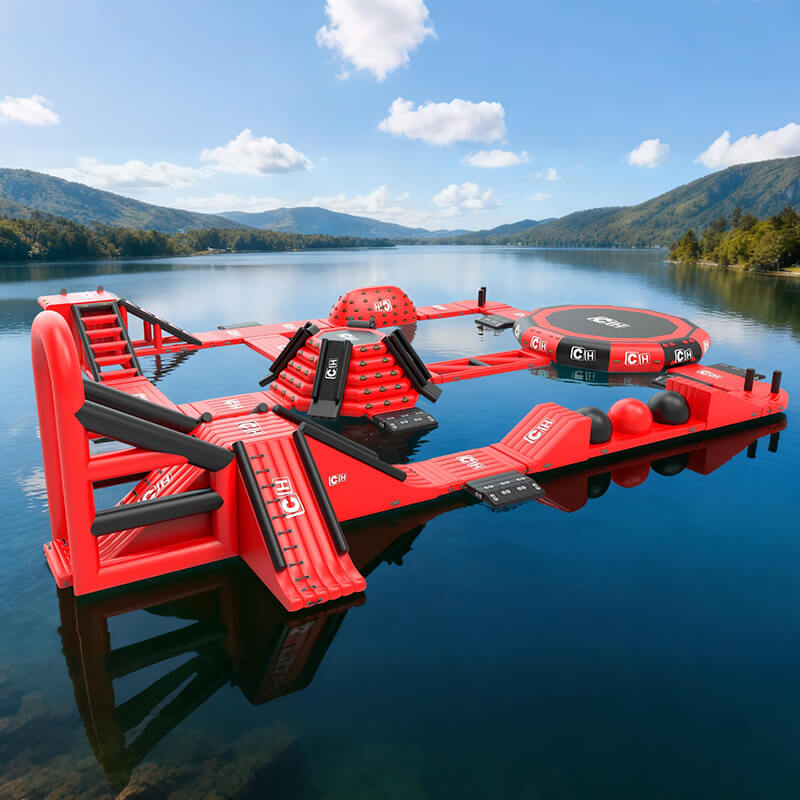
If you are looking to expand beyond a single slide, consider our High Quality Large Inflatable Floating Amusement Park. It utilizes the same marine-grade engineering for maximum durability.
Expert Opinion: "The biggest mistake rental companies make is underestimating blower power. Sand creates drag; you need high-output blowers to maintain safety compliance."
Frequently Asked Questions (FAQ)
Can standard inflatables withstand long-term saltwater exposure?
No, they fail fast. Standard units use metal that rusts and vinyl that lacks ultraviolet degradation protection. You need purpose-built gear.
Why is 0.9mm PVC crucial compared to standard materials?
Standard 0.55mm is fine for dry land. But 0.9mm marine grade vinyl offers the necessary tensile strength rating to resist sand abrasion and water pressure.
Do you support custom designs for specific beach themes?
Absolutely. At CH Inflatable, we specialize in customization. Whether you need a tropical theme or resort branding, we build it to marine standards.
Conclusion
Navigating the market for commercial beach water slides requires looking beyond the pretty colors. You have to focus on the engineering.
A nice-looking slide that rusts in a month is a liability. It is not an asset.
From insisting on marine grade vinyl to ensuring stainless steel anchoring is standard, these features dictate your profit.
At CH Inflatable, we combine 17 years of expertise with premium upgrades like heat sealed seams. We don't just build inflatables; we build business assets.
Ready to equip your rental fleet with beach-proof inflatables that deliver ROI year after year? Contact CH Inflatable today for a custom quote. Let's build your seaside empire.
Image by: Lio Voo
https://www.pexels.com/@lio-voo-262755153